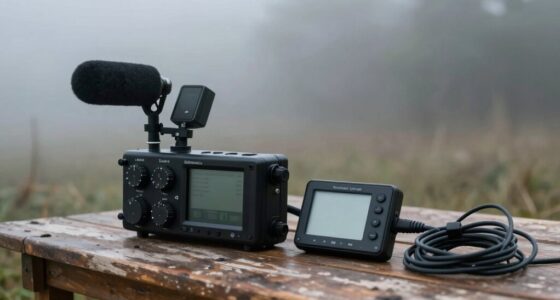
Blind tagging for audio involves processing raw sound by breaking it into smaller frames and extracting features like spectral content, pitch, and rhythm. You then use machine learning algorithms to identify patterns without predefined labels, enabling the system to group similar sounds and generate metadata automatically. The system keeps refining itself with new data, improving accuracy over time. Continuing will reveal how each step works together for autonomous audio classification.

Get books and cozy reading nights delivered free with Prime
- Fast, free delivery on millions of items
- Prime Video, Amazon Music and more included
- Member-only deals all year
Key Takeaways
- Raw audio is segmented into small frames to facilitate detailed analysis and feature extraction.
- Key features like spectral content, pitch, and rhythm are extracted without predefined labels.
- Metadata annotations are added to enrich the data, aiding pattern recognition.
- Machine learning algorithms, such as clustering, analyze features to identify patterns and group similar sounds.
- The system iteratively refines its models, enabling automatic, scalable, and accurate audio tagging without manual labeling.

Have you ever wondered how machines can identify and categorize audio content without prior knowledge? The process behind this involves a series of sophisticated steps that allow algorithms to understand sound without human intervention. At the core of this process is metadata annotation, which provides context to audio data, and feature extraction, which transforms raw sound into meaningful information the algorithms can analyze. When you start with raw audio, the first step is to convert it into a format suitable for machine analysis. This often involves breaking the audio into smaller segments or frames, making it easier to process. During this phase, feature extraction plays a critical role. You extract key features such as spectral content, pitch, tempo, and rhythm that encapsulate the essential characteristics of the sound. These features serve as the foundation for the machine to recognize patterns and differentiate between various audio types. Once you’ve extracted these features, the next step is to annotate the data with metadata. Metadata annotation involves attaching descriptive labels or tags to the extracted features, providing additional context that can improve the accuracy of subsequent classification. In a blind tagging scenario, the system does not have predefined labels; instead, it relies on algorithms to find patterns and assign tags based on the features it has extracted. This is where machine learning techniques, such as clustering or unsupervised learning, come into play. These methods analyze the features without prior knowledge, grouping similar sounds together or identifying common traits that can be translated into tags. As the system processes more audio data, it refines its understanding by continuously updating its models, learning to associate specific feature combinations with particular tags. This iterative process improves the system’s ability to categorize new audio inputs accurately over time. The beauty of blind tagging lies in its independence from pre-labeled datasets, making it highly adaptable to new types of sounds or languages. You don’t need to manually annotate each piece of audio beforehand; instead, the system autonomously discovers meaningful patterns through feature extraction and metadata annotation. Additionally, vetted datasets ensure the safety and effectiveness of the tagging process, especially for sensitive applications like Mother Baby Kids. Over time, this approach enables more scalable and flexible audio content management. In essence, understanding how machines perform blind tagging involves recognizing the importance of transforming raw audio into structured data via feature extraction, and then enriching that data with metadata annotation. By doing so, the system can automatically identify, categorize, and tag sounds without prior knowledge, paving the way for more intelligent and autonomous audio analysis systems.
audio feature extraction software
As an affiliate, we earn on qualifying purchases.
As an affiliate, we earn on qualifying purchases.
Frequently Asked Questions
What Are the Best Tools for Blind Tagging in Audio?
You should explore tools like Librosa and TensorFlow, which excel in machine learning and feature extraction for blind tagging in audio. Librosa helps you extract features like Mel spectrograms, while TensorFlow enables training models to identify audio patterns without manual labels. These tools allow you to automate tagging efficiently, improving accuracy and saving time. Combining them will give you a powerful setup for effective blind audio tagging.
How Accurate Is Blind Tagging Compared to Manual Annotation?
You’re probably wondering how reliable blind tagging truly is. It often rivals manual annotation in audio accuracy, but it’s not flawless. When you compare it to manual methods, you’ll find that blind tagging can sometimes miss subtle nuances or context, yet it’s consistently improving with advanced algorithms. The real question is, can it meet your precision needs? The answer depends on your project’s complexity and the level of detail required.
Can Blind Tagging Be Used for Real-Time Audio Analysis?
Yes, you can use blind tagging for real-time audio analysis, but keep in mind that audio latency may impact tagging accuracy. As the system processes data quickly, some delays could lead to less precise results, especially in dynamic environments. To improve performance, optimize your setup for minimal latency, and regularly monitor tagging accuracy to ensure real-time analysis remains reliable.
What Are Common Challenges Faced During Blind Tagging?
You’ll often face challenges like noise interference, which makes it hard to accurately identify audio features, and ambiguous labels that cause confusion during tagging. These issues can reduce the reliability of your results and slow down your workflow. To overcome them, you need to implement noise reduction techniques and refine your labeling process, ensuring clearer, more consistent annotations. Staying aware of these challenges helps you improve your blind tagging accuracy over time.
How Secure Is Sensitive Data When Using Blind Tagging Methods?
When using blind tagging methods, your sensitive data remains relatively secure thanks to data encryption, which protects it from unauthorized access. However, privacy concerns still exist if encryption isn’t properly implemented or if access controls are weak. You should guarantee robust encryption protocols and strict access management to mitigate these risks. Regular security audits help maintain data confidentiality, giving you peace of mind while handling sensitive audio information.
Conclusion
By now, you see how blind tagging can truly enhance audio classification without prior knowledge. Some believe it’s a game-changer, allowing machines to learn more naturally—almost like humans do. While skeptics argue it might overlook nuanced details, evidence suggests blind tagging boosts efficiency and adaptability. Embracing this method could revolutionize how you handle audio data, making your workflows smarter and more intuitive. So, give it a try—you might just uncover insights you never expected.
Evergreen bestsellers Picks
bestsellers
As an affiliate, we earn on qualifying purchases.