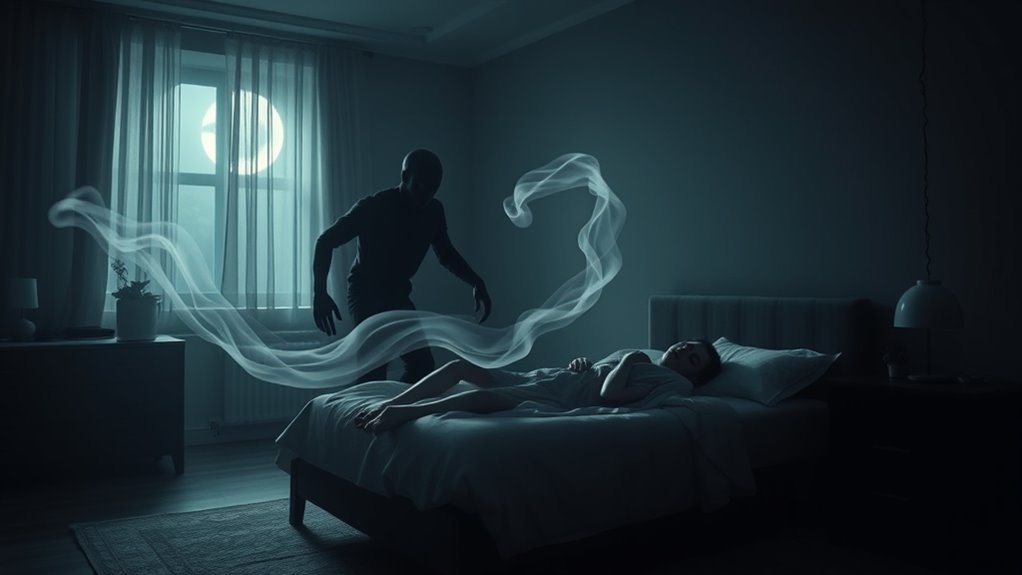

Sleep paralysis happens when your brain wakes up during a REM sleep phase but your muscles stay paralyzed, causing vivid hallucinations that might seem like supernatural visitations. These episodes are rooted in a natural disruption of your sleep cycle, not external entities. Your mind intrudes on dreams, creating frightening images while your body remains immobile. Understanding these scientific explanations can help clarify the experiences, and if you continue exploring, you’ll discover even more about what’s really behind these nighttime phenomena.
Key Takeaways
- Sleep paralysis occurs due to disrupted REM sleep, causing muscle atonia and hallucinations during transitions into or out of sleep.
- Nighttime visitations are often hallucinations during sleep paralysis, mistaken for supernatural encounters, but are caused by brain’s dream intrusion.
- The experience involves consciousness paired with paralysis, resulting from the overlap of wakefulness and REM sleep processes.
- Scientific explanations attribute these episodes to sleep cycle disruptions, not external or supernatural phenomena.
- Recognizing the physiological basis helps differentiate sleep paralysis from actual supernatural or supernatural-inspired visitations.
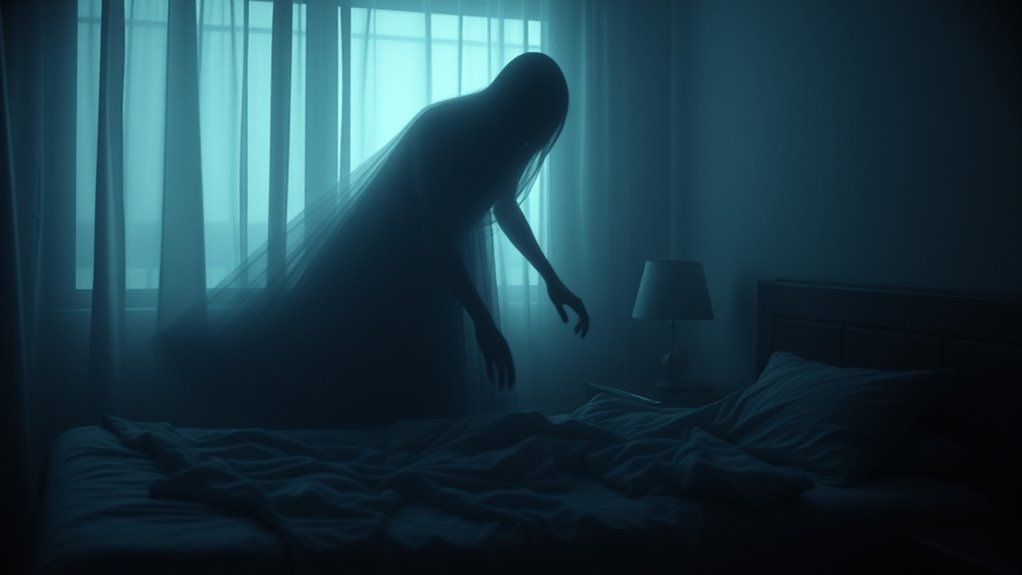
Many people experience unsettling episodes during the night that they might interpret differently—some see them as sleep paralysis, while others believe they are nighttime visitations from spirits or other entities. These experiences often occur when you’re shifting into sleep or waking up, making it essential to understand what’s happening in your brain during these moments. One common aspect of sleep paralysis involves sleep onset, the period when you’re moving from wakefulness into sleep. During this phase, your brain’s natural mechanisms for muscle atonia—intended to prevent acting out dreams—can sometimes persist even after you’ve mentally begun to drift off. This overlap creates a terrifying state where your mind wakes up, but your body remains paralyzed.
Sleep onset can cause your mind to wake while your body remains paralyzed, creating frightening hallucinations and sensations.
In this state, your subconscious might intrude with vivid, often frightening, hallucinations, which are sometimes mistaken for supernatural visitations. These are what we call dream intrusion—when elements from your dreams spill over into your waking awareness. During sleep onset, your brain is still partly in a dream-like state, which can cause hallucinations that feel incredibly real. You might see shadowy figures, feel a presence in the room, or hear unexplained noises. Because your muscles are still frozen, you can’t move or scream, which amplifies your fear and confusion. This combination of sleep paralysis and dream intrusion creates a perfect storm for an experience that feels like an encounter with something supernatural.
Scientists explain that these episodes happen because of the disruption in the normal sleep cycle, especially during REM sleep. Normally, your body suppresses muscle activity to keep you still during dreams, but if this process happens at the wrong time—like during sleep onset or upon waking—you might find yourself caught in a vivid, immobilizing hallucination. Unlike nighttime visitations, which are often described as external, conscious encounters, sleep paralysis involves a failure of the brain’s usual progression mechanisms. Your mind is conscious but unable to move, producing a sensation of being trapped between sleep and wakefulness. This phenomenon is closely linked to sleep architecture, which refers to the structure and pattern of your sleep cycles.
Understanding these processes can help you realize that what you’re experiencing isn’t supernatural but rooted in your brain’s complex sleep architecture. Recognizing the roles of sleep onset and dream intrusion clarifies that these episodes, while frightening, are harmless physiological phenomena. Knowing this can reduce fear and help you manage future episodes more calmly, reinforcing that your mind’s vivid imagery during these moments is an extension of your sleep process, not an external visitation.

Ultra Pain Relief Cooling Pillow for Neck Support, Adjustable Cervical Pillow Cozy Sleeping, Odorless Ergonomic Contour Memory Foam Pillows, Orthopedic Bed Pillow for Side Back Stomach Sleeper
- Innovative Hollow Concave Design: Cradles head and aligns neck naturally
- Six Contour Zones for Support: Targets pressure points for full neck and shoulder support
- Cooling Memory Foam Pillowcase: Reduces skin temperature by 5℃ with breathable fabric
As an affiliate, we earn on qualifying purchases.
As an affiliate, we earn on qualifying purchases.
Frequently Asked Questions
Can Sleep Paralysis and Visitations Occur Simultaneously?
Yes, sleep paralysis and nighttime visitations can occur simultaneously, which often fuels myths around these experiences. You might find yourself paralyzed while sensing a presence or feeling a visit from a spirit, blending sleep paralysis myths with nighttime visitation myths. These phenomena overlap in your mind, making it hard to distinguish between the two. Understanding that sleep paralysis can include vivid hallucinations helps demystify these experiences and reduces fear.
Are There Genetic Factors Influencing Sleep Paralysis or Visitations?
You might find that your genetic predispositions and hereditary factors act like a blueprint for your sleep experiences. These genetic influences can make you more susceptible to sleep paralysis or even influence how vividly you experience nighttime visitations. While not the sole cause, genetics play a role in shaping your vulnerability, much like a map guiding your body’s responses during sleep. Understanding this can help you better manage or anticipate these episodes.
Do Cultural Beliefs Affect the Perception of Nighttime Visitations?
Yes, cultural beliefs profoundly influence how you perceive nighttime visitations. Cultural narratives shape your understanding, making you interpret these experiences through your belief systems. If your culture views visitations as spirits or supernatural beings, you’re more likely to see them that way. Conversely, cultures with different narratives might interpret the same experiences as dreams or hallucinations, affecting how you process and respond to these phenomena.
How Do Medications Impact Sleep Paralysis Episodes?
Medications can crucially impact your sleep paralysis episodes by altering your medication effects on your sleep cycle. Some drugs, especially those that disrupt REM sleep, may increase the likelihood or intensity of episodes. Conversely, certain medications might help reduce occurrences by promoting more stable sleep patterns. It is vital to discuss any medication changes with your healthcare provider to understand how they influence your sleep cycle and sleep paralysis episodes.
Can Lifestyle Changes Reduce the Frequency of Both Phenomena?
Yes, you can reduce the frequency of both sleep paralysis and nighttime visitations by improving your sleep hygiene and managing stress. Establish a consistent sleep schedule, create a calming bedtime routine, and avoid screens before bed. Practice stress management techniques like meditation or deep breathing. These changes help regulate your sleep cycle and reduce anxiety, decreasing the chances of experiencing these phenomena. Consistency is key for long-term improvement.
Conclusion
So, next time you wake up feeling trapped or see mysterious figures, remember that sleep paralysis affects about 8% of the population, often blurring the line between reality and dreams. While it’s a common, harmless phenomenon, some believe it’s linked to supernatural encounters. Understanding the science helps you distinguish between natural sleep cycles and the eerie sensations of nighttime visitations. Knowing the facts can make those unsettling moments a little less frightening.