
Mirrors have long been thought of as portals to other worlds, filled with mystical significance in many cultures. Some believe they can connect you with spirits, other dimensions, or hidden domains, fueling legends of supernatural gateways. However, science confirms that mirrors are simply reflective surfaces with no actual power beyond bouncing light. While these myths persist and spark curiosity, exploring their history and symbolism reveals why they continue to fascinate us. Keep exploring to uncover more about their mysterious allure.
Key Takeaways
- Myth: Mirrors are spiritual gateways to other worlds; Reality: Scientific evidence shows they are optical devices reflecting light.
- Myth: Breaking a mirror causes bad luck; Reality: It’s a superstition with no scientific basis.
- Myth: Mirrors trap spirits or serve as boundaries between realms; Reality: Mirrors are simply reflective surfaces without mystical powers.
- Myth: Mirrors enable communication with spirits or the afterlife; Reality: There is no scientific proof supporting this belief.
- Myth: Mirrors hold mystical power and connect us to unseen dimensions; Reality: They symbolize reflection and self-awareness, not otherworldly portals.
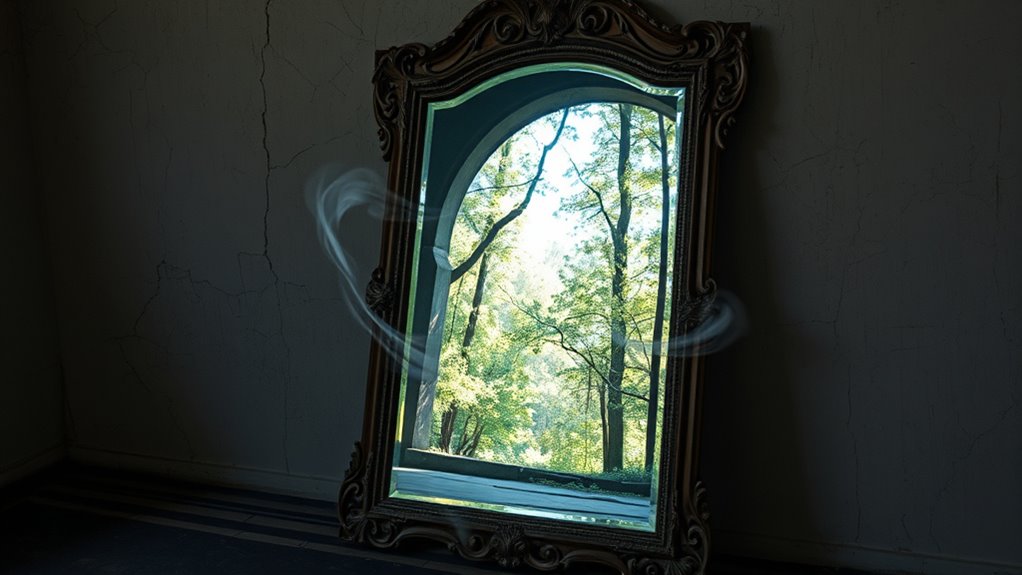
Mirrors have long fascinated us as more than just reflective surfaces; many believe they serve as portals to other worlds or dimensions. Throughout history, their significance extends beyond everyday use, rooted deeply in cultural symbolism and ancient beliefs. In ancient civilizations, such as Egypt and China, mirrors were regarded as mystical objects imbued with spiritual power. Egyptians believed mirrors held the soul’s reflection, and losing one could cause spiritual harm. In Chinese culture, mirrors symbolized clarity and truth, often used in rituals to ward off evil spirits. These historical origins reveal that humanity has long viewed mirrors as more than simple tools—they are gateways to understanding the unseen or connecting with other realms.
Mirrors have historically been seen as mystical gateways to unseen worlds and spiritual realms.
Culturally, mirrors have carried profound symbolism across different societies. In many traditions, they are seen as protectors, safeguarding against malevolent forces by reflecting negativity away. This idea persists in folklore where mirrors are believed to trap spirits or serve as boundaries between worlds. For example, in European legends, breaking a mirror was thought to invite seven years of bad luck, hinting at the mirror’s power to influence fates and energies. Conversely, some cultures view mirrors as conduits for spiritual communication, allowing the living to glimpse into the afterlife or converse with spirits. The symbolism of reflection also ties into themes of self-awareness and truth, reinforcing the idea that what we see in the mirror can reveal hidden aspects of ourselves or reality.
Despite these ancient beliefs and symbolic meanings, the idea of mirrors as portals remains more myth than fact. Modern understanding dismisses the notion of supernatural gateways, recognizing mirrors as optical devices that reflect light to produce images. However, the allure persists, fueled by stories, movies, and popular culture that romanticize the notion of portals and alternate dimensions. This blend of history, symbolism, and imagination keeps the idea alive, even if it’s rooted more in mythology than scientific reality. Still, it’s easy to see why these beliefs endure—mirrors challenge our perception of reality and evoke curiosity about what might exist beyond our visible world.
Ultimately, whether you view mirrors as mystical portals or simply reflective surfaces, their cultural symbolism and historical origins give them a powerful place in human imagination. They serve as reminders of our desire to explore the unknown, to seek truth, and to connect with unseen realms—whether real or imagined. While science may not support the idea of portals in mirrors, their mystique continues to captivate us, blending myth and reality in a fascinating dance that persists across cultures and centuries.
Top picks for "myth reality mirror"
Open Amazon search results for this keyword.
As an affiliate, we earn on qualifying purchases.
Frequently Asked Questions
Can Mirrors Really Show Alternate Realities or Parallel Worlds?
Mirrors can’t genuinely show alternate realities or parallel worlds. What you see are mirror illusions created by reflection symbolism, which can evoke thoughts about different possibilities. Sometimes, reflections seem to hint at other worlds, but they’re just illusions or symbolic representations. You might feel a connection to something beyond, but scientifically, mirrors only reflect your image and surroundings without revealing hidden dimensions or alternate realities.
How Do Mirrors Function as Portals in Different Cultures?
Imagine standing before a mirror that shimmers with mysterious light, a doorway to other worlds. In different cultures, supernatural beliefs turn mirrors into portals, symbolizing transformation, reflection, or spiritual connection. For example, some Asian traditions see mirrors as protectors, while European folklore views them as gateways to the spirit universe. These cultural symbols influence how societies interpret mirrors, blending myth and reality into mesmerizing legends.
Are There Scientific Explanations for Mirror-Based Portal Phenomena?
There aren’t scientific explanations for mirror-based portal phenomena, as they remain in the domain of myth and perception. Quantum physics explores phenomena at tiny scales, but it doesn’t support mirrors functioning as portals. Instead, psychological perception influences how you interpret reflections, making it seem like there’s more than just your image. So, while fascinating, these ideas lack empirical evidence and are best viewed as cultural stories rather than scientific facts.
What Are the Most Famous Historical Stories Involving Mirror Portals?
You’ll find that one of the most famous historical stories involving mirror portals is the legend of the “Mirror of the Witch” in 17th-century Europe, where supernatural encounters were believed to occur through enchanted mirrors. Mythological legends from China and Egypt also speak of mirrors acting as gateways to other worlds. These stories, enthralling and enduring, highlight how cultures have long associated mirrors with mystical, otherworldly domains.
Can Mirror Portals Be Used for Time Travel or Only Spatial Crossing?
Mirror portals primarily facilitate spatial crossing, allowing you to travel between different locations instantly. While some stories suggest they could be used for dimensional gateways, using them for time travel remains speculative and unproven. You might imagine stepping through a mirror to visit the past or future, but scientifically, they’re better understood as tools for spatial crossing rather than actual time travel. Always approach such ideas with curiosity and caution.
Conclusion
So, next time you catch your reflection, remember there might be more to it than meets the eye. While mirrors are just everyday objects, they can also whisper secrets of worlds just beyond reach. Embrace the mystery with a gentle smile, knowing that sometimes, a simple glance can hint at magic hiding behind the familiar. After all, life’s little wonders often lie in the soft glow of the ordinary, waiting to be discovered.