Betrayal at the House on the Hill 3rd Edition is my best overall pick for groups who want an eerie mansion to explore, changing scenarios, and a social mix of cooperation and betrayal. For a guided story with choices, Scooby-Doo: Escape from the Haunted Mansion is a standout, while Choose Your Own Adventure: House of Danger suits players who prefer branching narrative decisions. The main tradeoff is between hands-on exploration and a story-led experience; complexity, replayability, and how much players enjoy reading also separate these games. Some options are better for casual family play, while others ask for a longer commitment or more rules. Read on for the full breakdown and help matching a game to your group.

Get books and cozy reading nights delivered free with Prime
- Fast, free delivery on millions of items
- Prime Video, Amazon Music and more included
- Member-only deals all year
Key Takeaways
- Betrayal at the House on the Hill 3rd Edition leads for groups seeking the broadest mix of haunted-house exploration and changing scenarios, though its shifting rules and outcomes may not suit players who want a consistent story.
- Scooby-Doo: Escape from the Haunted Mansion and House of Danger put narrative choices ahead of open-ended exploration; the former draws on a familiar mystery-solving team, while the latter emphasizes branching decisions.
- Betrayal Legacy is the clearest choice for a group ready to revisit the same campaign over time, but its ongoing commitment makes it a poor fit for one-off game nights.
- Don’t Go in There and Haunted Halloween offer lighter entry points than the campaign-focused or more involved adventure games, making them stronger candidates for casual groups.
- Escape the Dark Castle and the Neibolt House expansion serve narrower tastes: one favors atmospheric cooperative adventure, while the other requires the base Betrayal game and adds a specific horror setting.
| Scooby-Doo: Escape from the Haunted Mansion Coded Chronicles Game |  | Best for Cooperative Puzzle Solving | Game type: Cooperative escape-room board game | Players: 1–6 | Recommended age: 12 years and up | VIEW LATEST PRICE | See Our Full Breakdown |
| Choose Your Own Adventure: House of Danger Cooperative Board Game |  | Best for Branching Story Choices | Players: 1 or more | Estimated play time: 1 hour | Age guidance: 10+ in title; 13–15 years in manufacturer recommendation | VIEW LATEST PRICE | See Our Full Breakdown |
| Betrayal at the House on the Hill 3rd Edition Cooperative Board Game |  | Best Overall Haunted House Crawl | Players: 3–6 | Recommended age: 12 years and up | Scenarios: 50 | VIEW LATEST PRICE | See Our Full Breakdown |
| Don’t Go in There Haunted House Adventure Board Game |  | Best Quick Haunted House Game | Brand: Asmodee | Manufacturer: R2i Games | Players: 2–5 | VIEW LATEST PRICE | See Our Full Breakdown |
| Avalon Hill Betrayal at the Neibolt House: The Evil of Pennywise Expansion |  | Best Horror-Themed Expansion | Brand: Avalon Hill | Game type: Horror board game expansion | Players: 3–6 | VIEW LATEST PRICE | See Our Full Breakdown |
| Escape the Dark Castle Cooperative Adventure Board Game |  | Best for Fast, Story-Led Play | Game type: Cooperative adventure board game | Players: 1–4 | Recommended age: 14 years and up | VIEW LATEST PRICE | See Our Full Breakdown |
| Betrayal Legacy Board Game |  | Best for a Haunted-House Campaign | Game type: Legacy campaign board game | Setting: Haunted house | Campaign structure: Several generations of families | VIEW LATEST PRICE | See Our Full Breakdown |
| Haunted Halloween: The Trick-or-Treat Board Game |  | Best for Family Halloween Nights | Brand: Castle Clark | Manufacturer: SkyGames | Players: 2–5 | VIEW LATEST PRICE | See Our Full Breakdown |
| haunted house board game | Players | Recommended age | Included components | Edition |
|---|---|---|---|---|
| Scooby-Doo: Escape from the Ha | 1–6 | 12 years and up | 5 narrative books, 13 map tiles, 60 clue cards, 8 secret envelopes, 5 character standees, 1 mystery manual | Standard Edition |
| Choose Your Own Adventure: Hou | 1 or more | — | 160 story cards, 129 clue cards, 1 game board, 1 die, 1 pawn, 1 cube, storage bag, instructions | — |
| Betrayal at the House on the H | 3–6 | 12 years and up | Haunt books, 6 double-sided character boards, 6 character figures, 6 figure bases, 30 clips, 8 dice, 74 game cards, 5 scenario cards, reference cards, 3 starting tiles, 42 room tiles, number track and pointer, 114 cardboard tokens, rulebook | 3rd Edition |
| Don’t Go in There Haunted Hous | 2–5 | 14 years and up | 6 glow-in-the-dark dice, 96 cards, 5 player aid/screens, 3 room mats, 25 custom meeples, 28 ghost tokens, rulebook | Standard Edition |
| Avalon Hill Betrayal at the Ne | 3–6 | 17 years and up | 3 character figures, character board overlay, plastic character board clip, 4 room tiles, 2 haunt books, 10 game cards, scenario card, 3 cardboard monster tokens, cardboard red balloon token | — |
| Escape the Dark Castle Coopera | 1–4 | 14 years and up | 45 chapter cards, 35 item cards, 6 character cards, 3 boss cards, 1 start card, 9 chapter dice, 6 character dice, scorepad, 4 pencils, and rulebook | Illustrated Edition |
| Betrayal Legacy Board Game | — | — | — | — |
| Haunted Halloween: The Trick-o | 2–5 | 7 years and up | — | Standard Edition |
More Details on Our Top Picks
Scooby-Doo: Escape from the Haunted Mansion Coded Chronicles Game
I’d pick Scooby-Doo: Escape from the Haunted Mansion for a group that wants to solve a haunted-house mystery together rather than compete for a winner. Its 50-plus clues and code-revealing mechanic make deduction the main event, while the narrative books, map tiles, and secret envelopes give the investigation a staged escape-room feel. That makes it more puzzle-focused than Don’t Go in There, which centers on risk-taking and curses instead of a shared mystery.
The tradeoff is that the escape-room setup asks players to provide their own room, and the 100-minute session takes more commitment than a short spooky game. The listed age guidance is also uneven: the specs say 12 and up, so I’d follow that rather than assume it suits younger Scooby-Doo fans. It’s a strong fit for communicative groups, but less suited to players who want a quick, replayable game with little setup.
Pros:- Cooperative clue-solving gives every player a reason to share observations and theories.
- More than 50 clues and a code-revealing mechanic make investigation central to play.
- Narrative books, map tiles, envelopes, and Mystery Inc. standees support an unfolding haunted-mansion story.
Cons:- The escape-room format requires players to provide a room and arrange the experience.
- A 100-minute playtime is a bigger commitment than the shorter Don’t Go in There.
- Age guidance is inconsistent in the listing; the stated specification recommends 12 years and up.
Best for: Scooby-Doo fans and cooperative groups who enjoy decoding clues, discussing theories, and setting aside a longer session for an at-home escape-room-style mystery.
Not ideal for: Families seeking a short game for younger children, or groups that do not want to arrange a room for an escape-room experience.
- Game type:Cooperative escape-room board game
- Players:1–6
- Recommended age:12 years and up
- Playing time:100 minutes
- Language:English
- Included components:5 narrative books, 13 map tiles, 60 clue cards, 8 secret envelopes, 5 character standees, 1 mystery manual
- Edition:Standard Edition
- Model number:TOP-CC001
Our verdict“Choose this for a longer, collaborative Scooby-Doo mystery built around decoding clues, not for a quick haunted-house game or a setup-free session.”
Choose Your Own Adventure: House of Danger Cooperative Board Game
House of Danger suits players who want their decisions to shape a haunted-house adventure. Its story and clue cards present choices, risks, items, and different endings, giving the group a reason to revisit the story and try another path. Compared with Scooby-Doo: Escape from the Haunted Mansion, it puts more weight on branching narrative choices than on decoding a large set of clues; compared with Betrayal at the House on the Hill, it keeps the focus on cooperative storytelling rather than a possible turn against the group.
The card-heavy format is easy to store, but much of the experience depends on reading and handling paper components. The listing also gives conflicting age advice, with 10+ in the title and a manufacturer recommendation of 13–15 years. I’d choose it for a group that likes discussing what to do next, but skip it if the table prefers tactile exploration or minimal reading.
Pros:- Branching choices and multiple endings give repeat sessions different story paths.
- Cooperative decisions encourage discussion and shared problem-solving.
- The compact box includes a board, cards, die, pieces, and a storage bag.
Cons:- The experience relies heavily on handling and reading a large number of paper cards.
- Age guidance conflicts between the title and manufacturer recommendation.
- Its narrative choice focus offers less tactile room exploration than Betrayal at the House on the Hill.
Best for: Story-focused players and small groups who enjoy making shared decisions, revisiting branching narratives, and reading cards aloud.
Not ideal for: Players who want room-by-room physical exploration, a low-reading game, or clear age guidance for choosing a family game.
- Players:1 or more
- Estimated play time:1 hour
- Age guidance:10+ in title; 13–15 years in manufacturer recommendation
- Included components:160 story cards, 129 clue cards, 1 game board, 1 die, 1 pawn, 1 cube, storage bag, instructions
- Material:Paper
- Language:English
- Dimensions:8.5 x 5.5 x 2.5 inches
- Weight:0.45 kg
- Model number:ZMGCYA01
Our verdict“Pick House of Danger if your group values shared story choices and alternate endings more than a physical haunted-house crawl.”
Betrayal at the House on the Hill 3rd Edition Cooperative Board Game
Betrayal at the House on the Hill 3rd Edition earns my overall pick because the haunted house itself drives play: explorers reveal modular rooms, build the layout, and encounter one of 50 scenarios. The group starts together, but the haunt can turn one player into an opponent, giving the spooky exploration a sharp change of pace. That separates it from House of Danger, where branching story choices stay at the center, and from Scooby-Doo: Escape from the Haunted Mansion, which is built around cooperative clue decoding.
The room tiles and large component set support varied sessions, while the guides and trackers offer help for new players. The main caveat is the betrayal twist: anyone expecting a fully cooperative game may dislike the shift in roles. Its horror theme may also be too intense for some groups, despite the 12-and-up recommendation. I’d choose it for a regular group that wants exploration and changing scenarios, not for a strictly cooperative puzzle night.
Pros:- Fifty scenarios and modular room tiles create variety across playthroughs.
- The changing house makes exploration a central part of the haunted setting.
- The hidden-traitor twist adds conflict and surprise beyond straightforward cooperation.
- Guides, trackers, and reference materials can help new players follow the game.
Cons:- The haunt can turn a cooperative session into a player-versus-group encounter.
- Its horror theme may not suit every group.
- It requires 3–6 players, unlike House of Danger, which supports solo play.
Best for: Groups of 3–6 who want modular haunted-house exploration, many scenario options, and are comfortable with one player potentially becoming an opponent.
Not ideal for: Players seeking a consistently cooperative experience, younger or horror-averse groups, or solo players.
- Players:3–6
- Recommended age:12 years and up
- Scenarios:50
- Edition:3rd Edition
- Included components:Haunt books, 6 double-sided character boards, 6 character figures, 6 figure bases, 30 clips, 8 dice, 74 game cards, 5 scenario cards, reference cards, 3 starting tiles, 42 room tiles, number track and pointer, 114 cardboard tokens, rulebook
- Material:Plastic
- Model number:F4541
Our verdict“Choose this as the broadest haunted-house experience if your group enjoys exploring a changing mansion and accepts a possible betrayal twist.”
Don’t Go in There Haunted House Adventure Board Game
Don’t Go in There is my pick for a shorter session where the haunted-house tension comes from deciding how much risk to take. Players collect items, attract ghosts and curses, then use items to clear curses; the winner is the player with the fewest curses. At about 30 minutes, it offers a more concise alternative to the longer Scooby-Doo: Escape from the Haunted Mansion, which builds its session around cooperative puzzles. It also differs from Betrayal at the House on the Hill: this is a competitive push-your-luck game, not a sprawling scenario-based exploration game.
The glow-in-the-dark dice and custom meeples give the table a playful haunted-house look, while the risk decisions keep turns focused. The tradeoff is that the game’s core tension comes from collecting ghosts and curses, which may feel punishing to players who dislike push-your-luck decisions. Its 14-and-up age recommendation also makes it less suitable for younger family groups.
Pros:- Approximately 30-minute playtime makes it a shorter option than Scooby-Doo: Escape from the Haunted Mansion.
- Push-your-luck decisions give players control over how much risk to take.
- Glow-in-the-dark dice and custom meeples add distinctive table presence.
- Supports 2–5 players.
Cons:- The ghost-and-curse system may frustrate players who dislike accumulating penalties.
- Its 14-and-up recommendation limits its fit for younger family groups.
- Competitive play offers less shared mystery-solving than the Scooby-Doo game.
Best for: Groups of 2–5 looking for a compact, competitive haunted-house game with quick turns and risk-versus-reward choices.
Not ideal for: Younger families, players who prefer cooperative mysteries, or anyone who dislikes accumulating penalties through push-your-luck play.
- Brand:Asmodee
- Manufacturer:R2i Games
- Players:2–5
- Recommended age:14 years and up
- Playing time:30 minutes
- Language:English
- Included components:6 glow-in-the-dark dice, 96 cards, 5 player aid/screens, 3 room mats, 25 custom meeples, 28 ghost tokens, rulebook
- Edition:Standard Edition
Our verdict“Choose this for a short, competitive haunted-house game built around risk-taking, not for cooperative clue-solving or younger players.”
Avalon Hill Betrayal at the Neibolt House: The Evil of Pennywise Expansion
Betrayal at the Neibolt House: The Evil of Pennywise is for players who already own Betrayal at the House on the Hill 3rd Edition and want a sharper, film-inspired horror flavor. Its five haunts, Pennywise encounter cards, themed figures, and four room tiles add new material to the base game’s explore-and-trigger structure. Compared with the base game on its own, this expansion narrows the theme around Pennywise; compared with Don’t Go in There, it offers scenario-based horror rather than a quick contest over curses.
This is not a standalone haunted-house game, which is its biggest limitation: the required base game is sold separately. The listed age recommendation is 17 and up, making it a poor match for younger groups and a more mature choice than the main Betrayal game. I’d treat it as a targeted add-on for fans of the film and the base game, not as a first purchase for someone building a haunted-house game collection.
Pros:- Adds five haunts and 10 Pennywise encounter cards to the base game.
- Three film-themed character figures and monster tokens reinforce the horror theme.
- Four room tiles expand the haunted-house layout options.
Cons:- Requires Betrayal at the House on the Hill 3rd Edition, sold separately.
- The 17-and-up recommendation makes it less suitable for younger groups.
- Its focused Pennywise theme may appeal less to players who want general haunted-house scenarios.
Best for: Existing Betrayal at the House on the Hill 3rd Edition owners who want Pennywise-themed haunts and are comfortable with a horror-focused expansion.
Not ideal for: New buyers without the required base game, groups seeking a standalone game, or players buying for anyone under the 17-and-up recommendation.
- Brand:Avalon Hill
- Game type:Horror board game expansion
- Players:3–6
- Recommended age:17 years and up
- Base game required:Betrayal at the House on the Hill 3rd Edition
- Haunts:5
- Game cards:10 Pennywise encounter cards
- Included components:3 character figures, character board overlay, plastic character board clip, 4 room tiles, 2 haunt books, 10 game cards, scenario card, 3 cardboard monster tokens, cardboard red balloon token
- Model number and year:G0166; 2025
Our verdict“Buy this only if you own Betrayal 3rd Edition and want a mature, Pennywise-focused addition rather than a standalone haunted-house game.”
Escape the Dark Castle Cooperative Adventure Board Game
Escape the Dark Castle is a compact cooperative adventure for groups who want a spooky, story-driven session without a long campaign. Players act as prisoners facing illustrated chapter cards, traps, and horrors, with custom dice and item cards shaping how the group handles each obstacle. Its roughly 30–45-minute play time and about two-minute setup make it a quicker start than Betrayal Legacy, which builds its haunted-house story across multiple sessions. The tradeoff is that this is a perilous fantasy castle rather than a modern haunted-house mystery, so it suits atmosphere and shared problem-solving better than house exploration. It supports one to four players, though its teamwork-focused design may be less satisfying solo, and the 14-and-up age recommendation rules out younger family groups.
Pros:- Illustrated chapter cards give the adventure a strong, eerie narrative feel.
- Cooperative decisions and shared challenges make teamwork central.
- Quick setup and a 30–45-minute session suit shorter game nights.
- Changing chapters and decisions vary how a playthrough unfolds.
Cons:- Its perilous castle setting is fantasy adventure, not a haunted-house setting.
- The age recommendation of 14 and up limits its use with younger families.
- The collaborative design may not appeal to solo players seeking a more substantial solo experience.
Best for: Small groups of teens or adults who want a cooperative, atmospheric adventure that can fit into one evening.
Not ideal for: Families with children under 14 or buyers seeking a richly explored haunted house and a multi-session campaign.
- Game type:Cooperative adventure board game
- Players:1–4
- Recommended age:14 years and up
- Estimated playing time:About 45 minutes
- Setup time:About 2 minutes
- Edition:Illustrated Edition
- Language:English
- Included components:45 chapter cards, 35 item cards, 6 character cards, 3 boss cards, 1 start card, 9 chapter dice, 6 character dice, scorepad, 4 pencils, and rulebook
Our verdict“Choose Escape the Dark Castle for a quick, cooperative spooky adventure, but pick Betrayal Legacy if you want the haunted house itself and its history to drive the game.”
Betrayal Legacy Board Game
Betrayal Legacy is the pick here for players who want a haunted house to accumulate history rather than serve as a one-session backdrop. Its campaign spans several generations, and player choices shape the house and the scenarios that follow. Exploration, character stats, and the possibility of a traitor give each session room for discovery and shifting loyalties. Compared with Escape the Dark Castle, this asks for a longer commitment but offers a more direct haunted-house setting and continuing story; it also goes further than a standalone scenario such as Betrayal at the House on the Hill by carrying consequences across a campaign. The tradeoff is practical: the narrative and customizations develop over multiple sessions, so a group that meets irregularly may struggle to keep the story’s momentum. Its customized game remains replayable after the campaign, though that is a different kind of replay from starting fresh.
Pros:- A haunted-house setting is central to the campaign.
- Choices shape the house’s history and later scenarios.
- Several generations provide continuity between sessions.
- The customized game remains replayable after the campaign.
Cons:- The campaign needs multiple sessions to reveal its story and changes.
- The group must be comfortable with permanent customizations to the game.
- Its ongoing narrative is a poor fit for groups that rarely play together.
Best for: Regular game groups who enjoy legacy decisions, evolving settings, and a haunted-house story that unfolds across multiple sessions.
Not ideal for: Casual groups looking for a complete one-night game or players who want every session to begin with an unchanged board and story.
- Game type:Legacy campaign board game
- Setting:Haunted house
- Campaign structure:Several generations of families
- Gameplay features:Exploration, character stats, multiple scenarios, and a possible traitor
- Player decisions:Shape the house’s history and future scenarios
- Replayability:Customized game can be replayed after the campaign
Our verdict“Pick Betrayal Legacy if your group can commit to a continuing haunted-house campaign; choose a standalone game for a self-contained evening.”
Haunted Halloween: The Trick-or-Treat Board Game
Haunted Halloween: The Trick-or-Treat Board Game turns spooky-house tension into a family-friendly candy-collecting strategy game. Players use costume powers, portals, BOOst Tokens, and glowsticks while trying to keep candy away from the Banshee and her ghosts. Its age recommendation of 7 and up makes it a more approachable family choice than Escape the Dark Castle, which is aimed at older players and leans into perilous fantasy. The 2–5 player range also suits a family night or small party, and the 3D pumpkin token holder adds a playful table feature. The tradeoff is its explicitly Halloween-focused theme, which may feel less fitting outside the season; unlike Betrayal Legacy, it offers a lighter trick-or-treat contest rather than a story that develops over many sessions. It also needs at least two players.
Pros:- A 7-and-up age recommendation makes it accessible to younger family players.
- Costume powers, portals, and glowsticks add strategic choices.
- Supports two to five players for family nights and small gatherings.
- The 3D pumpkin holder gives candy tokens a dedicated centerpiece.
Cons:- Its Halloween trick-or-treat theme may have less appeal outside the season.
- At least two players are required.
- The candy-collecting focus offers a lighter haunted experience than story-led games such as Betrayal Legacy.
Best for: Families with children aged 7 and up who want a seasonal strategy game for two to five players.
Not ideal for: Solo players, buyers seeking a serious haunted-house narrative, or groups who want a spooky theme that feels equally suited to year-round play.
- Brand:Castle Clark
- Manufacturer:SkyGames
- Players:2–5
- Recommended age:7 years and up
- Playing time:35 minutes
- Edition:Standard Edition
- Materials:Cardstock and plastic
- Included component:3D pumpkin candy token holder
- Dimensions:12.5 × 9.5 × 0.1 inches
Our verdict“Choose Haunted Halloween for a seasonal, kid-friendly strategy night, not for a campaign or a deeper haunted-house story.”
How We Picked
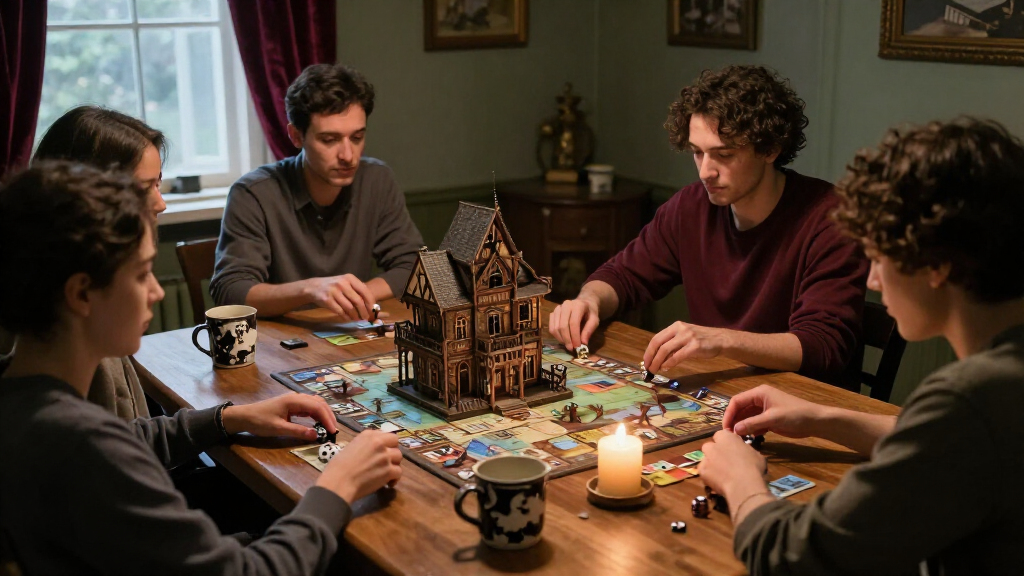
I ranked these games by how well their play experience matches the haunted-house promise: eerie exploration, suspense, unsettling story choices, or a memorable horror setting. I also weighed how quickly a group can learn the game, how much cooperation it asks for, whether a session stands alone or continues across multiple plays, and what a buyer must already own. Those factors matter more than theme alone; a spooky setting is less useful if the game’s structure does not suit the group.
Betrayal at the House on the Hill 3rd Edition ranks first for its balance of exploration and changing outcomes. Narrative-led games follow for readers who want a more directed story, while campaign and expansion options rank according to their narrower audience and setup needs. Lighter choices remain worthwhile for casual play, but they do not offer the same depth of haunted-house adventure. These rankings reflect differences in audience and play style, not a claim that one game suits every table.
| haunted house board game | Game type |
|---|---|
| Scooby-Doo: Escape from the Ha | Cooperative escape-room board game |
| Choose Your Own Adventure: Hou | — |
| Betrayal at the House on the H | — |
| Don’t Go in There Haunted Hous | — |
| Avalon Hill Betrayal at the Ne | Horror board game expansion |
| Escape the Dark Castle Coopera | Cooperative adventure board game |
| Betrayal Legacy Board Game | Legacy campaign board game |
| Haunted Halloween: The Trick-o | — |
Factors to Consider When Choosing Haunted House Board Games
Before choosing a haunted-house game, decide what you want players to do while the setting creates tension. A mansion to explore, a story to shape, a campaign to continue, and a quick seasonal game can all deliver spooky atmosphere, but they make different demands on a group. These factors can help narrow the choice beyond theme and artwork.
Choose Between Exploration and Story Choices
Start by asking whether your group wants to move through a space and discover what is there, or make narrative choices that shape what happens next. Exploration gives players a stronger sense of place and can make the house itself feel like part of the challenge. Story-led games put more weight on reading, discussion, and decisions, which can work well for groups that enjoy shared fiction. A common mismatch is buying a narrative game for players who mainly want tactical turns, or an exploration game for a group that prefers a clear plot. If your table has mixed tastes, look for a structure that gives players both decisions and physical game actions.
Match the Commitment to Your Group
A standalone session is easier to bring to a gathering where attendance changes, while a continuing campaign rewards a stable group that can return regularly. Before choosing a legacy-style experience, ask whether the same players can meet often enough to remember prior events and keep the story moving. Campaigns can create stronger continuity, but that benefit fades if sessions are frequently interrupted or players rotate. Do not mistake a longer box or bigger story for a better fit; the group’s schedule is part of the game’s practical value. For occasional play, favor a game that feels complete in one sitting.
Check the Group’s Appetite for Rules and Reading
Haunted-house atmosphere can come from suspense and story, but some games also ask players to learn layered rules or read substantial text. For a mixed-experience table, a short explanation and clear turns may matter more than a rich setting. Reading-heavy games suit players who enjoy acting on story details, though they can lose momentum if one person ends up doing all the narration. A frequent mistake is choosing by theme alone without checking whether the group likes cooperative discussion or prefers quick individual turns. Think about who will teach the game and whether everyone at the table will stay engaged with its main activity.
Decide How Much Replayability You Need
Some games get their appeal from changing events or outcomes, while others center on discovering a story that may feel familiar on a second play. Replayability matters most if the game will return to the table often; it matters less for a planned seasonal night or a group that values a single memorable story. A branching narrative can invite another run, but players may remember earlier choices and reduce the surprise. By contrast, variable scenarios can change the experience without requiring the same group to continue a campaign. Match replay potential to your actual habits rather than treating it as an automatic advantage.
Verify Base-Game and Expansion Requirements
An expansion can look like an easy way to add a fresh haunted setting, but it may not work as a standalone purchase. Check which base game it requires and whether your group already knows that system before choosing an add-on. An expansion is a better fit for players who want more content for a familiar game than for someone buying their first haunted-house board game. Also check whether the new material changes the experience in a way your group wants, rather than assuming extra content automatically means a better match. This simple check can prevent a box that cannot be played on its own from becoming an unused purchase.
Frequently Asked Questions
Which haunted-house board game is easiest to bring to a casual game night?
For a casual gathering, prioritize a game with a clear turn structure and a session that does not depend on previous plays. Don’t Go in There and Haunted Halloween are the lighter options in this lineup, while campaign games ask for more time and continuity. The best fit still depends on whether your group prefers playful seasonal adventure or a more serious spooky mood. If attendance may change, avoid a game whose story relies on the same players returning. A quick rules overview before game night can also help keep the atmosphere from being interrupted by repeated explanations.
Is Betrayal at the House on the Hill a good choice for players who want everyone to cooperate?
It can suit groups that enjoy working together at first and accept that the game’s direction may change. If your group wants consistent cooperation from setup through the ending, a fully cooperative story or adventure is a closer match. This distinction matters because players who dislike rivalry or shifting group roles may find Betrayal’s central tension less enjoyable than its haunted-house setting. For a reliably cooperative experience, compare it with Scooby-Doo: Escape from the Haunted Mansion or Escape the Dark Castle. Choose based on the kind of interaction your group wants, not only the theme.
Should I choose a branching story game or a game with changing scenarios?
Choose a branching story if your group enjoys discussing decisions and seeing how choices affect the narrative. A game with changing scenarios is a stronger fit if players want variation from one session to the next without following a long sequence of story decisions. Branching narratives can reward close attention, but remembered outcomes may reduce surprise on a repeat play. Variable scenarios can feel less like a single authored story, yet offer a different kind of replay. Think about whether your table talks more about the choices it made or the events and challenges it faced.
Can I play Betrayal at the Neibolt House without owning another Betrayal game?
No: Betrayal at the Neibolt House: The Evil of Pennywise is an expansion, so it requires a compatible base game to play. Check the product’s compatibility details before buying, since an expansion is not a standalone substitute for the core experience. If this would be your first game in the series, begin with a base game that matches your preferred complexity and group style. The expansion makes more sense for players who already have the required game and want a new setting. That distinction can matter more than the theme when deciding what to add to your collection.
Is a legacy game a sensible first haunted-house board game?
It can be, but only if your group is comfortable committing to repeated sessions and continuing story changes. A legacy format may create a stronger sense of shared history than a one-session game, but it is less flexible when players miss nights or the group changes. New players may find a standalone game easier to learn and easier to bring out for different occasions. Before choosing a campaign, talk with the group about how often you can play and whether everyone wants to keep the same game going. If that commitment is uncertain, start with a game that gives a complete experience in one sitting.
Conclusion
My best overall pick is Betrayal at the House on the Hill 3rd Edition for groups who want exploration and changing haunted-house scenarios. For the best value in broad play appeal, I’d start with Don’t Go in There as a lighter, more approachable option; buyers should still compare its style with their group’s preferences. Betrayal Legacy is my best premium-style choice for a stable group ready to invest in a continuing campaign, while Scooby-Doo: Escape from the Haunted Mansion is my pick for beginners who want a guided cooperative story. Choose House of Danger for branching narrative decisions, Escape the Dark Castle for atmospheric cooperative adventure, and Haunted Halloween for a lighter seasonal session. If you already own the required Betrayal base game and want a Pennywise setting, the Neibolt House expansion is the specific add-on to consider.