During investigations, guarantee your logging timestamps are accurate, consistent, and synchronized with reliable time sources like NTP servers. Use standardized formats and avoid mixing local time with UTC to prevent confusion and errors. Properly synchronized timestamps help you establish clear event sequences, reconstruct incidents accurately, and maintain the integrity of your findings. Attention to these details allows you to piece together complex timelines effectively; continuing further will reveal additional best practices to enhance your accuracy.
Key Takeaways
- Synchronize all logging systems with reliable time sources like NTP to ensure timestamp accuracy.
- Use a consistent timestamp format, preferably ISO 8601, across all logs for easier analysis.
- Record timestamps in Coordinated Universal Time (UTC) to prevent time zone discrepancies.
- Verify system clocks regularly and document synchronization status during investigations.
- Correlate logs from multiple sources based on synchronized timestamps for accurate event reconstruction.
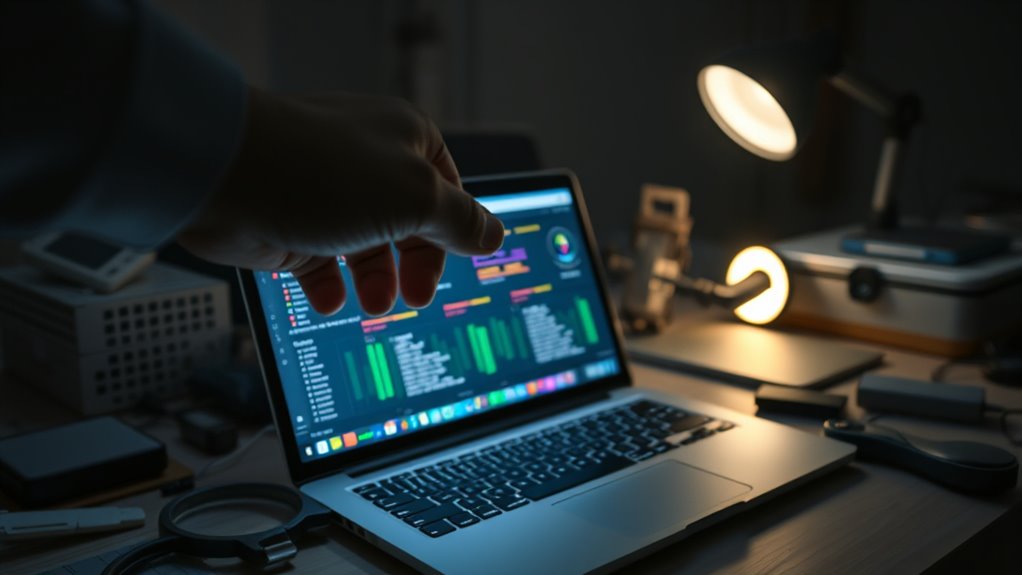
When conducting an investigation, accurately logging timestamps is essential for establishing a clear timeline of events. Timestamps serve as the backbone of your logs, providing precise markers for when each action or incident occurs. Ensuring timestamp consistency across all logs is critical because discrepancies can lead to confusion or misinterpretation of the sequence of events. If your logs record times that don’t align or seem inconsistent, it can undermine the credibility of your investigation and make it harder to piece together an accurate narrative. To avoid this, always verify that your systems are synchronized, preferably using a reliable time source such as an NTP (Network Time Protocol) server. This step guarantees that every log entry reflects the same accurate time, which simplifies later analysis. Additionally, being aware of discrepancies in time zones can prevent misinterpretation of event sequences across different locations.
Once you’ve established timestamp consistency, you can focus on applying effective log analysis techniques. These techniques involve more than just reviewing the logs sequentially; they require you to filter, correlate, and interpret data efficiently. Start by identifying key events and their timestamps, creating a timeline that highlights critical moments. Use filtering tools to isolate relevant entries, which helps you zero in on suspicious activity or anomalies. Correlating logs from different systems can reveal patterns that might otherwise go unnoticed—such as a login attempt from one device followed by unusual file access on another. Advanced log analysis techniques often involve automated tools that can parse large volumes of data quickly, flagging potential issues based on predefined parameters.
Identify key events, filter relevant data, and correlate logs to uncover hidden patterns and anomalies.
Additionally, consistency in timestamp formatting plays a fundamental role in your analysis process. Uniform formats make it easier to sort, search, and compare entries across different logs. When logs are inconsistent—say, some use UTC while others use local time—you risk misaligning events, which can distort your understanding of the incident. Standardizing timestamp formats and maintaining proper synchronization ensures your analysis is accurate and reliable. When you incorporate these best practices, your ability to reconstruct events improves dramatically, allowing you to identify root causes and respond accordingly.
In essence, meticulous attention to timestamp consistency and applying robust log analysis techniques empower you to manage investigations more effectively. They help create a coherent and trustworthy record of events, enabling you to uncover critical insights with confidence. Remember, accurate logging isn’t just about recording data—it’s about making that data meaningful and actionable. By prioritizing precise timestamps and employing strategic analysis methods, you lay a solid foundation for successful investigations.

Lathem Touch-Free Wi-Fi Time Clock System w/ 15 Badges (PCEXPRESS)
The Lathem PCEXPRESS-WEB features a proximity badge reader and full-color touchscreen for accurate employee time tracking. Its plug-and-play…
As an affiliate, we earn on qualifying purchases.
As an affiliate, we earn on qualifying purchases.
Frequently Asked Questions
How Do I Ensure Timestamp Accuracy Across Different Time Zones?
To guarantee timestamp accuracy across different time zones, you should implement synchronized logging by using a unified time source like UTC. Apply time zone conversion consistently when viewing logs from various locations. This way, you avoid discrepancies and maintain precise records. Always verify that your systems are synchronized with a reliable time server, and convert timestamps to your local time zone only for analysis, keeping the original in UTC for consistency.
What Are Best Practices for Securely Storing Timestamp Logs?
Did you know that 60% of data breaches involve poorly secured logs? To keep timestamp logs secure, use strong encryption techniques like AES to protect data at rest and in transit. Implement strict access controls, ensuring only authorized personnel can view or modify logs. Regularly audit your security measures and keep encryption keys separate from logs. These steps help maintain integrity and confidentiality during investigations.
Can Automated Tools Help With Timestamp Consistency During Investigations?
Yes, automated tools can definitely help with timestamp consistency during investigations. You should use automated timestamp verification to spot discrepancies quickly, and synchronization tools guarantee all logs are aligned accurately across systems. These tools reduce manual errors, improve accuracy, and save time. By automating timestamp checks, you gain reliable, consistent data, which is essential for maintaining the integrity of your investigation and ensuring the evidence stands up in court.
How Should Timestamps Be Formatted for International Collaboration?
Imagine a world where your timestamps speak multiple languages. You should use an ISO 8601 format, like 2024-04-27T14:30:00Z, to guarantee clarity. Incorporate time zone conversions for accuracy across regions, and standardize timestamps to avoid confusion. This way, your international collaboration becomes seamless, with everyone on the same page. Clear, consistent formatting minimizes errors, helping you trace events accurately without ambiguity.
What Are Common Mistakes to Avoid When Logging Investigation Timestamps?
You should avoid common mistakes like failing to synchronize clocks, which causes timestamp discrepancies, and inconsistent logging practices. Always verify your system time settings and use a standard format to guarantee clarity. Don’t neglect to document the exact time zone or ignore updates that might affect timestamp accuracy. These errors can lead to confusion or missed evidence, so double-check your logs regularly and maintain consistent logging procedures throughout the investigation.
ISO 8601 timestamp logger
As an affiliate, we earn on qualifying purchases.
As an affiliate, we earn on qualifying purchases.
Conclusion
By meticulously logging timestamps during investigations, you guarantee every moment is accounted for, turning chaos into clarity. It’s your secret weapon to unravel complex cases, making even the most tangled web of clues manageable. Remember, neglecting this step is like trying to find a needle in a haystack blindfolded—you might as well give up. Embrace precise timestamp recording, and you’ll wield the power to solve mysteries faster than anyone thought possible.
UTC time server for computers
As an affiliate, we earn on qualifying purchases.
As an affiliate, we earn on qualifying purchases.

EZ Home and Office Address Book Software
Address book software for home and business (WINDOWS 11, 10, 8, 7, Vista, and XP. Not for Macs)….
As an affiliate, we earn on qualifying purchases.
As an affiliate, we earn on qualifying purchases.