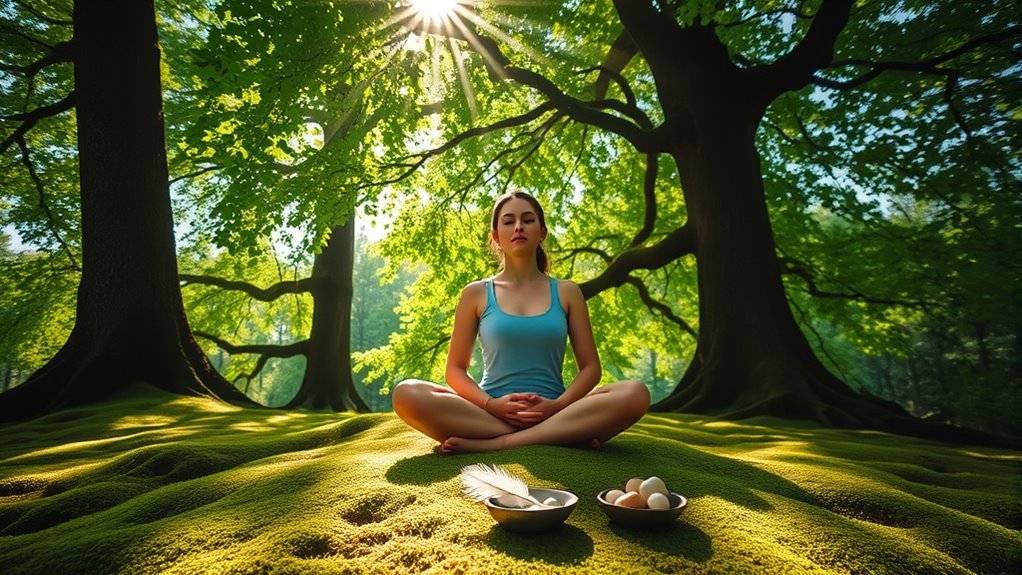
Personal grounding and centering help you reconnect with yourself, regain emotional strength, and find mental clarity during stressful or chaotic moments. By focusing on the present through simple practices like deep breathing, body scans, or feeling your feet on the ground, you can stay balanced and calm. Consistently practicing these techniques builds resilience and makes it easier to respond thoughtfully in challenging situations. Keep exploring how these methods can become a stable part of your daily life.
Key Takeaways
- Practice deep breathing and body scans to reconnect with the present moment and calm the nervous system.
- Use physical cues like feeling your feet on the ground to foster stability and awareness.
- Observe thoughts and feelings without judgment to detach from reactive patterns and regain balance.
- Incorporate visualization and mindfulness techniques regularly to strengthen resilience and mental clarity.
- Maintain consistent grounding routines to respond thoughtfully during stress and enhance emotional resilience.

Have you ever felt overwhelmed or disconnected in the midst of a busy day? When life’s demands pile up and your mind races with worries, it’s easy to feel out of control. That’s where personal grounding and centering come into play. These practices help you reconnect with yourself, restore emotional resilience, and regain clarity. One effective way to do this is through mindfulness exercises. By focusing your attention on the present moment, you can break free from spiraling thoughts and external chaos. Simple practices like deep breathing, body scans, or mindful observation of your surroundings anchor you in the now. For example, taking a few slow, deliberate breaths can immediately calm your nervous system and clear your mind. As you become more aware of your body and breath, you strengthen your emotional resilience, making it easier to handle stress without feeling overwhelmed. Incorporating elements of meditation can further deepen your sense of peace and focus. Centering yourself involves more than just relaxation; it’s about establishing a stable mental and emotional foundation. When you’re centered, you’re less likely to be thrown off by external events or negative thoughts. To achieve this, start by noticing what’s happening inside you—your thoughts, feelings, and physical sensations—without judgment. This awareness helps you detach from reactive patterns and respond more thoughtfully. Incorporating mindfulness exercises into your daily routine can substantially boost your emotional resilience. Over time, these practices help you develop a kind of mental armor, making it easier to stay balanced when life gets hectic. For instance, by regularly pausing to breathe deeply or to observe your surroundings mindfully, you train your mind to return to a calm, centered state more quickly after disruptions. Personal grounding and centering are also about creating a sense of stability amid uncertainty. When you’re grounded, you feel more rooted in your values and sense of self, which provides a steady anchor in difficult moments. You might find that taking a moment to stand firmly on the ground, feeling your feet beneath you, helps reinforce this sense of stability. Combining this physical awareness with mindful breathing or visualization techniques deepens your connection to the present and enhances your emotional resilience. Practicing these methods consistently makes them second nature, so during stressful situations, you can instinctively return to your center. This practice doesn’t eliminate challenges but equips you with a reliable tool to face them with clarity, calmness, and strength. Ultimately, cultivating personal grounding and centering through mindfulness exercises transforms how you navigate everyday life, making you more resilient and mindful in every moment.
Frequently Asked Questions
Can Grounding Techniques Help With Chronic Anxiety?
Yes, grounding techniques can help with chronic anxiety. By practicing mindfulness exercises and focusing on sensory awareness, you can anchor yourself in the present moment, reducing feelings of overwhelm. Techniques like deep breathing, noticing textures, or listening to sounds help calm your mind and body. Regularly using these methods can build resilience over time, making it easier to manage anxiety and stay centered during stressful situations.
How Long Does It Take to Feel Centered?
You can often feel centered in just a few minutes with consistent practice. Studies show that mindfulness exercises and breathing techniques can reduce stress in as little as 10 minutes. To speed up the process, focus on deep, slow breaths and grounding exercises. With regular practice, you’ll notice a quicker shift into a calmer, more centered state, helping you manage anxiety and stay present throughout your day.
Are There Specific Practices for Children or Seniors?
Yes, there are mindfulness exercises tailored for children and seniors to help with emotional regulation. For children, simple breathing games or guided imagery work well, while seniors benefit from gentle meditation or chair yoga. You can encourage them to practice daily, even for just a few minutes, to foster a sense of calm and stability. These practices help them feel more grounded and centered, making emotional regulation easier and more natural.
Can Grounding Improve Focus and Productivity?
Yes, grounding can improve your focus and productivity. By practicing mindful breathing and sensory awareness, you anchor yourself in the present moment, reducing distractions. When you take a few deep breaths and notice your surroundings, you calm your mind and enhance concentration. Regular grounding exercises help you stay centered, boost mental clarity, and increase your ability to stay productive throughout your tasks.
Is Personal Grounding Effective During High-Stress Emergencies?
During high-stress emergencies, personal grounding is highly effective. It helps you achieve stress reduction quickly and stabilizes your emotions, allowing you to think clearly and act decisively. By focusing on your breath or physical sensations, you anchor yourself in the present, preventing panic and maintaining emotional stability. This practice boosts your ability to respond calmly and effectively, even in chaotic situations, ultimately enhancing your resilience and decision-making under pressure.
Conclusion
By mastering personal grounding and centering, you unleash an unstoppable force within you, capable of conquering worlds of chaos and storm. With each breath, you become a fortress of calm, unshakable and radiant, defying the chaos that tries to shake your core. This practice transforms you into a beacon of unwavering strength, illuminating even the darkest moments with a brilliance so profound, it leaves the universe in awe of your unbreakable spirit.