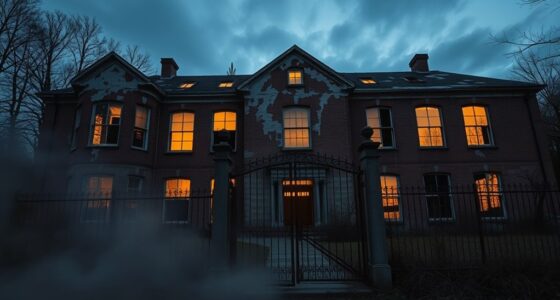
Between 1977 and 1979, the Enfield Poltergeist case unfolded in London, capturing media attention and sparking investigations by experts like Maurice Grosse and Guy Lyon Playfair. Reports describe objects moving, unexplained noises, and ghostly disturbances within a family home. Witnesses and recordings support these claims, but skeptics raise doubts about possible fabrications or psychological factors. To uncover the full details of this compelling timeline and the evidence involved, keep exploring this fascinating case.
Key Takeaways
- The Enfield Poltergeist case spanned from 1977 to 1979, involving multiple reported supernatural events at a house in Enfield, England.
- Investigators like Maurice Grosse and Guy Lyon Playfair documented phenomena including objects moving and unexplained noises.
- Media coverage and public interest increased as witnesses, including children and investigators, reported startling experiences.
- Skeptics questioned the authenticity, suggesting psychological factors or potential fabrications behind the phenomena.
- The case remains significant for its detailed documentation and ongoing debate over supernatural versus psychological explanations.
The Enfield Poltergeist incident remains one of the most documented cases of paranormal activity, capturing public and media attention in the late 1970s. As you explore this case, you’ll find that investigators from various backgrounds examined the phenomena, trying to uncover what was really happening in the Enfield household. Paranormal investigations during this period aimed to gather evidence of supernatural activity, documenting unexplained noises, objects moving on their own, and alleged levitations. Many investigators believed they were witnessing genuine poltergeist activity, but skeptics questioned whether these events could be explained through psychological explanations or deliberate hoaxes. Throughout the timeline, numerous witnesses, including the affected family members and investigators, reported startling occurrences. You’ll notice that some events involved objects flying across rooms, loud knocking sounds, and disembodied voices. Media coverage intensified as these reports gained credibility, prompting more investigators to visit the house, hoping to capture tangible proof of paranormal activity. However, the case also attracted criticism from skeptics who argued that the entire story could be fabricated or exaggerated. They suggested that psychological explanations, such as attention-seeking behavior or the influence of suggestion, might explain the phenomena. Some experts proposed that the children’s fantasies, stress, or desire for attention fueled the events, leading to the perception of a genuine poltergeist. Throughout 1977 to 1979, multiple investigations took place, including those led by renowned figures like Maurice Grosse and Guy Lyon Playfair. These investigators documented their findings meticulously, often recording strange noises, unexplained movements, or voices captured on tape. On the other hand, critics argued that some of these recordings could have been manipulated or misinterpreted. As the timeline unfolded, the debate between paranormal investigators and skeptics intensified, illustrating the complex nature of the case. Many believed that the phenomena pointed to a genuine supernatural presence, while others saw it as a product of psychological distress, manipulation, or mass hysteria. Interestingly, the case also highlights the importance of evidence collection and how the credibility of such reports can be influenced by the technology and methods used at the time. As you consider the sources and context of the Enfield Poltergeist timeline, it becomes clear that the case encapsulates the ongoing struggle to differentiate between the paranormal and psychological explanations. Whether you view it as a true supernatural event or a psychological phenomenon, the detailed documentation and widespread media coverage make this case a compelling chapter in the history of paranormal investigations. Ultimately, the Enfield case remains a fascinating example of how evidence, perception, and skepticism intersect in the quest to understand the unknown.
digital voice recorder for paranormal investigation
As an affiliate, we earn on qualifying purchases.
As an affiliate, we earn on qualifying purchases.
Frequently Asked Questions
Were There Any Similar Poltergeist Cases Before Enfield?
Yes, there were historical precedents of similar poltergeist cases before Enfield. You should know that prior incidents, like the Borley Rectory hauntings and the Rosenheim Poltergeist, share common features such as objects moving and unexplained noises. These cases helped shape understanding of poltergeist activity, demonstrating that such phenomena have been reported across different eras and locations, indicating a long history of paranormal disturbances before Enfield’s case emerged.
How Did the Media Initially Respond to the Enfield Reports?
The media’s initial response to the Enfield reports was a rollercoaster ride through skepticism and sensational headlines. You’d see newspapers painting wild pictures, questioning the supernatural claims, while others enthusiastically leaped to sensationalize every bump and whisper. Media skeptics doubted the haunting’s authenticity, yet the stories captivated the public’s imagination. This clash of disbelief and fascination turned the Enfield poltergeist into a media circus, fueling curiosity and debate nationwide.
What Were the Long-Term Effects on the Families Involved?
You see, the long-term effects on the families involved included ongoing psychological impacts, such as anxiety and mistrust. Their healing process varied; some managed to rebuild their lives, while others struggled with lingering trauma. The experience profoundly affected their mental health, influencing relationships and daily routines. Despite efforts to move on, many continue to grapple with the memories, highlighting the enduring emotional toll of the poltergeist events.
Did Paranormal Researchers Find Conclusive Evidence?
Paranormal researchers didn’t find conclusive evidence, and scientific skepticism remains strong due to evidential controversy. You should know that investigations showed some phenomena could be faked or misinterpreted, making it difficult to confirm supernatural activity. While some claim to have observed strange occurrences, the lack of solid, reproducible proof means the case stays unresolved. Ultimately, the evidence doesn’t satisfy scientific standards, leaving the paranormal questions open and debated.
How Has the Case Influenced Modern Paranormal Investigations?
Think of the Enfield case as a lighthouse guiding modern paranormal investigations. It’s pushed you to embrace new technological advances like video recording and audio analysis, transforming how you explore hauntings. Investigative methodologies have evolved, emphasizing skepticism and scientific rigor. This case reminds you that every strange occurrence is a puzzle piece, encouraging you to refine your techniques, stay curious, and seek evidence that bridges the gap between myth and reality.
night vision infrared camera for ghost hunting
As an affiliate, we earn on qualifying purchases.
As an affiliate, we earn on qualifying purchases.
Conclusion
As you piece together the Enfield Poltergeist timeline, one thing becomes clear: the story isn’t just about unexplained phenomena, but about the mysteries lurking beneath. Every event raises new questions—was it real, hoax, or something else entirely? As you explore deeper, the line between reality and illusion blurs, leaving you wondering what secrets still lie hidden in the shadows of Enfield’s haunting history. The truth, like the spirit itself, remains elusive.

The Ghost Meter EMF Sensor, Transparent
Simple one-handed operation
As an affiliate, we earn on qualifying purchases.
As an affiliate, we earn on qualifying purchases.
spirit box for paranormal communication
As an affiliate, we earn on qualifying purchases.
As an affiliate, we earn on qualifying purchases.