
To perform blind tagging for audio step-by-step, you start with raw recordings and extract key acoustic features like MFCCs and spectrograms. Next, you use machine learning algorithms to identify patterns without prior labels, enabling the system to classify sounds or speech segments automatically. Through model training and iterative refinement, the process uncovers meaningful tags based solely on intrinsic audio properties. Keep exploring to discover how these steps come together to achieve effective blind audio tagging.
Key Takeaways
- Begin with raw audio data and extract acoustic features like MFCCs and spectral properties.
- Use machine learning algorithms to analyze features and identify patterns without prior labels.
- Train models to classify segments into categories such as speech, music, or environmental sounds.
- Iteratively refine feature extraction and model parameters to improve tagging accuracy.
- Apply trained models to automatically generate meaningful, scalable labels for new audio data.
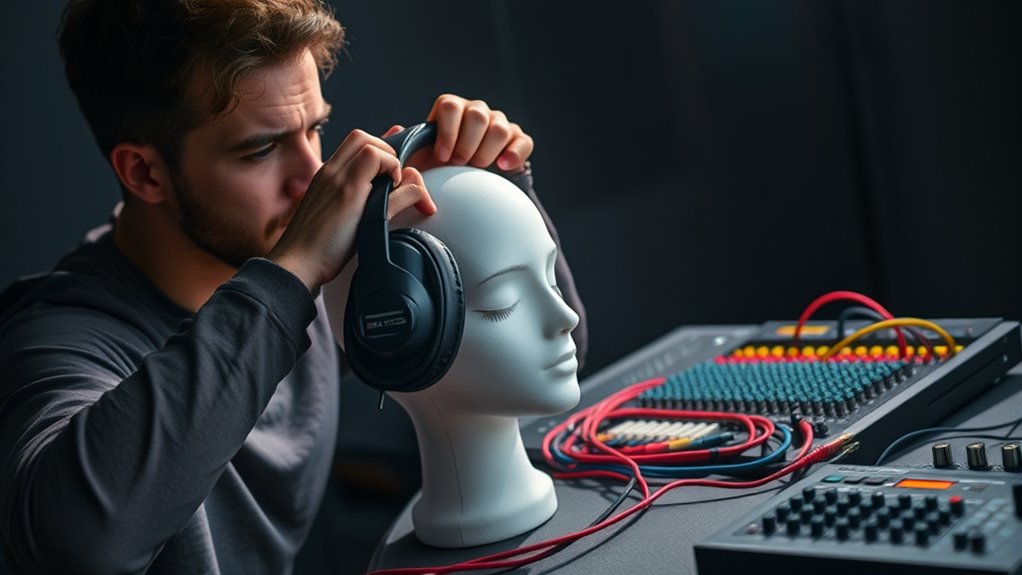
Have you ever wondered how audio content can be accurately labeled without prior knowledge of its specific characteristics? The key lies in a process called blind tagging, which relies on analyzing the raw audio itself rather than predefined labels. You start with raw audio data, and the first step involves metadata annotation, where you gather basic information like recording duration, sampling rate, and format. This metadata provides context but doesn’t reveal the content directly, making it a vital foundation for subsequent steps.
Next, you move into acoustic feature extraction. This is where you analyze the audio to identify key features such as pitch, tempo, spectral properties, and energy levels. These features act as the audio’s fingerprints, capturing its unique characteristics without needing prior labels. For example, extracting Mel Frequency Cepstral Coefficients (MFCCs) helps you understand the timbral qualities of the sound, while spectrogram analysis reveals the frequency content over time. This step transforms raw audio into a structured set of numerical data that machine learning algorithms can interpret. Additionally, understanding the importance of audio signal processing techniques enhances the effectiveness of feature extraction.
Analyzing audio to extract features like MFCCs and spectrograms creates meaningful, machine-readable representations.
Once you have your acoustic features, you use them to build models capable of classifying or tagging the audio. You typically feed these features into algorithms like neural networks or clustering methods, which learn to recognize patterns. Because you’re working with extracted features rather than labeled data, this approach is ‘blind’—it doesn’t rely on any prior annotations. Instead, the model finds regularities within the features itself, enabling it to classify sounds, speech, or music with minimal human input.
As the model trains, it begins to assign tags or labels based on feature similarities. For instance, it might identify audio segments as speech, music, or environmental sounds, even if it’s never seen those exact recordings before. This process is iterative—you can refine your features, adjust the algorithms, and improve accuracy over time. This adaptability makes blind tagging especially valuable for large datasets or new audio domains where manual annotation isn’t feasible.
In essence, the entire process hinges on converting raw audio into meaningful representations through metadata annotation and acoustic feature extraction. These steps allow you to perform effective audio labeling without prior knowledge, making blind tagging a powerful method for scalable, automated audio content analysis. It’s a way to let the data speak for itself, revealing insights purely from the audio’s intrinsic properties.
![WavePad Audio Editing Software - Professional Audio and Music Editor for Anyone [Download]](https://m.media-amazon.com/images/I/B1fcLEGCs6S._SL500_.png)
WavePad Audio Editing Software – Professional Audio and Music Editor for Anyone [Download]
Full-featured professional audio and music editor that lets you record and edit music, voice and other audio recordings
As an affiliate, we earn on qualifying purchases.
As an affiliate, we earn on qualifying purchases.
Frequently Asked Questions
What Equipment Is Necessary for Blind Tagging?
You’ll need a reliable audio interface to connect your microphones or instruments to your computer, ensuring clear sound quality. Additionally, have tagging software installed on your device to label and organize audio files efficiently. A good pair of headphones helps you accurately listen and tag, while a comfortable microphone can improve recording precision. With these essentials, you can perform blind tagging effectively without extra equipment.
How Accurate Is Blind Tagging Compared to Manual Methods?
You might find that blind tagging, powered by machine learning, often rivals manual methods in accuracy metrics, especially with large datasets. While it may not always match meticulous human annotations, recent advancements have considerably improved its reliability. When used correctly, blind tagging can provide consistent results, reduce human error, and save time. So, if you’re aiming for efficiency without sacrificing too much accuracy, you’ll likely find it a valuable tool.
Can Blind Tagging Be Applied to Live Audio Streams?
Yes, you can apply blind tagging to live audio streams, but you’ll face challenges like real-time processing and latency issues. You need to make certain your system processes data quickly enough to keep up with the stream, minimizing delays. Optimizing algorithms and using powerful hardware can help reduce latency. While it’s feasible, expect some trade-offs in accuracy or speed, so testing and tuning are essential for effective live blind tagging.
What Challenges Are Common in Blind Audio Tagging?
You’ll often face metadata challenges like incomplete or inconsistent tags, making it tough to organize audio. Noise interference is another common hurdle, especially in busy environments—imagine trying to tag a noisy street recording. For example, in a case study, background chatter led to missed tags. These issues can reduce accuracy, so improving noise filtering and standardizing metadata are key to successful blind audio tagging.
How Secure Is the Data During Blind Tagging Processes?
During blind tagging, your data remains relatively secure if proper measures like data encryption are in place. While privacy concerns exist, encrypting audio files ensures that unauthorized access is minimized, protecting sensitive information. However, it’s essential that the platform you use follows strict security protocols and regularly updates their encryption methods. This way, you can trust that your data stays confidential throughout the blind tagging process.
MFCC audio analysis tool
As an affiliate, we earn on qualifying purchases.
As an affiliate, we earn on qualifying purchases.
Conclusion
By embracing blind tagging for audio, you open the door to more unbiased and seamless data organization. While it might seem like a small step, it subtly guides you toward more accurate insights and efficient workflows. Remember, sometimes the quietest changes lead to the most meaningful improvements. Keep exploring these techniques, and you’ll find your audio projects becoming clearer and more refined—without even realizing how much you’re truly advancing.
spectrogram analysis software
As an affiliate, we earn on qualifying purchases.
As an affiliate, we earn on qualifying purchases.
machine learning audio classification
As an affiliate, we earn on qualifying purchases.
As an affiliate, we earn on qualifying purchases.