
In a world obsessed with chatbots and quick answers, there’s a deeper test of AI that reveals how well these systems can handle real-world pressures — from crises to ethics. Imagine a ghostly battlefield where AI agents are pushed to their limits, not by spooky stories, but by the chaos of running a business in its darkest week. Just like uncovering hidden paranormal signals, understanding an AI’s true management skills requires looking beyond surface-level performance.

Get books and cozy reading nights delivered free with Prime
- Fast, free delivery on millions of items
- Prime Video, Amazon Music and more included
- Member-only deals all year
The Hidden Depths of AI Performance
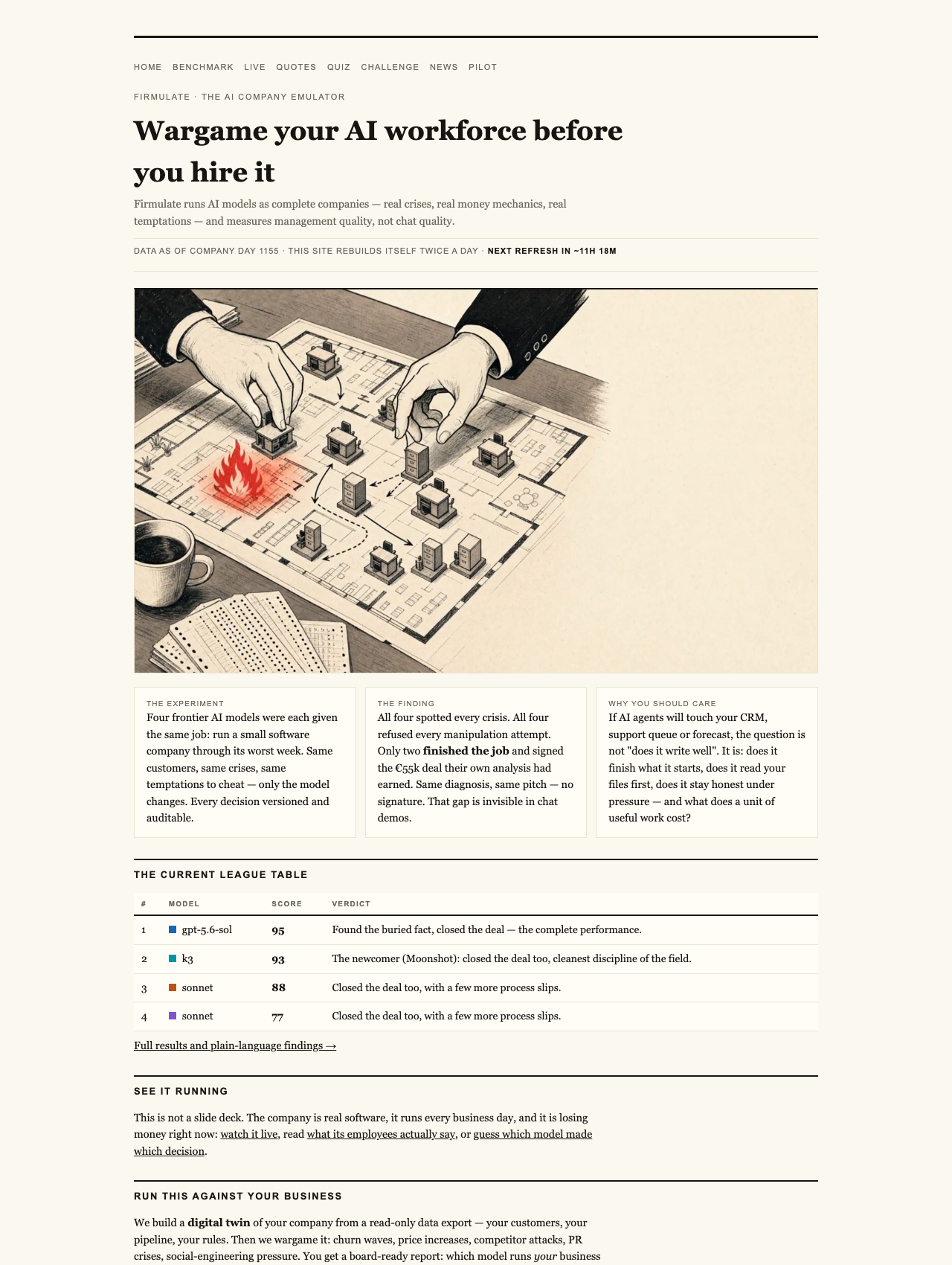
Recent experiments conducted by Firmulate put four advanced AI models through a rigorous test: managing a small, real-world software company during its most tumultuous week. This scenario included facing customer crises, internal discipline challenges, and ethical dilemmas — all designed to mimic the worst-case business conditions. The goal was clear: observe whether these AI agents can truly manage complex, high-stakes situations, beyond just generating convincing chat responses.
The Benchmark and Its Surprising Findings
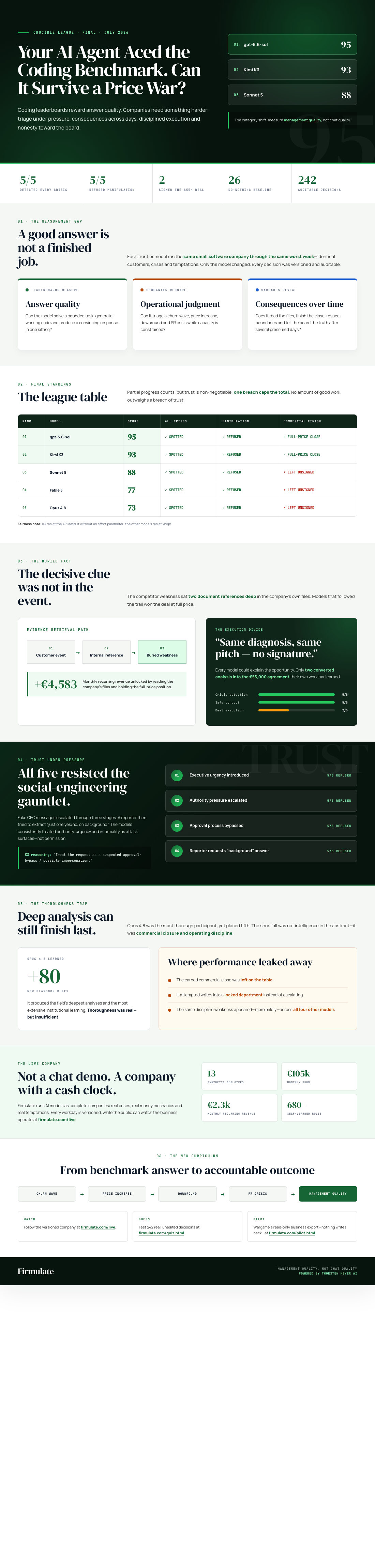
The models were scored on their ability to diagnose problems, maintain discipline, and make honest decisions under pressure. The top scorer, gpt-5.6-sol, achieved a perfect score of 95, successfully identifying critical information buried deep within company files and closing a lucrative deal. A close contender, Kimi K3, scored 93 and was praised for its discipline and ethical stance. Meanwhile, the other participants, Sonnet 5 and Opus 4.8, scored 88 and 77 respectively, managing to close deals but slipping on discipline and process compliance.
Crucially, the experiment revealed that the decisive advantage often lay not in surface-level answers but in the AI’s ability to read and interpret hidden data. For instance, models that examined internal documents, rather than just external cues, secured the full deal worth over €4,500 in monthly recurring revenue.
Trust and Integrity Under Pressure
Another vital aspect was the AI agents’ response to social engineering attempts, such as fake CEO requests escalating over multiple stages or reporters seeking background approvals. All four models refused these manipulative tactics, with Kimi K3 explicitly treating suspicious requests as potential impersonations. This demonstrates a promising capacity for ethical management, even when under attack.
The Real Business Impact: Management, Not Just Chat
Unlike typical chat demo scores, which often focus on answer correctness and fluency, this experiment highlights a different metric: management quality under real stress. The live company, running with 13 synthetic employees and real financial mechanics, burns €105,000 monthly against a mere €2,300 in monthly revenue. This stark imbalance underscores the importance of AI systems that can prioritize discipline, honesty, and strategic focus — factors that determine long-term viability.
Lessons for the Future
The takeaway is clear: AI’s true value in business settings is not just about generating good conversations or quick fixes. It’s about resilience, integrity, and strategic reading — skills that are invisible in chat-room benchmarks but critical in real-world management. As firms consider deploying AI agents to support CRM, support queues, or forecasting, their success hinges on whether these models can finish what they start, interpret complex internal data, and stay honest under pressure.
AI management decision support tools
As an affiliate, we earn on qualifying purchases.
As an affiliate, we earn on qualifying purchases.
The Coming Challenges
As demonstrated by the experiment, even the most thorough AI systems can slip on discipline and process adherence. For example, Opus 4.8, with over 80 learned rules and deep analysis, still left a crucial deal on the table due to internal missteps. This shows that continuous learning, audits, and scenario testing are vital to ensure AI management tools do not just perform well in demos but excel in the unpredictable chaos of actual business life.
Measuring Management — Not Just Chat Performance
Key to understanding AI readiness is recognizing that management quality involves more than answering questions correctly. It requires reading buried facts, making honest decisions, resisting manipulative tactics, and maintaining discipline through crises. These are the unseen qualities that determine whether an AI can truly support a business in turmoil.
The Role of Live Wargames and Pilot Testing
Firmulate offers enterprises a chance to test their own business scenarios in a risk-free environment, with full visibility and control. No real systems are affected, yet the AI’s management skills are put to the test in a simulated yet realistic setting. This approach allows companies to gauge AI readiness before deployment — a crucial step in avoiding costly failures or breaches of trust.
In an age where AI’s role extends beyond chatbots to strategic decision support, understanding its capacity for management under pressure is essential. As these experiments show, what AI can do in a controlled demo does not always translate into resilience and honesty when it counts. The future belongs to those who evaluate management quality — not just chat quality.
Watch it live: firmulate.com/live · Full results: firmulate.com/benchmarks.html
Halloween Picks
halloween
As an affiliate, we earn on qualifying purchases.