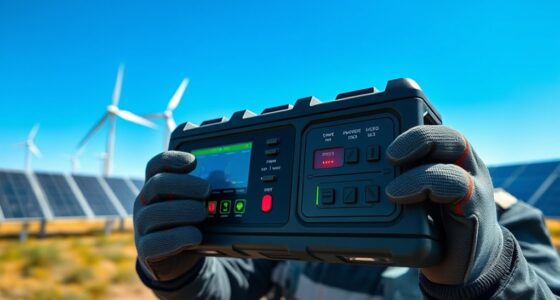

To measure static electricity step-by-step, first generate a charge by rubbing materials like a balloon on your hair or plastic. Then, bring the charged object close to a conducting plate connected to an electrometer, without touching it, to transfer the charge. The electrometer detects the electrostatic force, which you can then use to calculate the charge’s magnitude. Continuing will help you explore the precise methods and tools used for accurate measurements.

Get books and cozy reading nights delivered free with Prime
- Fast, free delivery on millions of items
- Prime Video, Amazon Music and more included
- Member-only deals all year
Key Takeaways
- Generate static charge by rubbing materials like balloons or plastic on hair or cloth.
- Bring the charged object near a conducting plate connected to an electrometer without contact.
- Observe the electrometer’s reading, which reflects the electrostatic force exerted by the charge.
- Use Coulomb’s law and known distances to calculate the amount of charge present.
- Ensure the environment is stable and the instrument is calibrated for accurate and reliable measurements.

Have you ever wondered how scientists measure static electricity? It’s a fascinating process that involves understanding the electrostatic force and accurately quantifying the charge involved. When static electricity builds up, it creates an electrostatic force that can attract or repel objects. To measure this force, scientists often use specialized instruments called electrometers or electrostatic voltmeters. These devices detect tiny charges and convert them into readable voltage levels, allowing precise charge quantification.
Scientists measure static electricity by detecting electrostatic forces with specialized instruments like electrometers.
The first step is to generate a static charge, which you can do by rubbing two materials together—such as a balloon on your hair or a plastic rod with a cloth. Once you’ve created a charge, you need to transfer it to a measurement device without losing any of it. This usually involves bringing the charged object close to a conducting plate connected to an electrometer. The electrometer detects the electrostatic force exerted by the object without making physical contact, guaranteeing an accurate reading. The device then displays the voltage, which correlates with the amount of charge present on the object.
To understand the relationship between the electrostatic force and the charge, consider Coulomb’s law, which states that the force between two charges is proportional to the product of their magnitudes and inversely proportional to the square of the distance between them. By measuring the electrostatic force using the electrometer, you can calculate the charge based on known distances and the properties of the device. This process is essential because it allows you to move from simply feeling static shocks or seeing sparks to quantifying the exact amount of charge involved. Additionally, understanding the role of charge quantification helps improve the accuracy of scientific measurements and industrial processes.
Charge quantification becomes particularly important in scientific experiments and industrial applications. For instance, in electronics manufacturing, knowing the static charge level helps prevent damage to sensitive components. In laboratories, precise charge measurements allow researchers to analyze electrostatic phenomena more accurately. To improve the accuracy of your measurements, guarantee that the environment is free of vibrations, drafts, or other external influences that might interfere with the sensitive equipment. Calibration of your measuring instruments is also vital to maintain consistency and reliability.
electrometer for static electricity measurement
As an affiliate, we earn on qualifying purchases.
As an affiliate, we earn on qualifying purchases.
Frequently Asked Questions
How Does Humidity Affect Static Electricity Measurements?
Humidity influences static electricity measurements by reducing their accuracy. When humidity is high, moisture in the air helps dissipate static charges, making them less intense and harder to measure precisely. Conversely, low humidity allows static charges to build up more easily, leading to stronger, more detectable static. To guarantee measurement accuracy, you should control and monitor humidity levels, especially in environments prone to static buildup.
Can Static Electricity Cause Damage to Electronic Devices During Testing?
Yes, static electricity can damage your electronic devices during testing. Electrostatic discharge (ESD) leaps like a mischievous sprite, zapping sensitive components if you’re not careful. That’s why grounding techniques are your best friends—strap yourself to the earth and keep static at bay. Ignoring these precautions is like inviting a lightning storm into your circuit; a quick zap could ruin hours of work in an instant.
What Are the Safety Precautions When Measuring Static Electricity?
When measuring static electricity, prioritize electrostatic safety by wearing anti-static wristbands and grounding yourself to prevent static discharge. Follow measurement precautions like using properly calibrated equipment and avoiding touching sensitive components directly. Keep work surfaces anti-static and handle devices carefully to prevent damage. Always stay aware of static buildup, and make certain your environment is static-controlled. These steps help protect both you and your electronic components during testing.
How Often Should Static Electricity Measurements Be Performed?
You should measure static electricity as often as you breathe—frequently enough to catch any sudden surges! Typically, measurement frequency depends on your environment and equipment, but a good rule of thumb is weekly or after major changes. Remember to stick to proper calibration intervals to guarantee accuracy. Regular checks help prevent static buildup from causing damage or sparks, keeping your workspace safe and your measurements reliable.
Are There Different Methods for Measuring Static Electricity in Various Materials?
Yes, you can measure static electricity differently depending on the material’s conductivity. For insulators, use an electrostatic voltmeter or field meter to detect electrostatic discharge, which indicates static buildup. For conductive materials, a simple multimeter can measure surface charge more directly. Understanding the material’s conductivity helps you choose the right method, ensuring accurate readings and better control of static electricity in your environment.
Conclusion
Now that you’ve learned how to measure static electricity, you’re practically a superhero wielding the power of sparks! With just a few simple tools and some careful steps, you can unveil the secret energy that’s hiding all around you. Remember, each tiny charge is like a tiny lightning bolt ready to surprise you. Keep practicing, and soon you’ll be shocking everyone with your incredible ability to measure static electricity—your skills are truly electrifying!
Halloween Picks
halloween
As an affiliate, we earn on qualifying purchases.