To use dowsing rods critically, start by understanding the historical context and recognizing that scientific evidence doesn’t support their effectiveness. Prepare a controlled environment to minimize subconscious cues, such as blind or double-blind tests. Stay aware of the ideomotor effect and biases that can influence rod movements. Question each step and rely on scientific principles rather than anecdotal stories. If you keep exploring, you’ll discover how to assess claims more effectively and avoid common pitfalls.
Key Takeaways
- Conduct blind or double-blind tests to minimize subconscious influence and personal biases during dowsing attempts.
- Use controlled environments to eliminate environmental variables and assess whether rods respond beyond chance.
- Rely on scientific methods and record results objectively, avoiding anecdotal evidence or traditional beliefs.
- Be aware of the ideomotor effect; recognize that subconscious movements may cause rod reactions.
- Critically analyze results, questioning any perceived success and considering alternative explanations grounded in scientific skepticism.
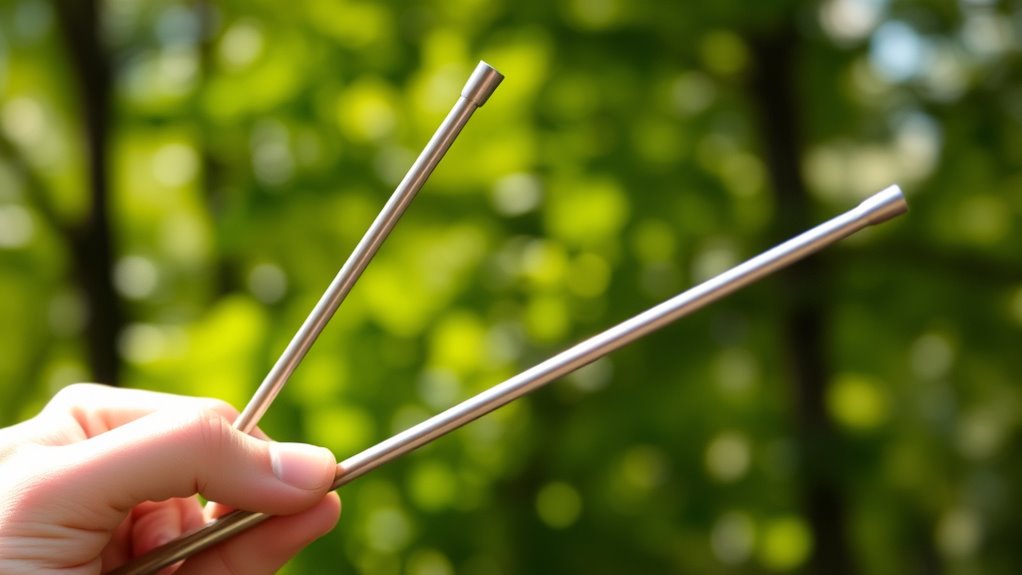
Dowsing rods have long been used by enthusiasts seeking to locate underground water, minerals, or other hidden objects, but approaching their use with critical thinking is essential. Many believe in the effectiveness of dowsing based on historical beliefs that date back centuries, where it was thought that the rods could intuitively detect unseen substances beneath the earth’s surface. However, from a scientific skepticism standpoint, these claims lack credible evidence and are often attributed to subconscious cues or the ideomotor effect—where your own expectations subtly influence your movements. Recognizing this is crucial if you want to avoid misconceptions about what dowsing can realistically achieve.
Understanding the historical beliefs surrounding dowsing helps you appreciate why many have trusted these tools for generations. People believed that the rods responded to natural energies or spiritual forces, and this faith persisted despite the absence of scientific validation. Today, many researchers consider dowsing a pseudoscience because controlled experiments repeatedly show that the success rate of dowsing rods is no better than random chance. Yet, it’s important to acknowledge that these beliefs persisted because, for centuries, they seemed to work in local traditions or individual cases, even if no scientific explanation ever emerged. This disconnect between historical beliefs and scientific skepticism underscores the importance of approaching dowsing with a rational mindset.
If you’re interested in using dowsing rods critically, start by questioning the assumptions behind their effectiveness. Don’t rely solely on anecdotal stories or traditional beliefs, which often lack rigorous testing. Instead, focus on understanding the scientific method—testing the rods under controlled conditions where variables are minimized. Be aware of your own biases; if you expect the rods to find something, your subconscious movements can influence their motion, creating a false impression of success. Conduct blind or double-blind tests whenever possible to eliminate personal bias. Remember, the goal isn’t to dismiss personal experiences outright but to approach them with a healthy dose of skepticism rooted in scientific principles.
In essence, using dowsing rods critically involves balancing curiosity with skepticism. Respect the historical context but don’t accept claims without evidence. Approach each attempt with a questioning mind, recognize the limitations of the tools, and rely on scientific methods to evaluate their effectiveness. Additionally, understanding the ideomotor effect can help you recognize how your own expectations influence your movements. By doing so, you protect yourself from false hope and ensure your pursuits remain rooted in rational inquiry rather than superstition. Ultimately, a critical approach helps you distinguish between genuine discovery and confirmation bias, fostering a more accurate understanding of what dowsing can and cannot do.
Frequently Asked Questions
Can Dowsing Rods Detect Non-Physical Energies or Spirits?
You might believe dowsing rods can detect non-physical energies or spirits, but scientifically, there’s no solid evidence for this. While some claim they enhance spiritual detection and energy perception, skeptics see it as a psychological or subconscious response rather than actual detection. If you’re exploring spiritual energies, keep an open mind but also critically evaluate the results, understanding that dowsing rods aren’t proven tools for detecting spirits or non-physical energies.
Are There Scientific Studies Supporting Dowsing Rod Effectiveness?
Think of dowsing rods as a compass in a storm—reliable only if you trust your intuition. Scientific skepticism questions their effectiveness, as many studies lack rigorous experimental methodologies. While some claim success, controlled research often shows results no better than chance. You should approach dowsing with an open mind but rely on scientific evidence, which currently doesn’t support their effectiveness beyond anecdotal reports.
How Can I Differentiate Between Genuine Hits and False Positives?
To differentiate genuine hits from false positives, you should use calibration techniques to establish your rods’ accuracy and consistency. Always account for environmental factors like electromagnetic interference, nearby metal objects, or weather conditions, which can cause false readings. Test your rods in controlled settings, compare results over multiple sessions, and remain skeptical of hits that aren’t consistently replicable to make certain you identify genuine signals.
What Are Common Psychological Biases Influencing Dowsing Results?
Imagine your mind as a garden, easily overrun by weeds like confirmation bias and cognitive illusions. These biases subtly influence your dowsing results, making you see what you want to find rather than what’s true. Confirmation bias leads you to focus only on hits that support your beliefs, while cognitive illusions trick your perception. Being aware of these pitfalls helps you stay grounded and objective in your dowsing practice.
Does Age or Experience Improve Dowsing Accuracy?
Age and experience can influence your dowsing accuracy, but not always positively. Age-related biases might cause you to rely on outdated methods or assumptions, reducing effectiveness. Conversely, more experience can improve your skills through practice, helping you recognize patterns and reduce subconscious biases. However, overconfidence from experience might lead to ignoring potential errors. Stay aware of these effects to maintain a critical, open-minded approach, regardless of age or experience level.
Conclusion
So, next time you pick up those dowsing rods, remember—they’re just tools, not magic wands. Approach with skepticism and curiosity alike, because believing without questioning is like sailing a ship without a compass. Stay grounded in evidence, and let curiosity be your guiding star. Dowsing can be intriguing, but never forget: critical thinking is your true map through the unknown. Keep questioning, keep exploring—your journey’s worth it.