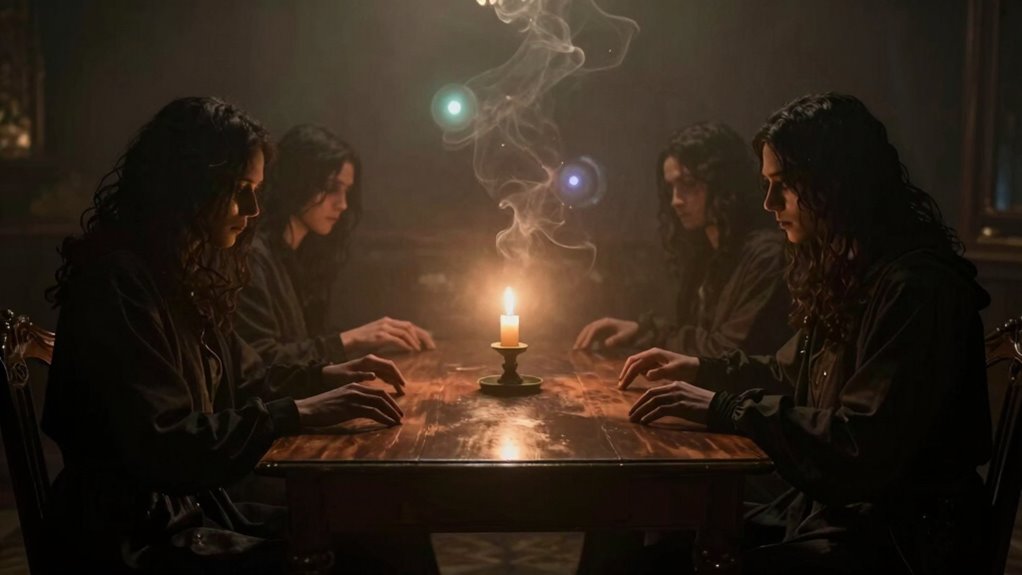

You explore table-tipping and séance lore as practices rooted in centuries-old beliefs where participants think they can communicate with spirits through physical movements. In these rituals, people place their hands on tables, believing spirits cause the table to move or rattle. Skeptics say it’s the subconscious “ideomotor effect” at play. These traditions reflect cultural influences and societal curiosity about the supernatural. Keep going to uncover more about their fascinating history and how they still captivate people today.

Get books and reading essentials delivered free — and shop member deals
- Fast, free delivery on millions of items
- Access to Prime Big Deal Days deals on October 6–7
- Prime Video, Amazon Music and more included
Key Takeaways
- Table-tipping involves participants placing hands on a table to induce movement, interpreted as spirit communication or explained by subconscious actions.
- Historically popular during the 19th century, especially in Victorian America and Europe, as part of spiritualist practices.
- Methods vary culturally, with some seeing table movements as spirits’ messages, while skeptics attribute them to the ideomotor effect.
- Seance rituals served social and cultural functions, fostering community beliefs in the supernatural and the afterlife.
- Modern perspectives view table-tipping mainly as psychological or theatrical, highlighting subconscious influences like the ideomotor effect.

If you’ve ever sat around a table in a dimly lit room hoping for a spirit to communicate, you’ve likely encountered the practice of table-tipping. This intriguing activity has roots that stretch back centuries, with its historical origins intertwined with various spiritual movements. During the 19th century, especially in Victorian America and Europe, table-tipping gained popularity as part of the burgeoning spiritualist movement. People believed that spirits could communicate through physical means, like moving tables or knocking sounds, as a way to bridge the gap between the living and the dead. These gatherings often took place in private homes or dedicated séance rooms, where participants would place their hands on a table and wait for it to shift or rattle in response to spirits’ messages. Over time, table-tipping became not just a method for seeking contact but also a social phenomenon, with many believing it was a genuine form of spiritual communication. Cultural influences played a significant role in shaping how table-tipping evolved across different regions. In America, the spiritualist movement was fueled by a mix of religious curiosity and scientific inquiry, encouraging people to explore the supernatural with a sense of skepticism and wonder. Meanwhile, in Europe, especially in England and France, séances often incorporated other mystical practices and were influenced by local folklore and spiritual beliefs. Indigenous traditions, too, contributed to the lore surrounding seances, blending indigenous spiritual practices with Western ideas of contacting spirits. This mixture created a rich tapestry of cultural influences, making table-tipping more than just a parlor game—it became a reflection of society’s collective fascination with the unknown. Throughout history, cultural influences have also dictated the methods and interpretations of table-tipping. Some groups believed the movement was evidence of spirits’ presence, while skeptics argued it was caused by unconscious physical movements—what’s now called the ideomotor effect. Additionally, the cultural exchange of ideas has allowed these practices to adapt and evolve over time, influencing modern interpretations of seance rituals. Regardless of intent, these séances cultivated a sense of mystery and intrigue, often serving as communal rituals that reinforced beliefs in an unseen world. Today, while many view table-tipping as a psychological or theatrical act, its historical and cultural significance remains palpable. It’s a practice born from a mixture of curiosity, cultural influences, and a desire to connect with the beyond. Interestingly, the ideomotor effect has been studied extensively in psychology, shedding light on how subconscious movements can create the illusion of supernatural phenomena. Whether seen as genuine communication or a fascinating psychological phenomenon, table-tipping endures as a fascinating element of seance lore.
As an affiliate, we earn on qualifying purchases.
Frequently Asked Questions
How Do Table-Tippers Prepare for a Séance?
You prepare for a séance by focusing on spiritual preparation, clearing your mind, and setting a respectful intention. Create a calm, quiet séance environment free of distractions. You might meditate or pray beforehand to connect spiritually. Gather with trusted participants, arrange the table properly, and make certain everyone’s mindset is open and receptive. This preparation helps foster a respectful atmosphere, increasing the chances of a meaningful, authentic experience during the session.
Are There Specific Rituals to Enhance Spirit Communication?
Yes, there are specific rituals you can perform to boost spirit communication. You start by cultivating spiritual openness, clearing your mind and intentions. Using ritual tools like candles, incense, or a spirit board can deepen the connection. As you focus, recite calming chants or invoke protective energies, creating an atmosphere charged with intention. This suspenseful preparation invites spirits to respond, making the experience more intense and meaningful.
Can Table-Tipping Be Safely Practiced at Home Alone?
You can attempt table-tipping alone at home, but prioritize psychic safety and respect spiritual boundaries. Make certain you’re in a calm, focused state and set clear intentions to protect yourself from negative energies. Always approach with caution, avoid forcing the activity, and remember that solo practice can be risky without proper experience. If you’re unsure or uncomfortable, consider seeking guidance from a knowledgeable practitioner to ensure a safe and respectful session.
What Are Common Signs of Genuine Spirit Presence?
When spirit detection occurs, you might notice ghostly signs like unexplained noises, sudden temperature drops, or flickering lights. A gentle, rhythmic movement of objects or a whisper in the silence can also hint at a presence. These signs often feel eerily real, sending chills down your spine. Trust your intuition—if these moments resonate deeply, they could be genuine signs of spirit activity, urging you to pay close attention.
How Has Modern Technology Influenced Séance Practices?
Modern technology has markedly changed séance practices by providing tools that detect ghostly phenomena more accurately. You now use electromagnetic field meters, audio recorders, and infrared cameras during paranormal investigations, which help verify spirit activity. These devices enhance your ability to observe and document paranormal phenomena, making séances more credible and scientific. As a result, technology bridges the gap between traditional spirit communication and contemporary scientific inquiry, deepening your understanding of ghostly phenomena.
Conclusion
So, now you see that table-tipping and seance lore are more than just spooky stories — they’re gateways to the unknown. With every spirit whispered and table spun, you’re stepping into a world where the supernatural is just a breath away. Remember, the mysteries you’ve uncovered could shake the very foundation of what you think is real. Stay curious, brave, and never underestimate the power of the unseen — it’s more alive than ever!
Halloween Picks
halloween
As an affiliate, we earn on qualifying purchases.