
TL;DR
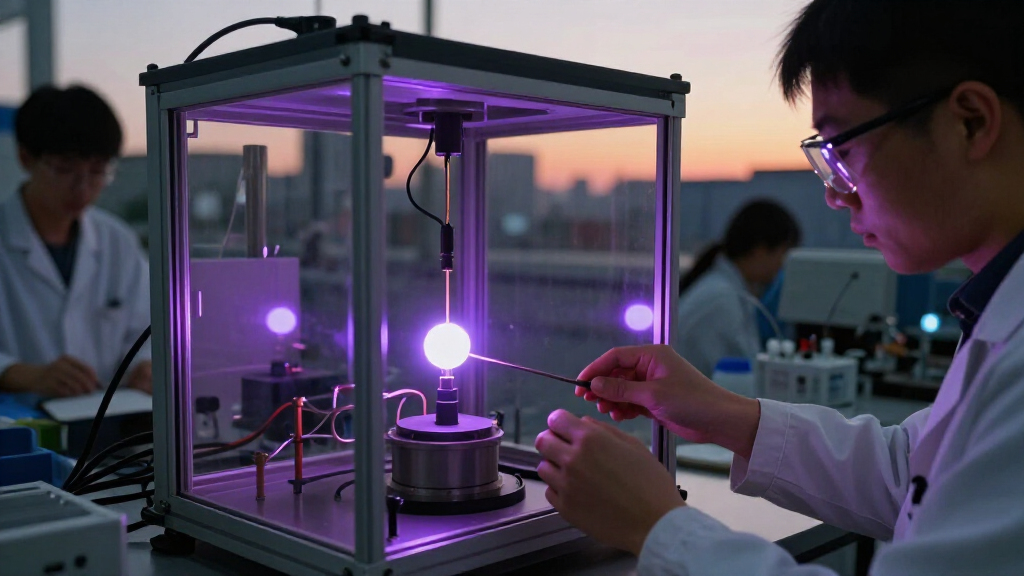
Researchers at the Shanghai Institute of Optics and Fine Mechanics created a glowing, concentrated electromagnetic structure using powerful terahertz fields. The sphere lasted about 100 nanoseconds and showed features that may help scientists investigate ball lightning, but it does not explain how the natural phenomenon forms.
Researchers at the Shanghai Institute of Optics and Fine Mechanics report creating a glowing, concentrated electromagnetic structure with powerful terahertz radiation, an experiment that may help scientists study ball-lightning-like phenomena. The lab-produced sphere, described as a soliton, remained detectable for about 100 nanoseconds; it is not a recreation of natural ball lightning or an explanation of how the rare atmospheric phenomenon forms.

Get books and cozy reading nights delivered free with Prime
- Fast, free delivery on millions of items
- Prime Video, Amazon Music and more included
- Member-only deals all year
The study, titled “Ball-lightning-like relativistic terahertz solitons,” was published in Nature Photonics. The team used intense fields of terahertz radiation, which lies between microwaves and infrared light in the electromagnetic spectrum, to create a concentrated structure researchers characterize as a spherical soliton. A soliton is a wave that can propagate without quickly dissipating under suitable conditions.
The researchers detected the structure for approximately 100 nanoseconds, or one ten-millionth of a second. The reported experiment produced a sphere only a few meters across, and the observed lifetime refers to the lab phenomenon—not the duration of naturally occurring ball lightning. The researchers also recorded light spanning ultraviolet, visible and infrared wavelengths.
Spectral measurements indicated ionization, suggesting the intense fields interacted with surrounding matter. The team also tracked changes in the sphere’s size and light emissions, which it reported were consistent with theoretical models of energetic fields interacting with matter. These observations describe the experiment; they do not establish that the same process produces luminous spheres during thunderstorms.
FIELD NOTES · NATURE PHOTONICS
How Scientists Recreated a Ball Lightning-Like Phenomenon in the Lab
A glowing sphere, built from terahertz fields. Researchers at the Shanghai Institute of Optics and Fine Mechanics created a concentrated electromagnetic structure that may offer a controlled way to study ball-lightning-like phenomena. It does not explain how natural ball lightning forms.
01 / WHAT WAS OBSERVED
A brief, bright sphere under controlled conditions
The team used intense terahertz radiation to produce a concentrated structure described as a spherical soliton. A soliton is a wave that can propagate without quickly dissipating under suitable conditions.
Light across wavelengths
Researchers recorded emissions spanning ultraviolet, visible and infrared wavelengths.
Signs of ionization
Spectral measurements indicated ionization, suggesting the intense fields interacted with surrounding matter.
Changing size and glow
Tracked changes were reported as consistent with theoretical models of energetic fields interacting with matter.
What this means: These observations describe the laboratory experiment. They do not establish that the same process creates luminous spheres during thunderstorms.
02 / LAB AND NATURE
Similar appearance, very different evidence
Natural ball lightning remains difficult to explain. Reported atmospheric examples and the measured laboratory structure differ in scale, duration and setting.
Laboratory soliton
Natural reports
Observed lifetime
Detectable for about one ten-millionth of a second.
Reported duration
Some accounts describe luminous spheres lasting several seconds.
Experimental scale
The reported lab structure was only a few meters across.
Reported scale
Some natural accounts describe spheres around a meter or larger; these are not equivalent measurements.
03 / THE EXPERIMENTAL PATH
From terahertz fields to a measurable structure
Rather than reproduce a thunderstorm or generate a natural electrical discharge, the researchers studied what powerful electromagnetic fields could produce in the lab.
Drive the fields
Apply intense terahertz radiation to create a concentrated electromagnetic structure.
Detect the sphere
Measure a spherical soliton that remains detectable for about 100 nanoseconds.
Study its light
Record wavelength emissions and changes in size to compare with theoretical models.
Photon storage and radiation technologies
The report points to possible future relevance for high-energy photon storage and technologies using powerful radiation.
No working application reported
The experiment does not establish a practical energy-storage device or technology ready for deployment.
04 / LIMITS AND NEXT STEPS
A research route, not a solved mystery
The result offers a method and observations for further study. The connection to natural ball lightning remains an open question.
How natural ball lightning forms
The study does not establish whether a comparable process occurs in the atmosphere or causes natural luminous spheres.
Formation and interaction
More work can test how these structures form, interact with matter and remain concentrated under different conditions.
Control and repeatability
Any photon-storage or radiation application would need separate demonstrations of control, repeatability and practical performance.
Next question: Do the measured light emissions and ionization match predictions across different experimental conditions—and can the lab phenomenon be meaningfully connected to atmospheric reports?
QUICK ANSWERS
Key questions
Did researchers recreate natural ball lightning?
No. They produced a ball-lightning-like electromagnetic soliton in a lab. The experiment did not reproduce a thunderstorm or show that natural ball lightning forms the same way.
How long did it last?
About 100 nanoseconds, or one ten-millionth of a second—far shorter than the several seconds reported in some natural accounts.
How was it produced?
With powerful terahertz electromagnetic fields. Terahertz radiation sits between microwaves and infrared light on the electromagnetic spectrum.
Does this solve the mystery?
No. It creates a controlled way to study a related structure, while the cause of natural ball lightning remains unknown.
Could it lead to new technology?
Potential relevance to photon storage and radiation technology is proposed, but no working application was demonstrated.
Where was the work reported?
The study, “Ball-lightning-like relativistic terahertz solitons,” was published in Nature Photonics.
A Laboratory Route to Studying Ball Lightning
Ball lightning has been reported for centuries, but its formation and behavior remain difficult to explain. Reports commonly describe luminous spheres that persist for seconds, a duration far longer than the 100-nanosecond lab observation. Producing a related electromagnetic structure under controlled conditions gives researchers a way to examine concentrated fields and their interaction with matter without relying only on rare or difficult-to-measure atmospheric events.
The work may also have relevance beyond explaining ball lightning. The research report points to possible future applications involving high-energy photon storage and technologies that use powerful radiation. Those are prospective possibilities, not demonstrated uses of the experiment. The findings show that a particular terahertz-driven structure can be created and studied; they do not establish a practical energy-storage device or a technology ready for deployment.
Popular right now

Shark Navigator Robot Vacuum with 30-Day Self-Empty Base, White (AV2110S)

De'Longhi Classic Signature Espresso Machine with Adjustable Milk Frother

DREAME D20 Air Plus Robot Vacuum and Mop with Auto-Empty Dock
As an affiliate, we earn on qualifying purchases.
From Atmospheric Reports to Terahertz Fields
Natural ball lightning is generally described as a glowing, roughly spherical phenomenon that can appear during or around thunderstorms. Accounts vary, and the exact physical process behind it remains unresolved. Some reported natural examples are described as lasting several seconds and reaching around a meter or more in size, but those descriptions are not equivalent to measurements of the much smaller experimental structure.
The Chinese team approached the problem through terahertz electromagnetic fields, rather than by reproducing a thunderstorm or generating a natural electrical discharge. The study’s title identifies the result as a “ball-lightning-like” relativistic soliton. That wording signals a resemblance and a possible avenue for comparison, not proof that the lab structure and atmospheric ball lightning share the same cause.
What the Experiment Cannot Yet Explain
The study does not establish whether the terahertz soliton is the same kind of structure as natural ball lightning, or whether a comparable process occurs in the atmosphere. The formation mechanism of natural ball lightning remains unresolved, and the short laboratory lifetime differs markedly from reports of natural spheres lasting several seconds.
The supplied account does not provide detailed information about the experimental setup, the energy required to generate the fields, or independent replication of the results. It also does not specify a publication date or report practical demonstrations of photon storage or radiation applications. Those points should not be inferred from the stated findings.
Further Tests of Terahertz Solitons
The immediate next step is further experimental and theoretical work to test how these structures form, how they interact with surrounding matter, and under what conditions they remain concentrated. Additional studies could assess whether the observed light emissions and ionization match predictions across different experimental conditions.
Researchers would also need to establish whether the laboratory phenomenon can be meaningfully connected to natural ball-lightning reports. Any proposed applications in photon storage or radiation technology would require separate demonstrations of control, repeatability and practical performance. The current report provides a method and observations for further study, rather than a confirmed explanation or an application milestone.
Source: The Debrief
Key Questions
Did the researchers recreate natural ball lightning?
No. They produced a ball-lightning-like electromagnetic soliton in a laboratory. The experiment did not reproduce a thunderstorm or establish that natural ball lightning forms through the same process.
How long did the lab-created structure last?
The structure was detectable for about 100 nanoseconds, or one ten-millionth of a second. That is far shorter than the several-second duration reported in some accounts of natural ball lightning.
How did the team produce it?
The team used powerful terahertz electromagnetic fields to create a concentrated spherical soliton. Terahertz radiation falls between microwaves and infrared light on the electromagnetic spectrum.
Does this solve the mystery of ball lightning?
No. The findings offer a controlled way to study a related electromagnetic structure, but the cause of natural ball lightning remains unknown.
Could the research lead to new technology?
The study points to possible future relevance for high-energy photon storage and radiation technologies. The reported experiment does not demonstrate a working application or a technology ready for use.
Source: The Debrief