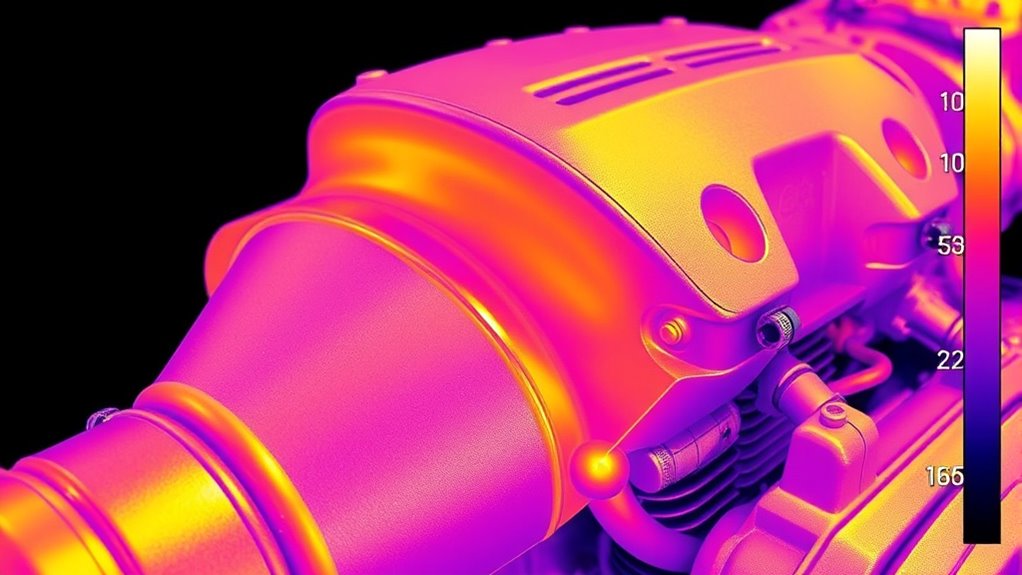
Infrared thermography faces limitations due to sensor resolution and environmental factors that can distort thermal readings. Higher resolution sensors detect finer temperature differences, providing clearer images, while low-resolution ones may miss subtle issues. External elements like wind, rain, fog, and reflective surfaces can interfere with accurate measurements, causing false readings or overlooked problems. Managing these influences is vital for reliable results. If you keep exploring, you’ll discover how these challenges can be addressed effectively.
Key Takeaways
- Sensor resolution limits affect the ability to detect small temperature differences, impacting image detail and diagnostic accuracy.
- Environmental factors like wind, rain, fog, and dust can distort infrared signals, leading to measurement errors.
- External conditions such as sunlight, drafts, and reflective surfaces cause temperature fluctuations, complicating accurate thermographic readings.
- Moisture, dust, and surface contaminants absorb or scatter infrared radiation, reducing measurement reliability.
- Proper calibration, timing, and environmental control are essential to mitigate external influences and improve thermography accuracy.
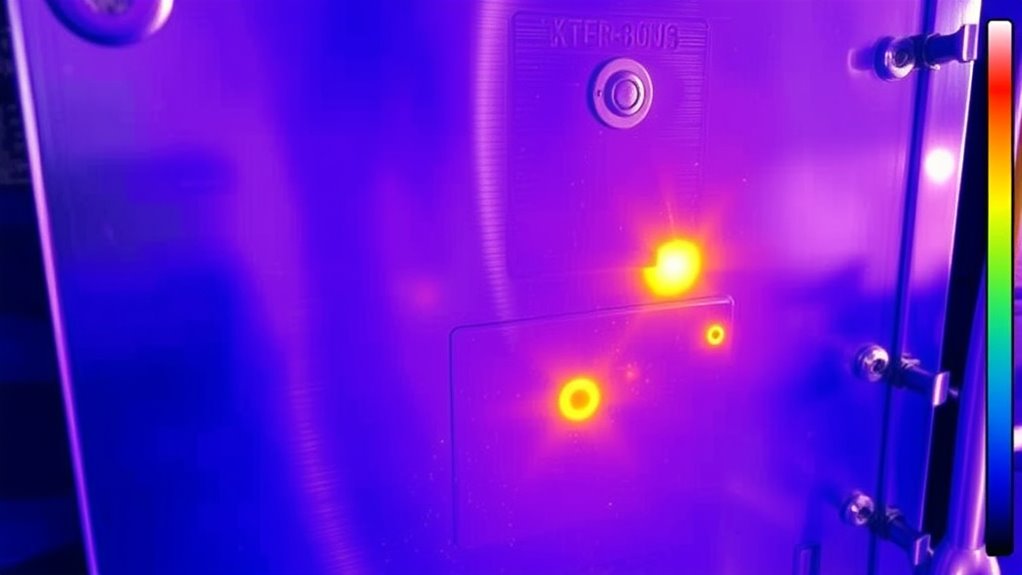
Infrared thermography offers a powerful way to detect temperature differences and identify potential issues, but it has notable limitations you need to understand. One key factor that influences the accuracy of infrared images is sensor resolution. Sensor resolution determines how detailed the thermal image will be. Higher resolution sensors can pick up smaller temperature variations and provide clearer images, making it easier for you to pinpoint problems precisely. Conversely, low-resolution sensors might miss subtle temperature differences, leading to less accurate assessments. If the sensor resolution isn’t adequate for your specific application, you might overlook critical issues or misinterpret the data, which can have serious consequences in fields like electrical inspections, building diagnostics, or healthcare.
Another significant challenge comes from environmental interference, which can distort infrared readings and compromise reliability. External factors such as wind, rain, fog, or dust can affect the infrared signals reaching the sensor. For example, moisture on a surface or in the air can absorb or scatter thermal radiation, making objects appear cooler or warmer than they truly are. Temperature fluctuations caused by sunlight or drafts can also interfere with measurements, especially if you’re inspecting machinery or building components during varying weather conditions. These environmental influences can introduce noise into your thermal images, making it difficult to distinguish between genuine temperature anomalies and artifacts caused by the surroundings. Additionally, environmental interference can vary depending on the setting. Indoors, factors like air conditioning, heating, or reflective surfaces can alter thermal readings. Outdoors, changing weather patterns and sunlight can complicate your efforts to obtain accurate data. Because of this, it’s vital to account for environmental conditions before performing thermographic inspections. Proper calibration, choosing the right time of day, and controlling environmental variables as much as possible can help mitigate these issues. Failing to do so might result in false positives or negatives, leading to unnecessary repairs or missed problems.

HF96 Thermal Camera with Laser Pointer, Intelligent Scene Detection, Super Resolution 240 x 240, -4°F~1022°F, Thermal Imaging Camera 96 x 96 IR Resolution, 25 HZ Infrared Camera, 11h Runtime
【Intelligent Scene Recognition with IntellFault】HF96 features HSFTOOLS' unique IntellFault technology for automated scene detection. Powered by deep learning,…
As an affiliate, we earn on qualifying purchases.
As an affiliate, we earn on qualifying purchases.
Frequently Asked Questions
How Does Weather Impact Infrared Thermography Accuracy?
Weather influence and atmospheric conditions considerably impact infrared thermography accuracy. You’ll notice that rain, fog, or snow can absorb or scatter infrared signals, leading to distorted temperature readings. Humidity and wind also play a role by changing surface temperatures or cooling surfaces unevenly. To get precise results, you should perform inspections in stable weather, avoiding extreme conditions that can compromise the thermographic data.
Can Infrared Thermography Detect Hidden Moisture Behind Walls?
You can definitely spot hidden moisture behind walls with infrared thermography, but it’s not magic—more like a superhero’s gadget. Moisture changes wall temperature, making it stand out from insulated areas. However, if wall insulation is thick or uniform, detecting moisture becomes tricky, like finding a needle in a haystack. So, while powerful, infrared thermography has its limits, especially when moisture hides behind well-insulated walls.
What Equipment Is Required for High-Precision Thermography?
You need a high-precision infrared camera with accurate calibration requirements and high sensor resolution to achieve detailed thermography. Look for equipment with a thermal sensitivity of at least 0.05°C and a detector resolution of 640×480 pixels or higher. Proper calibration guarantees accurate temperature readings, while high sensor resolution captures finer thermal details. These features are essential for precise, reliable thermographic inspections, especially in professional or sensitive applications.
How Do Surface Emissivity Variations Affect Temperature Readings?
Sure, surface emissivity variations turn temperature readings into a game of hide and seek. When surface properties change, their emissivity varies, making your thermographic camera see a different temperature than what’s actually there. It’s like trying to read a thermometer through tinted glass—your readings get skewed. So, if you overlook these emissivity variations, your temperature data may be wildly inaccurate, turning precision into a delightful guessing game.
Is Infrared Thermography Effective for Detecting Electrical Faults?
Yes, infrared thermography effectively detects electrical faults by identifying thermal anomalies caused by electrical anomalies. When you scan electrical systems, the infrared camera spots abnormal heat patterns that indicate potential issues like loose connections or overloaded circuits. However, verify that surface emissivity variations are accounted for, as they can affect temperature readings and possibly mask or exaggerate thermal anomalies, leading to false positives or missed faults.

H128 Handheld Thermal Camera, 240 x 240 TISR Resolution, 24h Battery Life Thermal Imaging Camera, 25 Hz Infrared Camera with Temperature Alarm, -4℉~ 842℉ Temp Range, IP65 Protection Level
Enhanced Clarity with 240×240 TISR Resolution: Equipped with TISR technology, the H128 infrared camera elevates your thermal imaging…
As an affiliate, we earn on qualifying purchases.
As an affiliate, we earn on qualifying purchases.
Conclusion
While infrared thermography offers valuable insights, it’s not a silver bullet and has its limitations. You need to be aware of factors like surface emissivity, environmental conditions, and equipment constraints that can cloud your readings. Don’t put all your eggs in one basket; understanding these pitfalls helps you make smarter decisions. By acknowledging these boundaries, you’re better equipped to avoid falling into false assumptions and truly leverage the technology’s potential.

KNINE OUTDOORS Infrared Thermometer Laser Temperature Gun, -58℉ to 1112℉, Single Laser Targeting, Distance to Spot Ratio 12:1, for Cooking, Oven and Meat (Orange)
Wide Temperature Range: Measures temperatures from -58℉ to 1112℉ (-50℃ to 600℃), making it perfect for a variety…
As an affiliate, we earn on qualifying purchases.
As an affiliate, we earn on qualifying purchases.
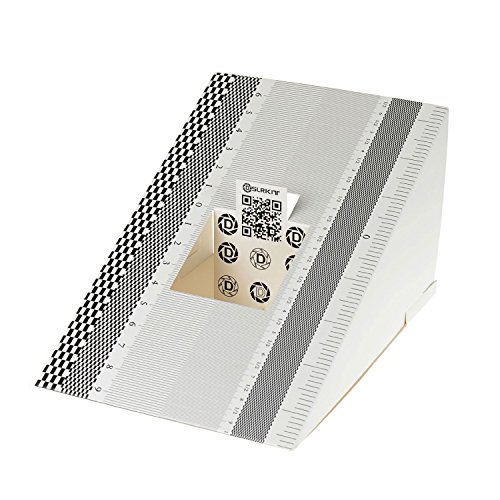
DSLRKIT Lens Focus Calibration Tool Alignment Ruler Folding Card(Pack of 2)
This compact ruler allows you to determine if your lens is auto-focusing accurately as it should. It is…
As an affiliate, we earn on qualifying purchases.
As an affiliate, we earn on qualifying purchases.