
Pareidolia happens when your brain interprets random images or sounds as familiar patterns like faces or voices. It’s driven by neural pathways specialized in recognizing faces and meaningful sounds, shaped by evolution and reinforced by cognitive shortcuts. Your senses filter noisy, ambiguous signals, prompting the brain to fill in gaps with recognizable shapes or sounds. This fascinating process reveals how your brain seeks order and meaning amid chaos—exploring this further uncovers even more intriguing details.
Key Takeaways
- Pareidolia arises from the brain’s pattern recognition system, which seeks familiar shapes or sounds in ambiguous stimuli.
- Neural pathways are specialized to detect faces and voices, leading to perceiving these patterns in random images or noise.
- Cognitive biases favor simple, recognizable patterns, causing the brain to interpret randomness as familiar objects or voices.
- Sensory processing filters ambiguous signals, often filling in gaps to create illusions of faces, figures, or sounds.
- Neural plasticity allows the brain to adapt and refine perceptual biases, influencing how we perceive pareidolia over time.
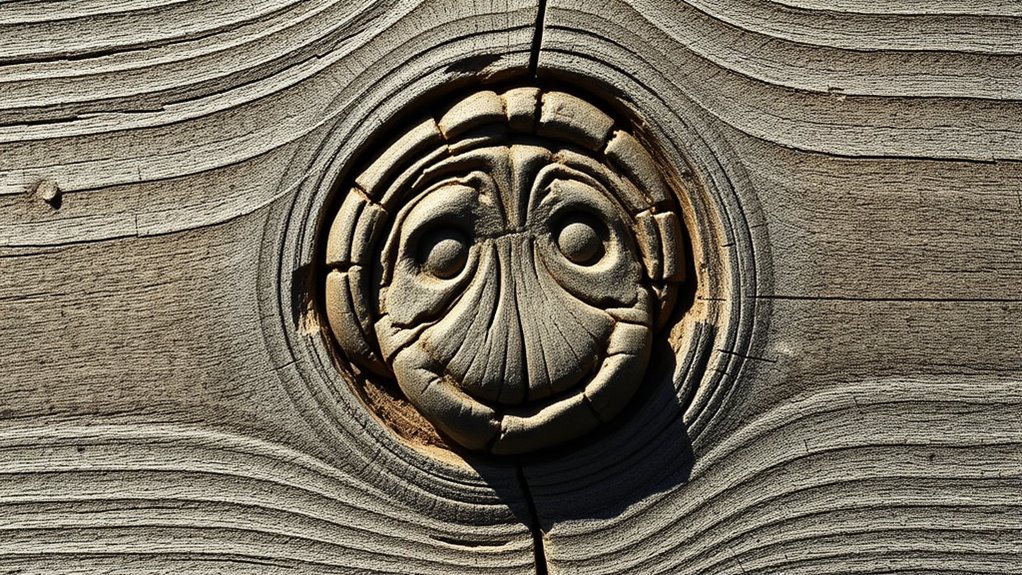
Have you ever looked at a cloud and thought it resembled an animal or face? That’s pareidolia in action—a fascinating phenomenon where your brain interprets random visual or auditory cues as familiar patterns. When you see a face in a coffee stain or hear a melody in static noise, your neural processing kicks into gear, quickly searching for recognizable shapes or sounds. This process isn’t random; it’s deeply rooted in how your brain is wired to prioritize social and meaningful information. Your neural pathways are tuned to detect faces and voices because, evolutionarily, recognizing others was essential for survival. This heightened sensitivity means your brain is constantly on alert for familiar patterns, even when none are intentionally present.
But this tendency isn’t purely instinctive; cognitive biases heavily influence what you perceive. For example, the face pareidolia bias causes you to see faces in objects like tree bark or car grills. Your brain’s tendency to favor familiar and meaningful patterns over randomness is a cognitive bias called pareidolia bias. It acts as a shortcut, helping you interpret complex sensory data rapidly, but it also leads to seeing faces or figures where none exist. This bias is reinforced by your brain’s pattern recognition system, which prefers simple, recognizable shapes over ambiguous or complex ones. It’s why a shadowy outline might suddenly look like a person or an animal, and why you might hear words or voices in background noise. Your neural processing filters auditory signals, highlighting any semblance of speech or familiar sounds, even if they’re just random noise. This is why, when listening to static or ambiguous audio, your mind might fill in gaps, creating the illusion of a recognizable voice or phrase. Moreover, recent research suggests that neural plasticity allows your brain to adapt and refine its pattern recognition capabilities over time, influencing how susceptible you are to pareidolia.
These processes reveal how your brain’s predispositions and cognitive biases work together to generate pareidolia. Your neural circuitry is designed to seek out familiar patterns because doing so has historically helped you interpret your environment more efficiently. Yet, this same system can lead to illusions, whether visual or auditory, that feel real in the moment. It’s a testament to the incredible efficiency of your brain, but also a reminder of how easily perception can be skewed by biases and neural shortcuts. When you experience pareidolia in photos or audio, it’s not just a random quirk; it’s a window into the complex interplay between your neural processing and your innate tendency to find meaning in chaos.
Frequently Asked Questions
Can Pareidolia Be Intentionally Induced in Images or Sounds?
Yes, you can intentionally induce pareidolia in images or sounds through visual illusion manipulation and sensory expectation triggering. By designing images with subtle shapes or patterns that resemble familiar objects, you stimulate your brain’s tendency to find familiar forms. Similarly, sounds with ambiguous or hidden elements can trigger pareidolia. This approach leverages your brain’s natural tendency to seek familiar patterns, making you perceive faces or objects where none actually exist.
Are There Psychological Disorders Linked to Heightened Pareidolia?
Yes, certain psychological disorders are linked to heightened pareidolia, as they can cause perceptual distortions. For example, schizophrenia and bipolar disorder often involve hallucinations or delusions, where individuals interpret random stimuli as meaningful. Your mental health may influence how strongly you experience pareidolia, and heightened tendencies could be a sign of underlying perceptual or cognitive issues. Recognizing this connection can help in understanding and managing these conditions.
How Does Pareidolia Differ Across Cultures?
You might find that pareidolia varies across cultures, as interpretive differences shape what you see or hear. Cultural symbolism influences how your mind perceives patterns—what’s a face or figure in one society could be something entirely different in another. It’s like comparing apples and oranges; your background colors your perception, making pareidolia a fascinating reflection of cultural diversity and personal symbolism.
Can Pareidolia Be Used in Art Therapy or Creativity?
Yes, pareidolia can boost your creativity and aid art therapy. You might see familiar shapes in pareidolia in painting, inspiring new ideas or emotional expression. Similarly, pareidolia in music allows you to find hidden melodies or patterns that spark your imagination. Engaging with these phenomena helps you explore feelings, reduce stress, and develop your artistic skills, making it a powerful tool for personal growth and creative expression.
What Role Does Memory Play in Perceiving Pareidolia?
Memory plays a vital role in how you perceive pareidolia, as your visual memory and cognitive associations shape what you see. When you encounter ambiguous images, your brain quickly matches them to familiar objects stored in your mind. This process helps explain why different people see different things, as your past experiences influence your perception and the patterns your brain recognizes in random stimuli.
Conclusion
So, next time you see a face in your coffee or hear a voice in static, remember—pareidolia is your mind’s way of turning the ordinary into the extraordinary. It’s a fascinating reminder that our brains are wired to seek patterns, even where none exist. Embrace this curious quirk of perception, for isn’t it the very magic of human nature that turns the mundane into the marvelous? After all, isn’t that what makes life endlessly intriguing?