
The Ganzfeld procedure uses sensory deprivation to create a controlled environment that heightens your perceptual sensitivity. By blocking out external sights and sounds with uniform visuals and gentle noise, it encourages you to focus inward and relax. This state may make you more receptive to subtle cues or internal images, aiming to explore extrasensory perception. If you keep exploring, you’ll discover how this technique influences perception and what scientists say about its effectiveness.
Key Takeaways
- The Ganzfeld procedure uses sensory deprivation to create a uniform visual and auditory environment, aiming to enhance perception.
- It minimizes external stimuli through tools like halved Ping-Pong balls and white noise, promoting internal focus.
- Sensory distortion during the process may increase sensitivity to subtle cues, potentially revealing extrasensory perception.
- The technique aims to induce relaxed, altered states of consciousness to facilitate perception beyond normal senses.
- Scientific debates question its validity, citing concerns about bias, sensory leakage, and inconclusive results.
The Ganzfeld procedure is a popular method used in parapsychology experiments to test for extrasensory perception (ESP). It involves creating a controlled environment where sensory input is minimized, allowing you to focus inward without external distractions. This process uses sensory deprivation techniques, such as a uniform visual field and diffuse auditory stimuli, to reduce your sensory input to a minimum. As a result, your perception becomes more susceptible to subtle impressions or impressions that might otherwise be masked by normal sensory distractions. The goal is to see if you can perceive information beyond your usual senses, such as telepathy or clairvoyance.
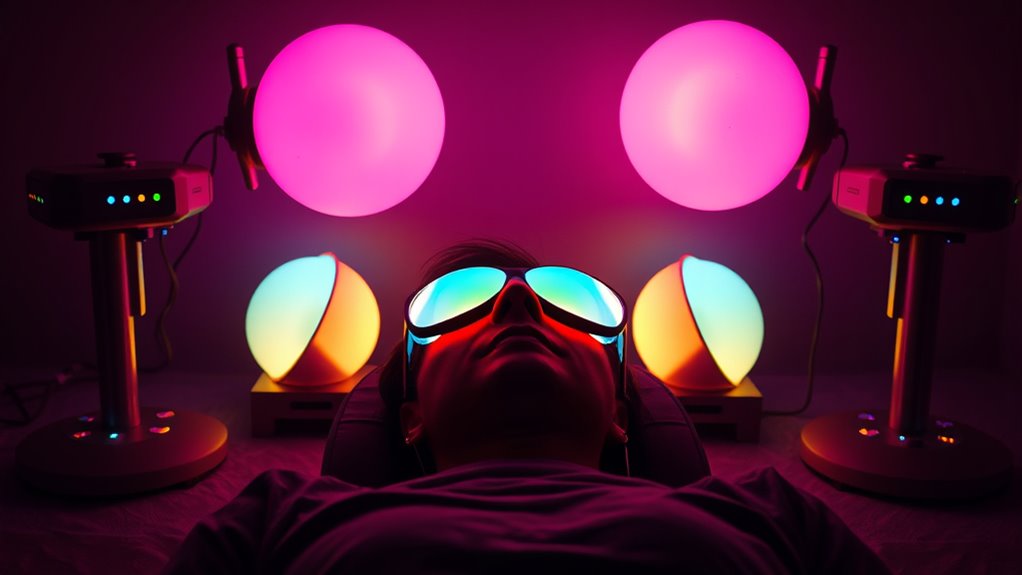
During a typical Ganzfeld session, you wear halved Ping-Pong balls over your eyes or a translucent screen, which produces a uniform visual field. Simultaneously, you listen to white noise or gentle sounds through headphones. These measures create perceptual distortion by blocking out external stimuli and producing a state of sensory deprivation. This environment encourages your brain to enter a relaxed, altered state that’s ideal for heightened perception. The idea is that by reducing sensory input, your mind becomes more open to subtle signals or impressions that might be linked to distant or hidden sources.
Wearing halved Ping-Pong balls and listening to white noise fosters sensory deprivation and heightened perception.
This process taps into the idea that perceptual distortion caused by sensory deprivation can lead to a kind of mental clarity. When your senses are dulled, your brain may compensate by becoming more sensitive to faint cues or internal images, which could be interpreted as ESP. Researchers hypothesize that this heightened sensitivity could facilitate the transfer of information that wouldn’t normally reach your conscious awareness. Additionally, controlled environments like the Ganzfeld are designed to eliminate external noise and distractions, making it easier for you to focus and potentially perceive information telepathically or clairvoyantly.
While many skeptics argue that the results of Ganzfeld experiments are inconclusive or susceptible to sensory leakage and experimenter bias, proponents believe that the procedure genuinely taps into extrasensory abilities. The perceptual distortion induced by sensory deprivation is thought to heighten your awareness of subtle cues, whether from your own subconscious or from external sources. This makes the Ganzfeld an intriguing, if controversial, tool for exploring the limits of perception. Ultimately, the process shows how controlling sensory input can influence your perceptual experience, opening a window—however small—into possibilities beyond ordinary senses.
Frequently Asked Questions
Can the Ganzfeld Procedure Improve Psychic Abilities?
The ganzfeld procedure might enhance your visual perception temporarily by reducing sensory input through sensory deprivation, which can make subtle impressions more noticeable. While some believe it could boost psychic abilities, scientific evidence remains inconclusive. You may experience heightened awareness or intuition during the process, but it’s unlikely to produce permanent psychic improvements. Keep an open mind, but understand that current research doesn’t definitively support long-term enhancements in psychic abilities through the ganzfeld method.
What Are the Potential Risks of the Ganzfeld Technique?
You should be aware that the ganzfeld technique can pose risks like causing visual impairment if used improperly or excessively. Sensory overload may occur because the method involves intense sensory deprivation and stimulation, which can lead to discomfort, headaches, or anxiety. It’s important to use the procedure cautiously and under supervision, especially if you’re sensitive to sensory changes, to minimize potential negative effects.
How Does Individual Variability Affect Ganzfeld Results?
Imagine your mind as a unique landscape, shaped by genetic differences that influence how you experience sensory adaptation. These individual variances affect your Ganzfeld results, making some more receptive to subtle stimuli while others become desensitized quickly. Your genetic makeup determines how your senses respond, so outcomes vary greatly. Recognizing this, it is crucial to take into account personal differences to interpret results accurately and understand the procedure’s diverse effects on individuals.
Is the Ganzfeld Method Suitable for Clinical Therapy?
You might find the Ganzfeld method somewhat suitable for clinical therapy, but its therapeutic efficacy remains uncertain. While some practitioners explore its potential for relaxation and sensory integration, more research is needed to establish reliable clinical applications. If you’re considering it, consult with a healthcare professional to weigh its benefits and limitations, as current evidence doesn’t fully support its widespread use in formal therapeutic settings.
What Technological Advancements Are Enhancing the Ganzfeld Experience?
Ever wonder how technology is transforming your sensory deprivation experience? Virtual reality and advanced sensory deprivation tools now create more immersive Ganzfeld sessions, heightening your perception and awareness. These innovations allow for precise control of sensory input, making the experience more vivid and personalized. Don’t you want to explore deeper states of consciousness? With these advancements, the Ganzfeld procedure becomes more engaging, accessible, and effective than ever before, revealing new potentials for your mind.
Conclusion
So, there you have it—proof that the ganzfeld procedure is the ultimate scientific marvel, or at least a fantastic way to pass the time while questioning reality. With its blend of sensory deprivation and mind-bending claims, who needs facts when you can just float in a sea of speculation? Whether it releases hidden psychic powers or simply makes you forget your keys, one thing’s for sure: the ganzfeld keeps you guessing—and that’s half the fun.