The best paranormal investigation camera in this roundup is the Spirit Store Full Spectrum 4K Action Camera Kit, which is designed around a kit-based setup with night vision and a dual mount grip. The ORDRO HDR-AC3+IR suits investigators who want a camcorder format with 4K recording and infrared night vision, while the Mini Handheld Infrared Thermal Camera serves a different role: showing heat patterns rather than recording conventional video. Your main tradeoff is between a flexible video setup, easier hands-free handling, and specialized thermal imaging; high resolution alone does not prove that a camera captures paranormal activity. Read on for the full comparison, ranking logic, and guidance on matching a camera to your investigation style.

Get books and cozy reading nights delivered free with Prime
- Fast, free delivery on millions of items
- Prime Video, Amazon Music and more included
- Member-only deals all year
Key Takeaways
- The Spirit Store kit ranks first for its investigation-focused setup: full-spectrum 4K recording, night vision, and a dual mount grip make it a more purpose-built choice than a standard camcorder.
- The ORDRO HDR-AC3+IR is the stronger camcorder-style alternative: its 4K and infrared combination suits buyers who prioritize conventional video recording over a bundled action-camera setup.
- Thermal imaging is a separate tool, not a night-vision substitute: the Mini Handheld Infrared Thermal Camera is for viewing heat differences, not capturing ordinary visible-light footage.
- The roundup spans convenience and control: models with flip screens, touchscreens, microphones, or included batteries and memory can reduce setup friction, while each feature adds a different kind of utility.
- Resolution labels do not settle the choice: handling, infrared capability, mounting, sound capture, and the camera’s intended role matter more than comparing 4K, 5K, or 8K claims alone.
| VETEK 8K 48MP WiFi Camcorder |  | Best Feature-Rich Camcorder | Video resolution: Up to 8K at 15 fps; 5K at 30 fps; 4K at 60 fps | Photo resolution: 48 MP | Night vision: Infrared | VIEW LATEST PRICE | See Our Full Breakdown |
| ORDRO V12 1080p Camcorder with Night Vision, 16GB Card, and Two Batteries |  | Best Lightweight Starter | Video resolution: 1080p | Maximum still resolution: 30 MP | Night vision: Infrared with two IR lights | VIEW LATEST PRICE | See Our Full Breakdown |
| Mini Handheld Infrared Thermal Camera |  | Best for Temperature Anomalies | Temperature range: -40°C to 300°C | Accuracy: ±2°C | Thermal resolution: 32 × 24 | VIEW LATEST PRICE | See Our Full Breakdown |
| ORDRO HDR-AC3+IR 4K Night Vision Camcorder |  | Best for Manual Control and Field Setup | Video resolution: 4K (2880 × 2160) at 24 fps; 2K at 30 fps; 1080p at 60 fps; 720p at 120 fps | Still image resolution: 13 MP | Sensor: 13 MP CMOS; 24 MP interpolated | VIEW LATEST PRICE | See Our Full Breakdown |
| 2.7K 64MP Camcorder with IR Night Vision |  | Best Compact All-Rounder | Video resolution: 2.7K | Photo resolution: Up to 64 MP | Night vision: Infrared, black-and-white recording | VIEW LATEST PRICE | See Our Full Breakdown |
| Hojocojo 4K Camcorder with Infrared Night Vision and External Microphone |  | Best for Long, Hands-Free Sessions | Maximum video resolution: 4K | Sensor: CMOS | Display: 3-inch IPS flip screen | VIEW LATEST PRICE | See Our Full Breakdown |
| Spirit Store Full Spectrum 4K Action Camera Kit with Night Vision and Dual Mount Grip |  | Best for Full-Spectrum Investigations | Sensor: 1/2.3-inch CMOS | Video resolution: 4K at 25 fps | Other video modes: 2.7K at 30 fps; 1080p at 60/30 fps; 720p at 120/60 fps | VIEW LATEST PRICE | See Our Full Breakdown |
| ORDRO 5K Night Vision Camcorder with 3-Inch Touchscreen |  | Best for Flexible Framing | Sensor: 1/2.7-inch CMOS | Maximum video resolution: 5K at 25 fps | Night vision: Infrared with two IR lamps and IR-CUT | VIEW LATEST PRICE | See Our Full Breakdown |
| 4K Digital Camcorder with Infrared Night Vision, External Microphone, and Flip Screen |  | Best for Motion-Detection Recording | Maximum video resolution: 4K | Additional video resolutions: 2.7K and 1080p | Night vision: 850 nm infrared illuminator; black-and-white footage | VIEW LATEST PRICE | See Our Full Breakdown |
| paranormal investigation camera | Night vision | Display | Video resolution |
|---|---|---|---|
| VETEK 8K 48MP WiFi Camcorder | Infrared | 3-inch touchscreen, rotates up to 270 degrees | Up to 8K at 15 fps; 5K at 30 fps; 4K at 60 fps |
| ORDRO V12 1080p Camcorder with | Infrared with two IR lights | 3-inch TFT-LCD, rotates 270 degrees | 1080p |
| Mini Handheld Infrared Thermal | — | 2.8-inch TFT, 320 × 240 | — |
| ORDRO HDR-AC3+IR 4K Night Visi | — | 3.1-inch IPS touchscreen | 4K (2880 × 2160) at 24 fps; 2K at 30 fps; 1080p at 60 fps; 720p at 120 fps |
| 2.7K 64MP Camcorder with IR Ni | Infrared, black-and-white recording | 3-inch LCD, rotates 270 degrees | 2.7K |
| Hojocojo 4K Camcorder with Inf | 850 nm infrared illuminator | 3-inch IPS flip screen | — |
| Spirit Store Full Spectrum 4K | — | — | 4K at 25 fps |
| ORDRO 5K Night Vision Camcorde | Infrared with two IR lamps and IR-CUT | — | — |
| 4K Digital Camcorder with Infr | 850 nm infrared illuminator; black-and-white footage | — | — |
More Details on Our Top Picks
VETEK 8K 48MP WiFi Camcorder
I’d choose the VETEK when an investigation needs one camera for daylight documentation, infrared recording, and remote monitoring. Its IR night vision, WiFi, and flip-out touchscreen cover more practical field tasks than the simpler ORDRO V12, while the included microphone, fill light, remote, and two batteries make the kit more ready to assemble. The headline 8K mode records at only 15 fps, though, so it is less suited to smooth motion than its resolution label suggests; 4K at 60 fps is the more useful setting for moving subjects. Fixed focus and digital zoom also limit close-up framing, so this is not a substitute for a lens with optical zoom. I see it as the most versatile conventional camcorder here, not the strongest choice for detail at a distance.
Pros:- IR night vision adds a way to record in dark locations without relying on visible-light footage.
- 4K recording at 60 fps offers a smoother motion option than the 8K mode.
- WiFi and a 270-degree flip-out touchscreen support remote viewing and flexible setup.
- Includes an external microphone, fill light, remote, SD card, and two batteries.
Cons:- 8K recording is limited to 15 fps, which can make movement look less fluid.
- Fixed focus and digital zoom restrict framing flexibility and distant detail.
- A tripod and HDMI cable are not included.
Best for: Investigators who want one bundled camcorder for IR footage, remote viewing, and both 4K and high-resolution recording modes.
Not ideal for: Buyers who need smooth 8K motion, optical zoom, or precise close-up focus; its 8K mode is 15 fps and its lens is fixed-focus.
- Video resolution:Up to 8K at 15 fps; 5K at 30 fps; 4K at 60 fps
- Photo resolution:48 MP
- Night vision:Infrared
- Zoom:18x digital
- Display:3-inch touchscreen, rotates up to 270 degrees
- Focus:Fixed focus
- Battery life:Up to 2.5 hours
- Storage:32GB SD card included; supports cards up to 256GB
- Connectivity:WiFi, USB, and HDMI
Our verdict“Pick the VETEK for a versatile, accessory-rich investigation camcorder, but use 4K at 60 fps rather than its 8K mode when capturing movement.”
ORDRO V12 1080p Camcorder with Night Vision, 16GB Card, and Two Batteries
The ORDRO V12 is the straightforward pick for a beginner who wants infrared recording in a compact package without a long list of modes to sort through. It weighs 9.28 ounces and includes a memory card, two batteries, remote, charger, and bag, giving a new investigator useful basics straight away. Against the VETEK 8K, it gives up sharper recording and WiFi, but its simpler 1080p setup may be enough for documenting room checks and longer stationary shots. The main limitation is its fixed-focus lens, which needs about eight feet or more to focus, making close evidence shots a poor fit. Its stated 80-minute recording time applies to full HD, and night-vision use can run shorter. I’d favor it for basic, distant scenes—not detailed close-ups or extended dark sessions.
Pros:- Infrared night vision supports recording in dark settings.
- Compact 9.28-ounce body is easier to carry during room-to-room investigations.
- Rotating 3-inch screen and remote control help with flexible or unattended recording.
- Includes a 16GB card, two batteries, charger, cable, and camera bag.
Cons:- Fixed focus requires subjects to be about eight feet away or farther.
- Night-vision recording time is shorter than the stated 80-minute full-HD maximum.
- 1080p video and USB connectivity are more limited than the VETEK’s higher-resolution and WiFi options.
Best for: First-time investigators who want a light, simple IR camcorder with a memory card and spare battery for documenting rooms from a distance.
Not ideal for: Investigators who need close-up footage, WiFi monitoring, or lengthy uninterrupted night-vision recording.
- Video resolution:1080p
- Maximum still resolution:30 MP
- Night vision:Infrared with two IR lights
- Digital zoom:16x
- Display:3-inch TFT-LCD, rotates 270 degrees
- Weight:9.28 ounces
- Maximum recording time:Up to 80 minutes in full HD
- Memory card:16GB Class 10 card included
- Batteries:Two NP-120 3.7V 1200mAh lithium batteries
Our verdict“Choose the ORDRO V12 for lightweight, basic IR recording at a distance, and skip it if close focus or longer night sessions matter.”
Mini Handheld Infrared Thermal Camera
This is the specialist choice in the group: rather than recording conventional video like the ORDRO HDR-AC3+IR, it creates thermal images and non-contact temperature readings. That makes it useful for checking temperature differences across a wall, doorway, or object during an investigation, but it cannot replace a camcorder for documenting what a room looks like. Its 32 × 24 thermal resolution is low, so the display is better for broad heat patterns than identifying fine details or small sources. The 8 Hz refresh rate also suits slow scans more than quick movement. It stores up to 100 images, connects to a PC over USB Type-C, and fits in a small handheld body. Celsius-only readings are another constraint for users who rely on Fahrenheit.
Pros:- Measures temperature without contact across a range from -40°C to 300°C.
- Compact 5.6-ounce design is convenient for scanning rooms and objects.
- Stores up to 100 thermal images for later review.
- USB Type-C connection allows PC linking.
Cons:- 32 × 24 thermal resolution shows broad patterns, not fine details.
- 8 Hz refresh rate is better suited to slow scans than fast-moving subjects.
- Temperature display uses Celsius only.
Best for: Investigators who want to check surface-temperature patterns and save thermal snapshots as a supplement to ordinary camera footage.
Not ideal for: Buyers seeking night-vision video, recognizable visual detail, or temperature readings displayed in Fahrenheit.
- Temperature range:-40°C to 300°C
- Accuracy:±2°C
- Thermal resolution:32 × 24
- Refresh rate:8 Hz
- Display:2.8-inch TFT, 320 × 240
- Storage:128 Mb; up to 100 images
- Viewing angle:55° × 35°
- Battery:3.7V, 800mAh rechargeable lithium-ion
- Interface:USB Type-C, 5V/1A
Our verdict“Buy this thermal camera as a temperature-checking companion, not as a replacement for the ORDRO camcorders’ video and IR recording.”
ORDRO HDR-AC3+IR 4K Night Vision Camcorder
The ORDRO HDR-AC3+IR suits investigators who want more control over setup than the simpler ORDRO V12 offers. Its manual focus, included external IR light, stabilizer, remote, and two batteries support deliberate shots and a more complete field kit. It records 4K at 24 fps, with 1080p at 60 fps available when smoother movement matters; night footage is black and white, with an IR range listed up to 16 feet. The 30× zoom is digital, so I would not treat it as a way to recover fine detail at a distance. The listed minimum focus distance is over three feet, and the stated weight of 1.43 kg makes it less appealing for long handheld searches than the lighter V12. It also lacks water resistance.
Pros:- Manual focus allows deliberate control over the focal point.
- Built-in IR night vision records black-and-white footage up to 16 feet.
- 1080p at 60 fps and 720p at 120 fps provide faster-motion recording options.
- Includes external IR light, stabilizer, two batteries, memory card, remote, bag, and cables.
Cons:- Night-vision footage is black and white, not color.
- Minimum focus distance is over three feet, limiting close-up shots.
- Not water resistant, and the listed 1.43 kg weight is substantial for extended handheld use.
Best for: Investigators who prefer manual focus and want an IR light, stabilizer, remote, and spare battery in one field-oriented kit.
Not ideal for: Buyers who need close-focus work, lightweight handheld use, color night footage, or protection from wet conditions.
- Video resolution:4K (2880 × 2160) at 24 fps; 2K at 30 fps; 1080p at 60 fps; 720p at 120 fps
- Still image resolution:13 MP
- Sensor:13 MP CMOS; 24 MP interpolated
- Night vision range:Up to 16 feet
- Digital zoom:30x
- Display:3.1-inch IPS touchscreen
- Focus:Manual; minimum focus distance over 3 feet
- Weight:1.43 kg
- Included storage:64GB memory card
Our verdict“Choose the HDR-AC3+IR for a manual-focus setup with bundled field accessories, but not for close shots or lightweight roaming.”
2.7K 64MP Camcorder with IR Night Vision
This compact camcorder is a middle-ground option for investigators who want more than the V12’s 1080p recording but do not need the VETEK’s 8K modes and broader connectivity. Its 2.7K video, IR night vision, rotating screen, and 290g weight make it a practical portable setup for basic room documentation. The 64MP photo figure is useful as a listed still-image maximum, while autofocus is specified for photos; it should not be read as a promise of equally flexible video focus. Compared with the ORDRO HDR-AC3+IR, this model is lighter and offers a longer stated recording time, but it lacks that camera’s manual focus and bundled external IR light. Its digital zoom and limited stabilization leave handheld footage less dependable at higher magnification.
Pros:- 2.7K video provides a resolution step up from the ORDRO V12’s 1080p recording.
- Infrared black-and-white recording supports dark-location documentation.
- Lightweight 290g body and rotating 3-inch screen suit portable, flexible setups.
- Includes a 16GB card, with storage expandable up to 128GB.
Cons:- Video zoom is digital, and digital stabilization may not keep footage steady.
- Autofocus is specified for photos, leaving video focus flexibility unclear.
- Battery recording time is listed as up to 90 minutes.
Best for: Mobile investigators who want a lightweight camera with IR recording, a rotating display, and a resolution step above 1080p.
Not ideal for: Buyers who need manual video focus, a bundled external IR light, or steady footage while using digital zoom.
- Video resolution:2.7K
- Photo resolution:Up to 64 MP
- Night vision:Infrared, black-and-white recording
- Video zoom:4x digital
- Photo zoom:16x digital
- Display:3-inch LCD, rotates 270 degrees
- Recording time:Up to 90 minutes
- Weight:290g
- Storage:16GB SD card included; supports cards up to 128GB
Our verdict“Pick this model for portable 2.7K IR recording, but choose the HDR-AC3+IR if manual focus and an external IR light matter more.”
Hojocojo 4K Camcorder with Infrared Night Vision and External Microphone
The Hojocojo is a practical pick for investigators who want a conventional handheld camera that can stay recording through a long room sweep. Its 850 nm infrared illuminator supports footage in darkness, while the included external microphone, tripod, and two batteries reduce the amount of extra kit to source. Recording while charging also helps when a session runs beyond a battery’s roughly 90–150-minute run time. Compared with the Spirit Store Full Spectrum 4K Action Camera Kit, the Hojocojo is less specialized: it records standard video rather than visible, IR, and UV light. Its advantage is a flip screen and a stated 20× optical zoom for framing distant areas. The tradeoffs are its lack of water resistance and the possibility of degraded detail when using digital zoom.
Pros:- 850 nm infrared illumination supports recording in complete darkness
- External microphone and 360° tripod are included
- Two batteries and recording while charging suit longer sessions
- Flip screen helps frame shots from low or awkward positions
Cons:- Not water resistant, limiting use in damp or outdoor locations
- Digital zoom can reduce image quality at high magnification
- Does not offer the visible, IR, and UV capture of the Spirit Store kit
Best for: Investigators who want a ready-to-use handheld setup for extended indoor sessions, with a flip screen, external mic, and spare battery.
Not ideal for: Investigators who need a weather-resistant camera or want full-spectrum capture of infrared and ultraviolet light.
- Maximum video resolution:4K
- Sensor:CMOS
- Display:3-inch IPS flip screen
- Night vision:850 nm infrared illuminator
- Zoom:20× optical and 20× digital
- Battery life:90–150 minutes per battery
- Included accessories:External microphone, 360° tripod, two batteries
- Weight:0.62 kg
Our verdict“Choose the Hojocojo for a flexible, accessory-rich handheld setup, but skip it if full-spectrum capture or weather protection matters more.”
Spirit Store Full Spectrum 4K Action Camera Kit with Night Vision and Dual Mount Grip
The Spirit Store kit earns its place through a capability the other cameras here do not claim: visible, infrared, and ultraviolet capture. That makes it the more targeted choice for investigators who want to document different light ranges, rather than simply record a dark room with an IR lamp. The included IR light, dual mount grip, 64GB card, and mounting accessories also make it a more complete action-camera package than the ORDRO 5K Night Vision Camcorder, which emphasizes a rotating screen and app control. There is a clear frame-rate compromise: 4K is limited to 25 fps, while smoother recording is available at lower resolutions. The camera is listed as water resistant, but no protection level is given, so I would not treat it as ready for heavy rain or immersion.
Pros:- Captures visible, infrared, and ultraviolet light
- Includes an IR light for night recording
- Multiple resolution and frame-rate options, including 1080p at 60 fps
- Comes with a 64GB SD card, grip, mounting accessories, and card reader
Cons:- 4K recording is limited to 25 fps
- Water resistance level is unspecified
- Its full-spectrum focus may be unnecessary for buyers who only need ordinary IR night footage
Best for: Investigators who specifically want visible, IR, and UV recording in a compact, mountable camera kit.
Not ideal for: Buyers who prioritize 4K footage at higher frame rates or need a clearly specified level of water protection.
- Sensor:1/2.3-inch CMOS
- Video resolution:4K at 25 fps
- Other video modes:2.7K at 30 fps; 1080p at 60/30 fps; 720p at 120/60 fps
- Still resolution:12 MP
- Capture range:Visible, infrared, and ultraviolet
- Connectivity:USB and Wi-Fi
- Included storage:64GB SD card
- Included accessories:IR light, dual mount grip, mounting accessories, card reader
Our verdict“Pick this kit when full-spectrum capture is the priority, but choose a conventional camcorder if you want a flip screen and simpler handheld framing.”
ORDRO 5K Night Vision Camcorder with 3-Inch Touchscreen
The ORDRO stands out for investigators who need to reposition the camera quickly without giving up a clear view of the screen. Its 270° rotating touchscreen makes low-angle or over-the-shoulder framing easier than on the Hojocojo’s flip display, while Wi-Fi app control and live view offer another way to monitor a shot. It also records up to 5K at 25 fps and uses two IR lamps for night vision, a useful combination for documenting dark interiors. The high-resolution label does not remove the practical limits: zoom is digital only, focus is manual, and the camera is not water resistant. Compared with the Spirit Store kit, it offers a more camcorder-like screen and stabilization, but lacks that model’s stated UV capture and included 64GB card.
Pros:- 270° rotating touchscreen gives flexible framing options
- Two IR lamps and IR-CUT support night recording
- Wi-Fi app control includes live view and sharing
- Built-in anti-shake helps steady handheld footage
Cons:- 18× zoom is digital rather than optical
- Manual focus requires the operator to adjust focus directly
- Not water resistant
Best for: Investigators who often film from awkward angles and want app-based live viewing alongside infrared night recording.
Not ideal for: Buyers who need optical zoom, autofocus, weather protection, or full-spectrum UV capture.
- Sensor:1/2.7-inch CMOS
- Maximum video resolution:5K at 25 fps
- Night vision:Infrared with two IR lamps and IR-CUT
- Screen:3-inch IPS touchscreen, 270° rotating
- Zoom:18× digital
- Stabilization:Built-in anti-shake
- Connectivity:Wi-Fi and USB
- Storage:32GB SD flash memory
- Focus:Manual
Our verdict“Choose the ORDRO for adjustable framing and remote monitoring, but favor the Spirit Store kit if UV capture is a defining need.”
4K Digital Camcorder with Infrared Night Vision, External Microphone, and Flip Screen
This camcorder is the lineup’s most clearly task-focused option for investigators who want to leave a camera pointed at a room and capture movement. Its motion detection joins time-lapse, an 850 nm IR illuminator, and recording while charging, while the included microphone, two batteries, and 360° tripod provide a useful starting kit. Compared with the Hojocojo, it adds motion detection and lists both electronic and optical stabilization; the Hojocojo, by contrast, specifies 20× optical zoom. Zoom claims here are inconsistent—the description says 20×, while the raw title says 24×—so I would not choose it based on magnification. Night vision also produces black-and-white footage, and the supplied data does not establish that the IR mode captures color in darkness.
Pros:- Motion detection can trigger recording when movement is present
- 850 nm IR illumination supports recording in darkness
- Includes an external microphone, two batteries, and a 360° tripod
- Can record while charging and lists electronic and optical stabilization
Cons:- Zoom information conflicts between the title and description
- Night-vision footage is black and white
- No water-resistance rating is provided
Best for: Investigators who want a tripod-mounted camera with motion detection for unattended room recording and an external microphone for audio.
Not ideal for: Buyers who need dependable zoom specifications, full-spectrum capture, or color footage in infrared night mode.
- Maximum video resolution:4K
- Additional video resolutions:2.7K and 1080p
- Night vision:850 nm infrared illuminator; black-and-white footage
- Screen:3-inch flip IPS
- Zoom:20× in description; 24× in title
- Stabilization:Electronic and optical
- Connectivity:HDMI and USB
- Memory:32GB installed; Micro SD
- Included accessories:External microphone, two batteries, 360° tripod
Our verdict“Choose this model for motion-triggered room monitoring and included accessories, but pick the Hojocojo if clearer optical-zoom details matter more.”
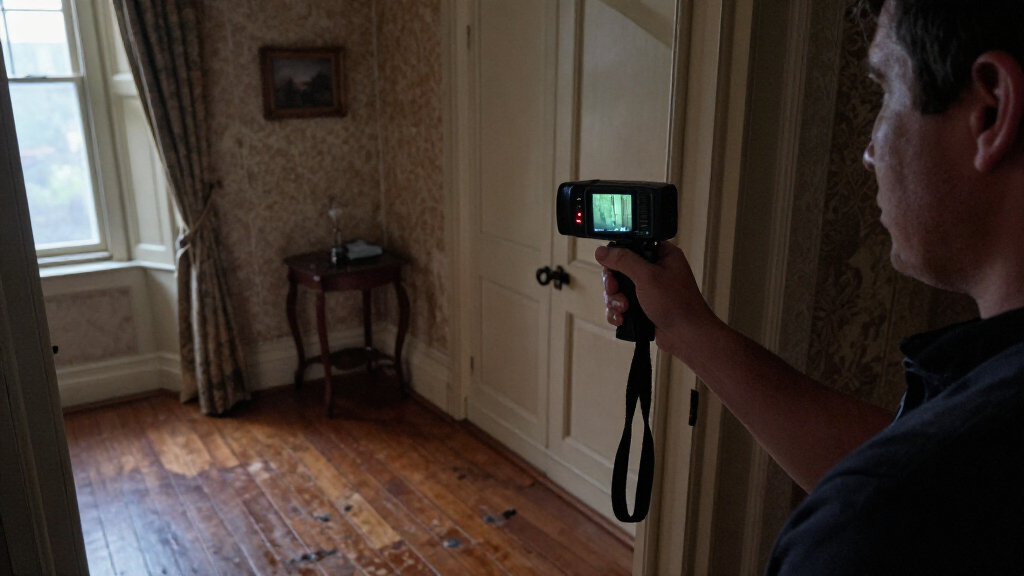
How We Picked
I ranked these cameras by how well their stated features match the practical demands of paranormal investigations: recording in low light, capturing usable footage and sound, staying manageable during long sessions, and supporting fixed or moving shots. I gave more weight to investigation-relevant capabilities such as infrared or full-spectrum recording, thermal imaging, mounting options, and included setup components than to headline resolution figures on their own.
The ranking also reflects how clearly each model serves a distinct buyer. The Spirit Store kit leads for its investigation-focused bundle, while the ORDRO HDR-AC3+IR offers a more conventional 4K camcorder route. Other options earn their place through features such as included batteries and storage, an external microphone, a flip screen, or thermal sensing. Where a product is specialized or its listed features leave practical limits, I treat that as a tradeoff rather than assuming every camera is equally versatile.
Factors to Consider When Choosing Paranormal Investigation Cameras
Choosing a camera for an investigation starts with deciding what evidence you want it to record. A night-vision camcorder, an action camera, and a thermal imager collect different kinds of information, so comparing them as if they were interchangeable can lead to the wrong purchase.
Decide Whether You Need Video, Thermal Imaging, or Both
Infrared night vision helps a camera record scenes in low light, while a thermal camera displays differences in surface temperature. Those outputs answer different questions and cannot be swapped just because both are associated with darkness. A thermal view may help you spot a temperature change, but it does not provide the same visual context as ordinary recorded video. A camcorder can document movement and sound, but it does not measure heat patterns unless it has a thermal sensor. Avoid buying a thermal device expecting a standard video record, or assuming infrared footage reveals temperature. If your investigation needs both kinds of evidence, plan for two tools rather than one camera that does everything.
Treat Night-Vision Claims as a Setup Question
Night vision is only useful if the camera can record the scene at the distance and angle you need. Before choosing, think about room size, whether the camera will be handheld or fixed, and whether its infrared illumination can reach the subject area. A bright infrared source may help nearby recording but can also create reflections from glass, dust, or close surfaces. Check what recording mode is available in darkness and whether the camera can save that footage in a format you can review later. Do not assume that a high-resolution label guarantees clear night footage; low-light performance and focus behavior matter too. For repeatable sessions, practice framing and focus in a dark room before taking the camera on site.
Choose a Recording Style You Can Sustain
A handheld camcorder offers direct control and a familiar screen, but holding it for a long session can introduce shake and fatigue. An action-camera kit with a grip or mount can make static or hands-free recording easier, though it may provide a different control experience from a traditional camcorder. A flip screen is useful when the camera sits at an awkward height or faces the operator, while a touchscreen can speed up menu changes if it remains easy to use in dim conditions. Decide whether you will walk and film, leave cameras running in fixed positions, or alternate between the two. A setup that is comfortable for the whole session often produces more useful footage than a feature-rich camera that is awkward to operate.
Plan for Sound, Storage, and Power Together
Video is only part of an investigation record; ambient sound can provide context for a noise or movement captured on camera. An external microphone may offer a different audio setup from a camera’s built-in mic, but placement matters because handling noise and nearby equipment can overwhelm quiet sounds. Long recording sessions also use storage and battery capacity, so assess the expected session length before relying on included accessories. Bundled memory or extra batteries can reduce initial setup work, yet you should still check compatibility, recording limits, and charging needs. Carrying spare power and a tested memory card is more useful than discovering that a camera cannot continue recording mid-session.
Match Resolution to Your Review Workflow
Higher resolution can provide more detail when cropping or inspecting a frame, but it may also create larger files and demand more storage and transfer time. For investigations, stable footage, a useful field of view, and clear focus can matter more than a larger number printed in the product name. Think about how you will archive and review recordings: a phone-based workflow, a computer, or a shared evidence folder may each impose different file-size limits. If several cameras record at once, consistent timestamps and labeling can make comparison easier than simply increasing resolution. Choose the recording quality your equipment and review habits can support throughout a full session.
Pay for a Feature That Changes Your Investigation
A higher-spec model makes sense when its features solve a real problem, such as needing full-spectrum recording, a thermal view, an external microphone, or a mount for unattended shots. A costly resolution upgrade is harder to justify if you will not crop footage or have enough storage to keep it. Beginners may benefit more from an uncomplicated setup with straightforward controls and included essentials than from advanced modes they rarely use. Experienced investigators can prioritize specialized sensing or a multi-camera workflow, provided they understand what each device records. Before paying more, name the specific limitation you expect the upgrade to fix and check that the product actually addresses it.
Frequently Asked Questions
Can a thermal camera replace an infrared night-vision camcorder?
No. A thermal camera displays temperature differences, while an infrared night-vision camcorder records a visual scene using infrared illumination. Thermal output can help identify heat patterns, but it does not provide the same context as video of a room. A camcorder can record movement and sound, but it does not show temperature unless it includes a thermal sensor. Choose based on the kind of information you need to review, and use both tools if your investigation calls for both.
Should I choose a 4K, 5K, or 8K camera for paranormal recording?
Choose based on the footage you can use, not the resolution label alone. Higher resolution can help when you need to inspect or crop recorded frames, but it also creates larger files and can increase storage demands. Low-light image quality, stable framing, focus, and recording duration may matter more during a long investigation. If you do not have a clear need for extra detail or a workflow for handling larger files, a lower-resolution option with useful night-vision features may be the more practical fit.
Is a bundled memory card and extra battery enough for an overnight session?
Not necessarily. Session length, recording settings, battery condition, and how much footage you capture all affect whether the included supplies will last. Check the camera’s recording limits and test it with the card and batteries you plan to bring. For an overnight investigation, spare compatible power and additional storage can prevent an avoidable recording gap. Keep a backup plan for transferring or labeling footage between sessions, especially if several cameras are recording at once.
Do I need an external microphone if the camera already records audio?
Not every investigator does. An external microphone may give you more flexibility in positioning audio capture, but it cannot remove background noise or guarantee that faint sounds will be clear. Consider whether you need audio from the camera’s exact position or from a separate point in the room. Also account for cable handling, wind or room noise, and the risk of bumping the microphone during setup. If sound is a central part of your documentation, test the full audio arrangement before relying on it in the field.
Is a full-spectrum action camera a better first purchase than a camcorder?
It depends on how you plan to record. A kit with a grip and mounting options may suit fixed shots and hands-free placement, while a camcorder can feel more natural for handheld filming and direct screen-based framing. Full-spectrum recording is a distinct capability, but it does not make a camera automatically superior for every scene or workflow. Beginners should weigh ease of setup, controls, mounting, and included accessories alongside the sensor features. Pick the format that matches how you will actually capture and review an investigation.
Conclusion
For the best overall, I recommend the Spirit Store Full Spectrum 4K Action Camera Kit because its night-vision features and dual mount grip make it the most investigation-focused package in this lineup. The best value for a camcorder-style setup is the ORDRO V12, whose included memory card and two batteries reduce some of the initial setup work. For a best premium-style feature set, consider the ORDRO HDR-AC3+IR if 4K recording and infrared night vision are your priority; do not choose it solely for its resolution label. The best beginner pick is the Hojocojo 4K Camcorder with External Microphone for buyers who want a familiar camcorder approach with a separate audio option. For a specific thermal-imaging need, choose the Mini Handheld Infrared Thermal Camera, remembering that it complements rather than replaces a video camera. Match the camera to what you need to record, how you will mount it, and how long you need it running.