
When you use long-exposure photography, you extend the camera’s shutter time, allowing light to accumulate on the sensor for an extended period. This creates artifacts like light trails from moving lights and star circles caused by Earth’s rotation. These effects happen because your camera captures the continuous movement of light sources or celestial objects over time. If you continue exploring, you’ll discover how understanding this science helps you control and enhance these stunning visual phenomena.
Key Takeaways
- Artifacts result from continuous light accumulation on the sensor during prolonged exposure.
- Moving light sources create trails by recording their paths over time.
- Earth’s rotation causes stars to appear as arcs, forming star trails in long exposures.
- Camera settings like shutter speed directly influence the length and brightness of artifacts.
- Understanding light behavior and motion allows precise control over artifact appearance in images.

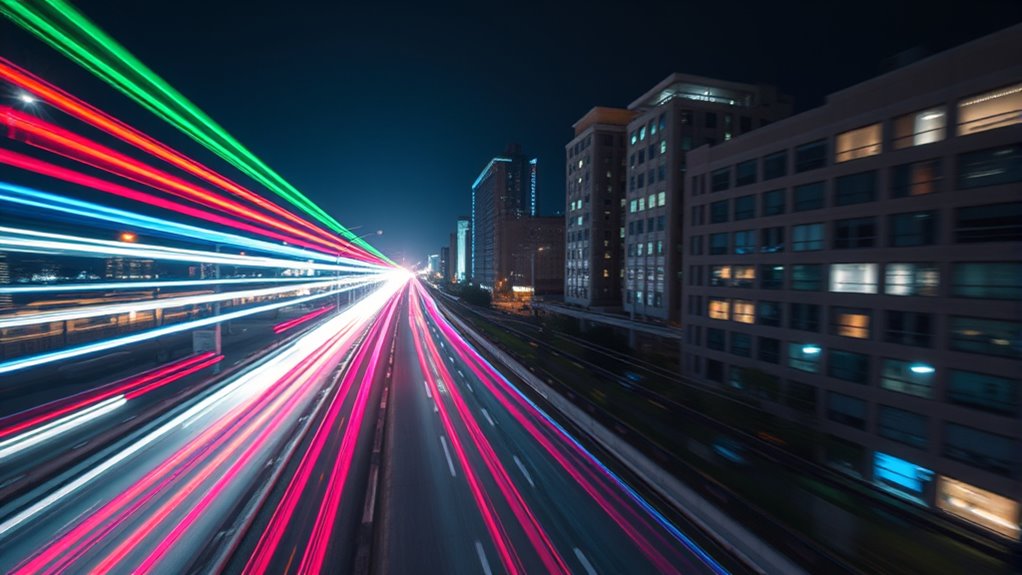
Long-exposure photography captures images over an extended period, allowing motion and light to create striking effects that aren’t visible to the naked eye. When you set your camera to a slow shutter speed, you’re fundamentally giving it more time to gather light, which results in fascinating visual artifacts. One of the most captivating effects you can produce are light trails, where moving light sources—like car headlights or glow sticks—leave behind streaks of illumination across the frame. These trails convey a sense of movement and energy that static photos can’t achieve, transforming ordinary scenes into dynamic compositions. As you experiment, you’ll notice that adjusting the exposure time changes the length and brightness of these light trails, giving you control over how busy or smooth the final image appears.
Long-exposure photography reveals dynamic light trails and motion effects invisible to the naked eye.
Star trails are another mesmerizing artifact of long-exposure photography. When you point your camera at the night sky and keep the shutter open for several minutes or even hours, the Earth’s rotation causes the stars to appear as arcs or circles rather than points. These star trails reveal the motion of celestial objects, providing a visual record of Earth’s rotation that’s impossible to see with the naked eye. To capture star trails effectively, you’ll need a stable tripod to prevent camera shake, and you’ll want to set your exposure time long enough to record the movement without overexposing the sky. The resulting images display a stunning sense of scale and motion, emphasizing the universe’s grand choreography.
Both light trails and star trails demonstrate how long exposure can transform simple scenes into extraordinary visuals by capturing motion over time. When you understand the underlying science, you realize that these artifacts are caused by the continuous accumulation of light on your camera’s sensor. Light trails appear where moving light sources are active during the exposure, creating streaks that trace their paths. Similarly, star trails are formed because the camera records the apparent movement of stars across the sky caused by Earth’s rotation, resulting in those circular patterns. These effects highlight the interplay between camera settings, Earth’s movement, and the behavior of light, giving you a powerful tool to interpret and manipulate visual phenomena in your photographs.
In essence, long-exposure photography reveals a world of invisible motion and light that your eyes can’t perceive in real time. Light trails and star trails are just two examples of how extended exposure times can turn ordinary scenes into extraordinary works of art. By understanding the science behind these artifacts, you gain the ability to anticipate and control their appearance, pushing your creative boundaries further. Whether you’re capturing the lively streaks of urban traffic or the silent swirl of stars in the night sky, long exposure invites you to see the unseen and tell stories through motion captured in light.
Additionally, knowing how resources and tools can aid in planning and executing long-exposure shots can greatly enhance your results and ensure safety during night photography sessions.

Tripod for Camera and Phone, 72" Tall Camera Tripod Monopod with Remote
- Lightweight and Portable: Weighs only 3.3 lbs with carrying bag
- Quick Setup: Flip leg lock for fast assembly
- Durable Aluminum Construction: Thicker legs for stability and long exposure
As an affiliate, we earn on qualifying purchases.
As an affiliate, we earn on qualifying purchases.
Frequently Asked Questions
How Does Sensor Size Affect Long-Exposure Artifacts?
Sensor size considerably impacts long-exposure artifacts by influencing image quality and noise levels. Larger sensor dimensions capture more light, reducing noise and allowing better detail preservation during long exposures. Smaller sensors tend to introduce more artifacts, like noise and color shifts, especially in low-light conditions. By choosing a camera with bigger sensor dimensions, you’ll notice clearer, crisper images with fewer artifacts, enhancing your overall long-exposure photography experience.
Can Long-Exposure Artifacts Be Completely Eliminated?
Absolutely, you can’t completely eliminate long-exposure artifacts, but you can substantially reduce them. Regular sensor cleaning helps prevent dust and debris from creating spots, while software correction tools can fine-tune and fix remaining flaws. By combining meticulous maintenance with smart editing, you can minimize artifacts, making your images cleaner and crisper. Remember, perfection is a pursuit, but you can get remarkably close with consistent care and clever corrections.
What Role Does Aperture Play in Artifact Formation?
Aperture effects play a significant role in artifact formation during long exposures. A wider aperture increases light intake, which can amplify artifacts like starbursts or lens flare, especially with bright lights. It also affects depth of field, making parts of your image more or less sharp. Narrowing the aperture reduces these effects, helping you control artifact appearance and achieve a clearer, more focused shot.
How Do Different Camera Brands Handle Long-Exposure Artifacts?
Different camera brands handle long-exposure artifacts through sensor calibration and firmware updates. You’ll find that brands like Canon, Nikon, and Sony often release firmware updates to improve artifact reduction, ensuring cleaner images. Sensor calibration helps minimize issues like hot pixels or banding. By keeping your camera’s firmware current and performing regular calibration, you can reduce artifacts and achieve clearer, more professional-looking long-exposure photos.
Are There Post-Processing Techniques to Reduce Artifacts?
Yes, you can use post-processing techniques to reduce artifacts in your long-exposure photos. Applying noise reduction tools in software like Adobe Lightroom or Photoshop helps smooth out unwanted grain and streaks. Additionally, software filters specifically designed for artifact removal can target and minimize long-exposure artifacts, giving your images a cleaner, more polished look. Just be careful not to overdo it, as excessive filtering can result in loss of detail.
Conclusion
Understanding the science behind long-exposure artifacts reveals how your camera captures more than just static scenes. Did you know that light trails can extend up to several miles in a single shot? By mastering these effects, you can create stunning images that showcase motion and time in a way your eyes can’t see. So next time you set up your camera, remember, you’re capturing a fascinating blend of physics and art—making every shot uniquely yours.