
The Stone Tape Hypothesis suggests that places can store traces of past events as residual energy rather than spirits. These energetic impressions, created during intense moments like emotional upheaval or violence, get embedded in the environment. Certain conditions, such as temperature or vibrations, can reactivate these residues, causing fleeting images, sounds, or feelings—what some call hauntings. If you want to discover how environmental factors influence these energy recordings, there’s more to explore.
Key Takeaways
- The Stone Tape Hypothesis suggests places can store energetic impressions of past events, acting like natural tape recorders.
- Atmospheric residues are energetic, not physical, and can be reactivated under certain environmental conditions.
- Significant emotional or violent events create residues that may manifest as fleeting images, sounds, or emotions.
- Environmental factors such as temperature, humidity, and vibrations influence the likelihood of reactivating these residues.
- The hypothesis offers an alternative explanation to traditional ghosts, focusing on environmental energy rather than spirits.
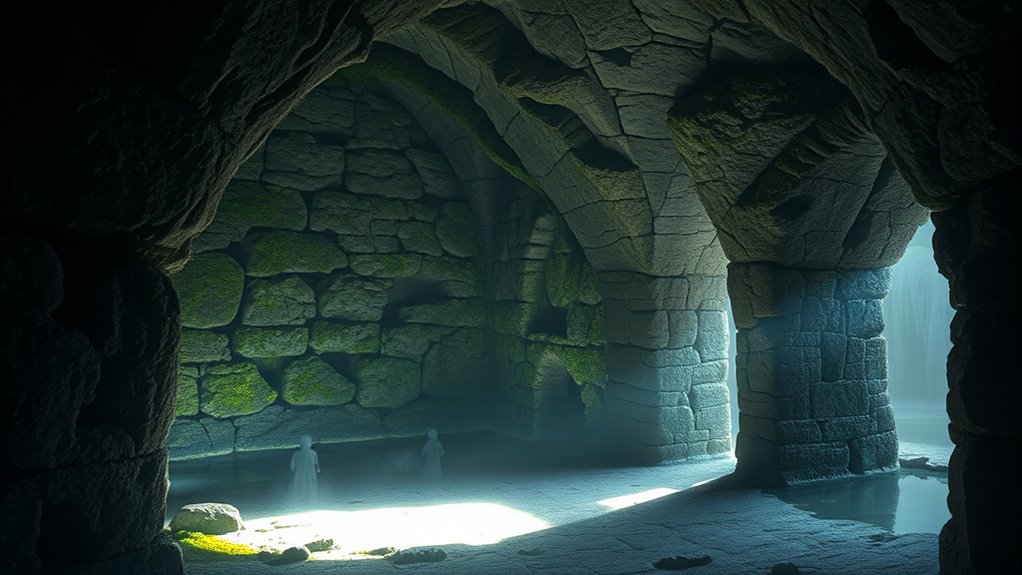
Have you ever wondered if certain locations seem to replay the past like a recording? The Stone Tape Hypothesis suggests that some places can indeed hold onto traces of previous events, almost like an invisible film stored in the environment. This idea hinges on the concept of energy recording, where the environment itself acts as a sort of natural tape recorder. When intense emotions or significant events occur, they leave behind what’s called atmospheric residue—energetic impressions embedded into the surroundings. These residues aren’t physical objects but rather subtle forms of energy that can be reactivated under the right conditions.
According to the hypothesis, when you visit a location with a strong atmospheric residue, you might experience what seem like echoes of the past. These are not ghosts in the traditional sense but are believed to be mental or energetic imprints on the environment. The energy recording process implies that certain environmental factors—like temperature, humidity, or specific vibrations—can cause these residues to be triggered. When this happens, you might see fleeting images, hear sounds, or feel emotions that aren’t actually happening in the present moment. It’s as if the environment itself is playing back a recorded scene, resonating with the stored atmospheric residue.
Visiting places with strong atmospheric residues can evoke echoes of past scenes and emotions.
This theory offers an intriguing explanation for why some places feel haunted or carry a persistent sense of history. It shifts the focus from spirits or supernatural entities to the physical properties of the environment itself. The energy recording process suggests that these residues are created during highly charged moments—such as violent acts, emotional upheavals, or intense celebrations—and then remain embedded in the fabric of the location. Over time, these atmospheric residues can accumulate, making some sites more prone to experiencing these “replays” than others.
Some researchers also consider the role of environmental conditions to be crucial in the energy recording process, as specific factors may enhance or diminish the likelihood of reactivation. Scientists and skeptics often debate whether atmospheric residue really acts like a recording. Still, many paranormal enthusiasts believe that certain environments are more susceptible to these energy recordings because of their history or emotional significance. They argue that, under specific conditions, the environment can act as a kind of natural tape, capturing and replaying moments from the past. Whether or not you buy into the idea of energy recording and atmospheric residue, it’s fascinating to ponder that some places might hold onto the echoes of history, waiting to be triggered again and again.

ERICKHIL Handheld EMF Meter, 5-Level LED Alerts,Ghost Hunting Equipmen
- Wide Range EMF Detection: 30Hz–20kHz detection from appliances to industrial machines
- 5-Level LED Alerts: Color-coded alerts from green to red
- Compact & Lightweight: Only 3.2oz, pocket-sized for portability
As an affiliate, we earn on qualifying purchases.
As an affiliate, we earn on qualifying purchases.
Frequently Asked Questions
What Are the Scientific Criticisms of the Stone Tape Hypothesis?
You might find that critics question the Stone Tape Hypothesis because it lacks solid scientific evidence. They argue that phenomena attributed to electromagnetic or quantum mechanics are better explained by established science, not memory-like recordings. Skeptics say that electromagnetic hypotheses don’t account for the complexity of human perception, and quantum mechanics doesn’t support the idea of residual energy recordings. therefore, the hypothesis remains speculative without rigorous empirical backing.
How Does the Hypothesis Compare to Other Paranormal Theories?
You see, compared to other paranormal theories, the Stone Tape Hypothesis suggests that environmental factors can create energy recordings of past events. Unlike spirit communication or ghost possession ideas, it treats these recordings as physical phenomena, not spirits. This hypothesis emphasizes natural causes, making it more scientific. However, skeptics still question whether energy recordings truly exist or if environmental factors can fully explain haunting experiences.
Are There Any Documented Cases Supporting the Hypothesis?
A picture is worth a thousand words, so you should know some historical case studies and anecdotal reports seem to support the hypothesis. While concrete scientific evidence remains elusive, stories of unexplained recordings in haunted locations are often cited. These accounts suggest that certain environments may “hold” residual energy, aligning with the hypothesis. However, definitive proof continues to be a mystery—like chasing shadows in the dark.
What Are the Psychological Explanations for Supposed “Residual Hauntings”?
You might believe residual hauntings are caused by memory imprinting and emotional residue from past events. Psychologically, these phenomena could be your mind’s way of recreating intense emotions or experiences stored deep in your memory. Stress, grief, or trauma can trigger such impressions, leading you to perceive echoes of the past. Your subconscious might project these residual feelings, creating the illusion of a haunting without any supernatural basis.
Has Modern Technology Proven or Disproven the Hypothesis?
Modern technology hasn’t proven the Stone Tape Hypothesis, nor has it disproven it. You see, technological evidence remains inconclusive, leaving room for scientific skepticism. While some researchers explore electromagnetic fields or thermal imaging, no definitive data supports residual hauntings as recordings stored in walls or stones. You’re left questioning whether these phenomena are truly echoes of the past or just illusions, as science continues to seek answers.
Conclusion
As you consider the Stone Tape Hypothesis, realize it’s like a ghostly echo etched into the fabric of time, waiting to be heard. This idea suggests places can record and replay memories, blurring the line between history and haunting. So, next time you feel a chill in an empty room, remember—you might just be listening to the past whispering back. In this silent symphony, the walls hold stories waiting to be uncovered.