
The Philip Experiment was trying to prove that belief, suggestion, and psychological factors can create convincing illusions of supernatural activity. By creating a fictional spirit called “Philip” and conducting controlled séances, you see how perceptions can be manipulated by subconscious minds and expectations. The experiment aimed to challenge the idea that spirits exist independently of human consciousness. If you’re curious about how this experiment shows the power of the mind, there’s more to uncover.

Get books and cozy reading nights delivered free with Prime
- Fast, free delivery on millions of items
- Prime Video, Amazon Music and more included
- Member-only deals all year
Key Takeaways
- To determine if a fictional spirit could be convincingly created and communicated with through controlled séance conditions.
- To test whether responses attributed to spirits could be generated by subconscious psychological processes.
- To challenge the belief that spirits exist independently outside of human perception and consciousness.
- To explore how suggestion, expectation, and collective belief influence paranormal experiences.
- To demonstrate that perceived supernatural phenomena might be explained by psychological and cognitive factors rather than actual spirits.

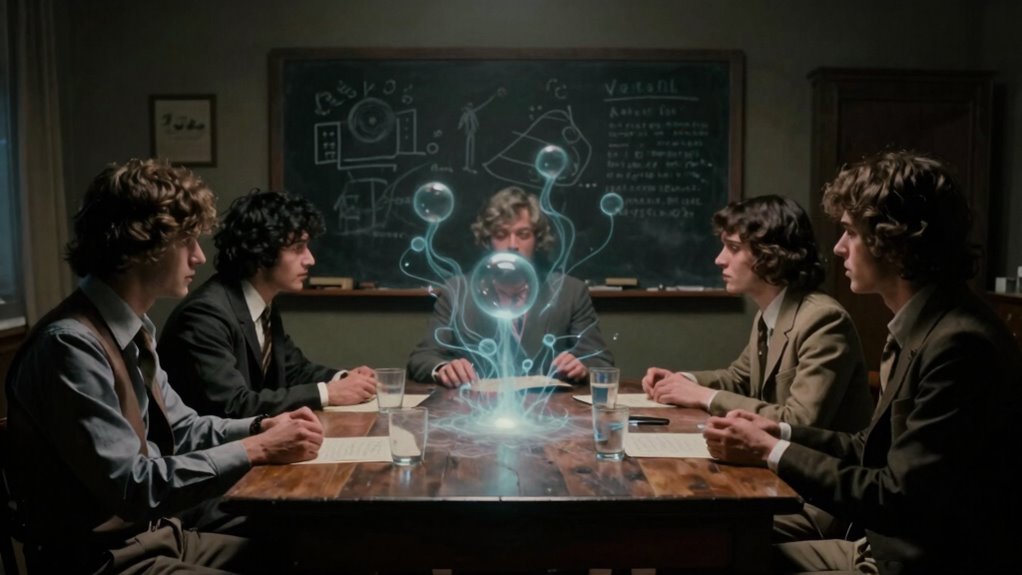
Have you ever wondered why the Philip Experiment was conducted? It all stems from a period marked by intense curiosity about the supernatural and the limits of human perception. In the late 1970s, researchers sought to explore whether the mind could influence physical reality through mental focus alone. This was a time when spiritualism and psychic phenomena had gained popularity, but scientific skepticism still cast doubt on such claims. The historical context is essential here: mainstream science was largely skeptical about the existence of spirits or ghosts, viewing them as psychological illusions or tricks rather than real phenomena. The Philip Experiment emerged within this climate, aiming to test whether a supposed spirit could be conjured and made to communicate under controlled conditions. The experiment was designed with strict scientific principles, reflecting a desire to approach the paranormal with the same rigor as any other scientific inquiry. The researchers created a fictional spirit named “Philip” and crafted a detailed backstory about him. They then attempted to communicate with “Philip” through a séance, carefully documenting every aspect of the process. The goal was to see if the participants’ subconscious minds could conjure responses that appeared to be from a spirit. If successful, this would challenge the widely held belief that spirits or ghosts are independent entities existing outside of human consciousness. The core idea behind the Philip Experiment was to test whether the mind alone could produce phenomena attributed to spirits. To do this, the researchers relied on the power of suggestion and the collective subconscious of the participants. They aimed to determine if the spirit’s responses were genuinely supernatural or simply the product of psychological processes. Throughout the experiment, the team maintained a high level of skepticism, meticulously eliminating any possibility of trickery or external influence. Despite this, the responses generated during séances appeared remarkably consistent with the fictional backstory they had created, which raised questions about the nature of belief and perception. Interestingly, the experiment also highlighted how scientific skepticism can influence interpretations of paranormal phenomena and shape research outcomes. The results demonstrated how powerful psychological processes can be in creating convincing illusions. This aligns with findings from other studies that suggest perception and suggestion play significant roles in paranormal experiences. Additionally, the experiment underscored how belief systems can shape individuals’ experiences of supposed supernatural events, emphasizing the importance of psychological context. This suggests that our perceptions of supernatural phenomena may often be rooted in cognitive biases and mental framing. In essence, the Philip Experiment was trying to prove that what people interpret as supernatural might actually be rooted in psychological phenomena. It sought to challenge the assumptions of spiritualism by demonstrating that the mind could generate convincing illusions of spirits. While skeptics argue that the experiment merely shows how suggestion and expectation influence perceptions, supporters see it as evidence that human consciousness might be capable of more than we typically acknowledge. Overall, the purpose was to explore the boundaries of scientific skepticism and understand whether paranormal phenomena could be psychologically manufactured or truly exist outside our understanding.
Popular right now

Bose QuietComfort Ultra Headphones (2nd Gen), Wireless Noise-Cancelling Over-Ear Headphones with Spatial Audio, Driftwood Sand

Ninja AF181 Air Fryer XL, 6.5 Qt, 6-in-1, Dark Grey

Vitamix Touch & Go Advance 32-Ounce Bar Blender, White
As an affiliate, we earn on qualifying purchases.
Frequently Asked Questions
Did the Philip Experiment Produce Any Definitive Evidence of Spirits?
The Philip Experiment didn’t produce definitive evidence of spirits. You see, it aimed to demonstrate that spirit communication could be simulated through mental focus and collective imagination, not actual contact with spirits. Using experimental methodology, participants believed they were communicating with a ghost, but the results suggested that their responses were driven by subconscious processes or suggestibility. So, while intriguing, it didn’t conclusively prove spirits’ existence.
How Did the Experiment Influence Modern Paranormal Research?
The experiment profoundly influenced modern paranormal research by encouraging scientists to explore spiritual hypotheses and the power of mental suggestion. You see, it demonstrated how focused intent and belief might produce ghostly manifestations, prompting researchers to consider psychological factors alongside traditional supernatural explanations. This shifted the approach from seeking definitive proof of spirits to understanding how human perception and expectation could generate paranormal-like phenomena, consequently advancing scientific inquiry into ghostly manifestations.
Were There Any Similar Experiments Conducted After Philip?
After the Philip Experiment, numerous paranormal methodology studies emerged, with over 50 experiments exploring similar concepts. You might find that researchers refined their experimental design, aiming to better detect or influence spirits. These studies often focused on controlling variables and minimizing bias, echoing the Philip Experiment’s approach. While results varied, these experiments helped shape modern methods, encouraging skeptics and believers alike to explore the paranormal with scientific rigor.
What Were the Skeptics’ Main Criticisms of the Experiment?
Skeptics criticize the Philip Experiment mainly through spiritual skepticism and scientific critique. They argue that the results lack scientific rigor, pointing out the absence of controlled conditions and reproducibility. They also believe the experiment relies on psychological factors like suggestion or wishful thinking rather than genuine paranormal activity. Overall, skeptics see it as an interesting but unconvincing exploration of the supernatural, emphasizing the need for more empirical evidence.
Has the Philip Experiment Been Replicated Successfully?
You might think of the Philip Experiment as a scientific fishing trip, hoping to catch proof of spirits. Regarding historical context, it hasn’t been successfully replicated using the same experimental methodology. Many researchers attempted to reproduce its results, but consistent success remained elusive. Like trying to duplicate a rare recipe, the unique conditions and subjective factors make replication difficult, leaving its true validity still debated today.
Conclusion
So, do you believe that the Philip Experiment truly proved the existence of spirits, or was it a clever illusion? As you reflect on its purpose to demonstrate that the mind can create reality, consider how much remains unknown about the mysteries of the afterlife. Perhaps the experiment challenges us to question what we accept as truth and encourages us to keep searching for answers. After all, isn’t the pursuit of understanding what makes us genuinely human?