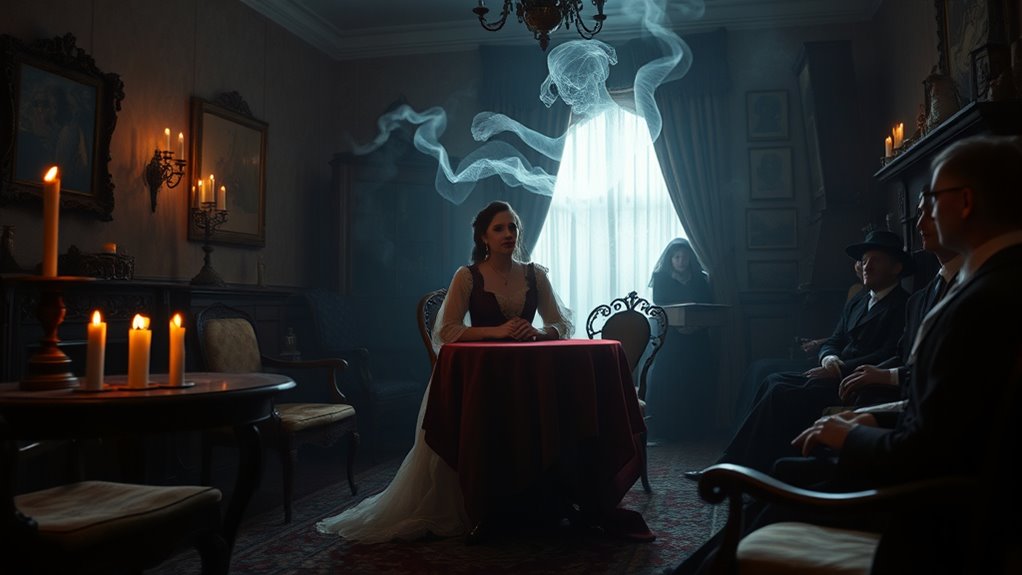

In the 19th century, spiritualism rose amid social upheaval and rapid scientific discoveries, appealing to those seeking connection with the afterlife and answers to life’s mysteries. People believed spirits of the dead could communicate through mediums and séances, offering comfort during uncertain times. Investigations by scientists both exposed frauds and validated some phenomena, fueling ongoing debate. To see how this movement shaped society and beliefs, explore the rich history and sources behind its rise.
Key Takeaways
- Spiritualism emerged in the 19th century, amid social upheaval, scientific advances, and societal shifts seeking connection with the afterlife.
- It focused on mediumship, séances, and trance practices to communicate with spirits, offering comfort during times of change.
- Scientific investigations both validated and debunked spiritualist claims, with notable researchers exposing frauds and recognizing genuine phenomena.
- The movement faced controversy due to widespread deception, but persistent belief and curiosity maintained its influence.
- Publications, media, and cultural narratives helped spread spiritualist ideas and reflect societal questions about mortality and the supernatural.

In the 19th century, spiritualism gained rapid popularity as people sought to connect with the afterlife and explore the mysteries of existence. This movement attracted many who believed that the dead could communicate with the living, offering comfort and answers during a time of social upheaval and scientific discovery. Central to spiritualism were mediumship practices, where individuals claimed to serve as conduits between spirits and the physical world. You might have attended séances, where a medium would attempt to relay messages from loved ones who had passed away. These sessions often involved trance states, automatic writing, or table-rapping phenomena, all designed to demonstrate the presence of spirits. As interest grew, so did skepticism, prompting scientific investigations aimed at understanding and validating these phenomena. Researchers and skeptics alike examined mediums and their methods, sometimes uncovering fraud but also, on occasion, reporting inexplicable events. These investigations played a *vital* role in shaping the public’s perception of spiritualism, highlighting both its potential and its limitations.
During this period, many believed that mediumship practices could reveal hidden truths about life after death, and some claimed to have *passionate* abilities to contact spirits. People flocked to séances, *enthusiastic* to experience contact firsthand, hoping to find closure or reassurance about their loved ones’ well-being in the afterlife. Meanwhile, scientists and skeptics approached these phenomena with a critical eye, conducting experiments to determine whether spirits or other supernatural forces were involved or if trickery was at play. Prominent figures like physicists and psychologists became involved, seeking empirical evidence or debunking false claims. This scientific scrutiny helped distinguish between genuine spiritual experiences and deliberate hoaxes, although it also fueled controversy. Many mediums were exposed as frauds, using hidden wires, secret accomplices, or psychological manipulation to create illusions.
Despite the skepticism, the popularity of spiritualism persisted, fueled by a mixture of genuine belief, curiosity, and the desire for comfort in uncertain times. The movement’s growth was also supported by the publication of numerous books, journals, and newsletters that shared stories of spirit contact and mediumship practices. These sources helped spread ideas and keep the public engaged. Overall, the rise of spiritualism in the 19th century was marked by a complex interplay of faith, scientific inquiry, and societal change. You see it as a reflection of how people grappled with mortality and the unknown — a blend of hope, skepticism, and a search for meaning that continues to influence spiritual and paranormal movements today.
spiritualist mediumship kit
As an affiliate, we earn on qualifying purchases.
As an affiliate, we earn on qualifying purchases.
Frequently Asked Questions
How Did Spiritualism Influence Modern Psychological Theories?
Spiritualism influenced modern psychological theories by highlighting the importance of the mind and unseen influences on mental health. You can see its impact in how psychologists explore consciousness, the subconscious, and the human experience. It encouraged a focus on mental health beyond just physical symptoms, fostering ideas about the mind-body connection. This shift helped shape contemporary approaches to therapy, emphasizing holistic understanding and the importance of mental well-being.
Were There Any Notable Skeptics of 19th-Century Spiritualism?
You’d be surprised, but yes, there were notable skeptics of 19th-century spiritualism. Scientific skepticism and religious opposition teamed up like an awkward tag team, questioning these ghostly claims. Thinkers like Harry Houdini, who scoffed at spiritualist tricks, and scientists like Lord Rayleigh, who demanded empirical proof, stood firm. They exposed the frauds and challenged the movement, proving that not everyone bought into the supernatural hype.
How Did Spiritualism Impact Women’s Roles in Society?
Spiritualism challenged traditional gender roles by empowering women as mediums and spiritual leaders, giving you a platform for greater agency. Women found new ways to express themselves and influence society through these practices, often gaining respect and independence. This movement subtly shifted societal expectations, allowing you to see women as active participants rather than just passive spectators, thereby expanding your understanding of gender roles during that era.
What Technological Advances Facilitated Spiritualist Practices?
Did you know that technological advances like the telegraph and spirit photography revolutionized spiritualist practices? The telegraph allowed mediums to claim they communicated with spirits across distances, adding credibility. Spirit photography, developed in the 1860s, created images of ghosts, mesmerizing audiences worldwide. These innovations made spiritualism more believable and accessible, fueling its rise and expanding its influence across society.
Did Spiritualism Have Any Political or Social Consequences?
Spiritualism considerably impacted society by challenging traditional beliefs and promoting societal acceptance of new ideas. You might recall mediumship scandals that shook public trust, yet they also fueled debates about authenticity and morality. These controversies led to increased scrutiny and, paradoxically, greater acceptance of spiritualist practices. Ultimately, spiritualism shaped social conversations around life, death, and the supernatural, leaving a lasting political and cultural influence.
séance table rapping replica
As an affiliate, we earn on qualifying purchases.
As an affiliate, we earn on qualifying purchases.
Conclusion
As you reflect on the rise of spiritualism, you’ll see it sparked a sensational surge of supernatural seeking and societal shifts. The century’s curious craving for connection, communication, and comfort created a mesmerizing cultural craze. By embracing eerie encounters and enigmatic energies, people sought solace in the mysterious and the mystical. Ultimately, spiritualism’s swift sweep shaped society’s sense of self, sparking stories, skepticism, and a lasting legacy of longing for the beyond.
automatic writing journal for spiritualism
As an affiliate, we earn on qualifying purchases.
As an affiliate, we earn on qualifying purchases.
spirit communication tools
As an affiliate, we earn on qualifying purchases.
As an affiliate, we earn on qualifying purchases.