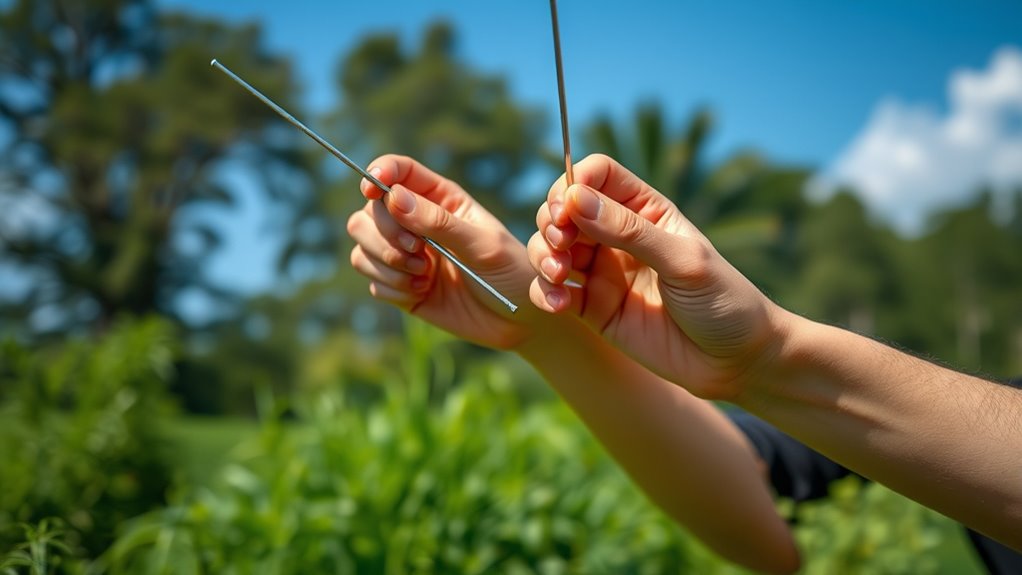

To critically evaluate dowsing rods, start by setting up a blind test where underground features are unknown to you. Keep detailed records of each attempt, noting whether the rods indicate locations and how accurate those are. Play close attention to environmental influences or subconscious cues that might affect responses. Question all results that seem too good to be true, and compare your findings to what random chance would produce. If you keep these steps in mind, you’ll gain insight into their reliability and limitations.
Key Takeaways
- Conduct blind, controlled tests where underground features are unknown to evaluate dowsing accuracy.
- Record each attempt meticulously, noting locations guessed and actual underground features for analysis.
- Use multiple trials and statistical methods to determine if success exceeds chance levels.
- Consider environmental influences, such as electromagnetic interference, that may affect dowsing responses.
- Maintain a skeptical, evidence-based approach, recognizing that scientific consensus dismisses dowsing as unreliable.

Dowsing rods have long been used as tools for locating underground water, minerals, or hidden objects, but approaching their use with analytical thinking is essential. When you engage in dowsing, it’s important to recognize the role of scientific skepticism, which urges you to question claims and seek solid evidence before accepting any results. Relying solely on intuition or tradition can lead you astray, so you need to evaluate evidence carefully. Before conducting a session, set aside any preconceived notions or expectations that might influence your responses. This helps you maintain objectivity and prevents confirmation bias from skewing your perceptions.
Once you’re ready to test your dowsing rods, establish a controlled environment. Perform a series of blind tests where you don’t know the location of underground water or objects beforehand. This allows you to assess whether your responses are genuinely accurate or simply coincidental. During the process, focus on evidence evaluation—determine whether the results consistently align with actual underground features or if they’re random. Keep detailed records of each attempt, including where you think water or objects are located and whether your guesses are correct. This data is essential for analyzing the reliability of your dowsing.
As you proceed, remain skeptical of any results that seem too good to be true. If your dowsing rods appear to “find” water or objects, ask yourself: could there be alternative explanations? Environmental factors such as electromagnetic interference, subconscious cues, or chance might be influencing your responses. It’s important to scrutinize your results critically and consider whether your observations are statistically significant or just luck. If your results are inconsistent or fail to outperform random chance, it’s a clear sign that your methods lack scientific support.
Additionally, understanding the scientific consensus that dowsing lacks a scientific basis helps you approach your practice with informed skepticism. Throughout this process, continue to educate yourself about the scientific consensus regarding dowsing. Many studies have shown that dowsing lacks a scientific basis, and its success rate often aligns with chance. By applying scientific skepticism and evidence evaluation, you protect yourself from falling into pseudoscientific traps. Remember, critical thinking isn’t about dismissing your experiences outright but about objectively analyzing whether your methods yield reliable, repeatable results. Combining these principles with your practice allows you to approach dowsing as a rational inquiry rather than a mystical art, helping you make more informed decisions about its validity.
Frequently Asked Questions
Can Dowsing Rods Detect Underground Water Reliably?
Dowsing rods can’t reliably detect underground water, despite historical myths and cultural perceptions suggesting otherwise. Many scientific studies show that their success is often due to chance or the subconscious movements of the user, not any actual ability to locate water. You might see people trusting these tools, but evidence doesn’t support their effectiveness. Rely on more proven methods like geological surveys for accurate water detection.
Are Dowsing Rods Scientifically Proven to Work?
You’re not imagining things—scientific skepticism strongly suggests dowsing rods lack proven reliability. Numerous experiments, with rigorous experimental validation, show they don’t reliably detect underground water or minerals. Despite centuries of use, there’s no scientific proof they work better than chance. So, while some swear by them, you should approach dowsing with skepticism, knowing that current scientific evidence doesn’t support their effectiveness.
How Do Personal Beliefs Influence Dowsing Results?
Your personal beliefs considerably influence dowsing results through belief bias and confirmation tendency. If you strongly believe in dowsing’s effectiveness, you’re more likely to interpret subtle rod movements as accurate signals, reinforcing your confidence. Conversely, skepticism can cause you to dismiss genuine cues. These subconscious biases shape your perceptions, making it essential to remain aware of how your beliefs might skew your interpretation of dowsing outcomes.
What Are Common Mistakes When Using Dowsing Rods?
Nearly 60% of dowsers make common mistakes, like falling for confirmation bias or using improper technique. You might unknowingly influence your rods with expectations or move them too quickly, leading to false signals. To avoid this, stay neutral, focus on steady movements, and question your assumptions. Recognizing these pitfalls helps guarantee your dowsing is more accurate and less biased, giving you clearer, more reliable results.
Can Dowsing Rods Be Used for Purposes Other Than Water Detection?
Yes, you can use dowsing rods for purposes beyond water detection, especially in divination practices and exploring historical applications. People have historically used them to locate minerals, lost objects, or even spiritual insights. While scientific support is limited, many trust their intuitive guidance during these practices. Just remember to stay open-minded and critically evaluate their effectiveness, recognizing their role in cultural and historical contexts rather than as definitive tools.
Conclusion
Remember, dowsing rods are like a compass in a fog—they can guide you, but they don’t guarantee clarity. I once met a water seeker who trusted his rods blindly and dug dozens of false wells before realizing patience and scientific methods were more reliable. Stay skeptical and use critical thinking; don’t let hope lead you astray. When tools become blinders, it’s time to step back and ask: is this the right path?