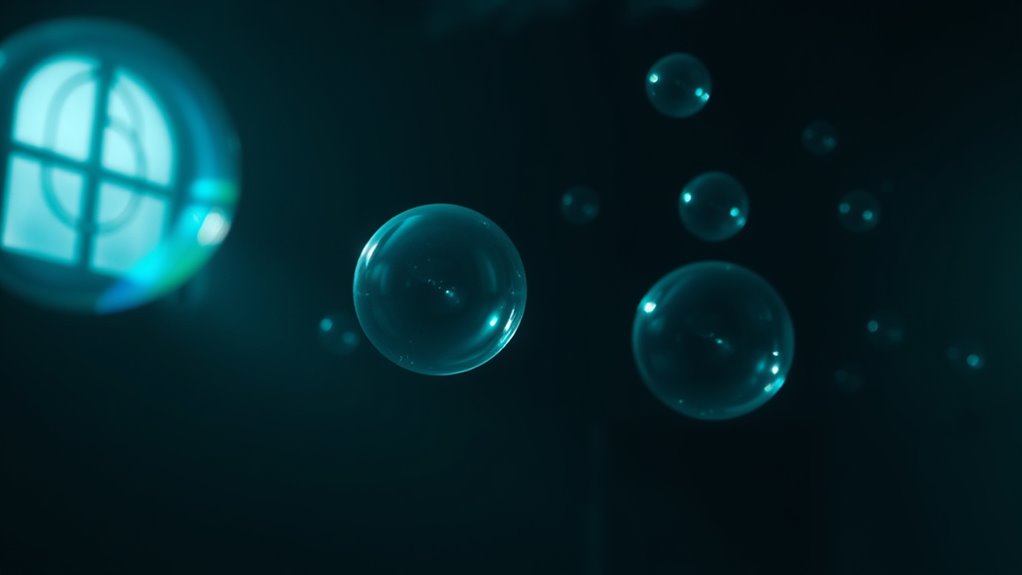

Many believe that orbs in photos prove spirits are nearby, but most are just reflections from dust, insects, or moisture caught by your camera’s flash or bright light. Environmental factors and camera settings often create these bright, round shapes that mislead you into thinking they’re paranormal. Understanding these natural causes helps you distinguish myth from reality. If you keep exploring, you’ll find out how science explains these mysterious-looking orbs and separates fact from fiction.
Key Takeaways
- Orbs are commonly mistaken for spirits but are often caused by dust, insects, or moisture reflecting camera flash.
- Modern camera settings and environmental factors can create or exaggerate orb appearances, not paranormal activity.
- Scientific explanations view orbs as optical illusions or camera artifacts, not proof of spirits.
- Critical analysis of images helps distinguish natural causes from alleged supernatural phenomena.
- Recognizing natural origins enhances credibility and prevents misinterpretation of orbs as proof of spirits.
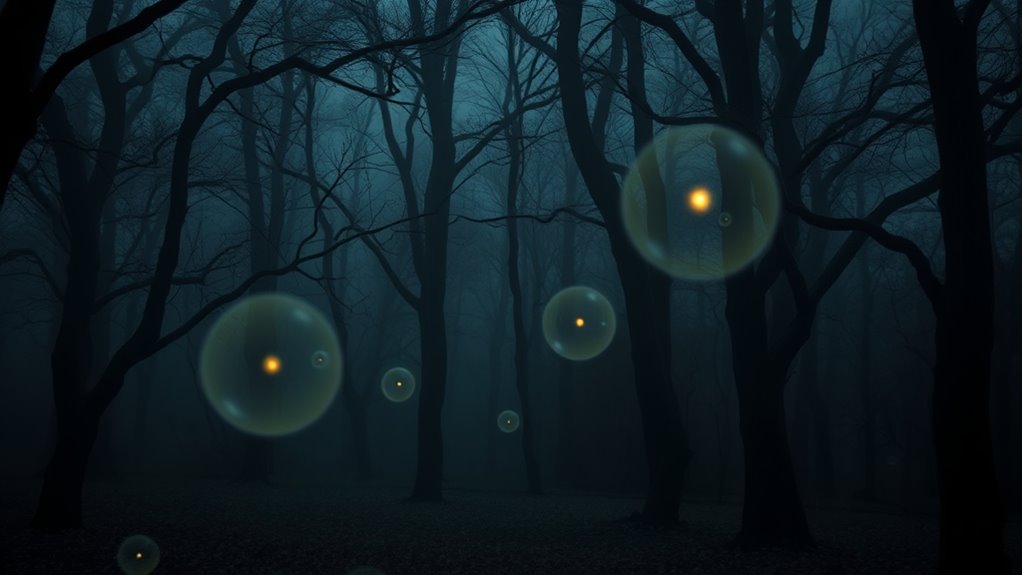
Many people believe that glowing orbs caught on camera are clear evidence of spirits, but the truth is more complicated. When you’re involved in ghost hunting, you often focus on capturing any anomalies that might point to supernatural activity. One of the most common phenomena reported are orbs—small, glowing circles that appear in photographs or videos. These orbs are frequently interpreted as spirits or ghostly energy, but in reality, understanding what you’re seeing requires a closer look at camera technology and the conditions under which these images are captured.
Many orbs are natural reflections, not spirits, resulting from dust, insects, or moisture captured by cameras.
The truth is that many orbs are just a result of mundane causes, like dust particles, insects, or moisture. When your camera’s flash or bright light hits these tiny particles, it creates a reflection that appears as a bright, round shape. Modern camera technology, especially digital cameras with high sensitivity, can easily pick up these reflections, making them look more mysterious than they really are. As you engage in ghost hunting, it’s important to deliberate the environment and the specific settings of your camera. For example, cameras with a short exposure time are less likely to capture orbs caused by dust or insects because they aren’t lingering long enough to be recorded. Conversely, long exposure shots can exaggerate these reflections, making them look like floating orbs.
Many paranormal enthusiasts rely on the assumption that orbs are spirits because they seem to appear in places with a history of ghost activity. However, scientific explanations suggest that orbs are more likely to be artifacts of camera technology. These artifacts happen when tiny particles close to the lens reflect the camera’s flash or light source. This is especially true in environments with poor lighting or high dust levels, where particles are abundant. As you continue your ghost hunting, it’s essential to analyze these images critically. Don’t jump to conclusions just because an orb appears in a photograph; instead, ponder other explanations such as environmental factors and camera settings.
Understanding the limitations of your camera technology can help you avoid misinterpretation. While it’s tempting to see orbs as proof of spirits, many are simply optical illusions or reflections. By paying attention to the conditions during your investigation, you can differentiate between genuine paranormal activity and natural causes. Recognizing that environmental factors and camera settings influence what you capture allows you to approach ghost hunting with a more analytical mindset, separating myth from reality. Ultimately, the science behind camera technology shows that orbs are often more about the environment and equipment than ghosts.
dust and insect camera lens cleaner
As an affiliate, we earn on qualifying purchases.
As an affiliate, we earn on qualifying purchases.
Frequently Asked Questions
Can Orbs Be Captured in Professional Photography Settings?
Yes, orbs can be captured in professional photography settings, often caused by lens flare or dust particles close to the lens. When you take photos, reflections from light or tiny dust in the air can create circular or orb-like shapes. These are not proof of spirits but rather optical phenomena. To minimize orbs, clean your lens regularly and avoid direct bright light sources during shots.
Are There Scientific Explanations for Orb Appearances in Photos?
Think of orb appearances as sneaky actors on a stage. Scientifically, they’re often just photography artifacts caused by dust, moisture, or insects, and environmental interference like flash reflections. These factors create bright spots or circles that look like orbs. So, yes, there are clear scientific explanations behind orb appearances in photos, and understanding these can help you distinguish between genuine phenomena and camera tricks.
Do Specific Camera Settings Influence Orb Detection?
Yes, your camera settings, like focus and lens quality, influence orb detection. If your focus isn’t sharp or your lens has imperfections, you’re more likely to capture orbs that may be caused by dust, moisture, or lens flare. Using a high-quality lens reduces unwanted artifacts, and adjusting focus properly guarantees clarity. Keep these settings in mind to improve your chances of capturing genuine images without misleading orb appearances.
How Do Different Lighting Conditions Affect Orb Visibility?
Lighting influence markedly impacts orb visibility. In dim or low-light conditions, orbs are easier to spot because they stand out against darker backgrounds. Bright or uneven lighting can cause reflections or lens flare, which might be mistaken for orbs. Visibility factors include light source intensity, direction, and ambient light levels. Adjusting your lighting conditions carefully helps you better observe orbs, reducing false positives and ensuring more accurate detection.
Can Orbs Be Caused by Environmental Factors Rather Than Spirits?
You might be surprised to learn that over 80% of orb sightings are caused by environmental interference or camera artifacts. These include dust, pollen, or moisture, which reflect light and create orbs in photos. Camera reflections or lens flare can also produce similar effects. So, rather than spirits, most orbs are just the result of natural environmental factors and technical glitches in capturing images.
digital camera with low light settings
As an affiliate, we earn on qualifying purchases.
As an affiliate, we earn on qualifying purchases.
Conclusion
So, now you see that orbs are often more myth than proof of spirits. Don’t jump to conclusions without evidence—sometimes, the simplest explanation is the right one. Keep your eyes open and question what you see; not everything that glitters is gold. Remember, just because something looks spooky doesn’t mean it’s haunted. Stay curious, but also stay grounded. After all, sometimes the best way to see the truth is to look beyond the surface.
long exposure camera for astrophotography
As an affiliate, we earn on qualifying purchases.
As an affiliate, we earn on qualifying purchases.
camera flash diffuser
As an affiliate, we earn on qualifying purchases.
As an affiliate, we earn on qualifying purchases.