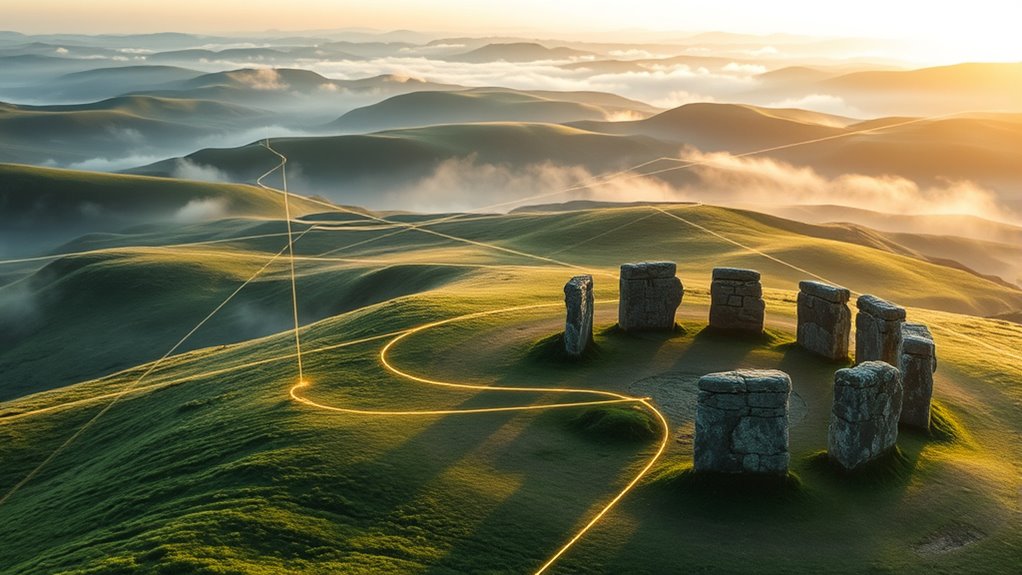

Ley lines are proposed energy pathways that connect sacred sites and ancient structures, suggesting humans once understood Earth’s subtle energies. While some believe these alignments enhance spiritual, cultural, or healing powers, many skeptics see them as patterns formed by coincidence or human bias. The debate continues over whether ley lines are real energy grids or symbolic paths of cultural significance. If you keep exploring, you’ll uncover more about the fascinating ideas and arguments behind these mysterious alignments.
Key Takeaways
- Ley lines are theorized alignments of ancient sacred sites and natural features, suggesting Earth’s energy pathways.
- They are historically linked to important monuments like Stonehenge and the Pyramids, implying intentional alignments.
- Critics argue that ley lines are patterns formed by confirmation bias and lack scientific evidence.
- Mystics believe ley lines influence health, spiritual energy, and earth stability, fueling cultural fascination.
- The debate continues, with some viewing ley lines as symbolic patterns and others seeking scientific validation.
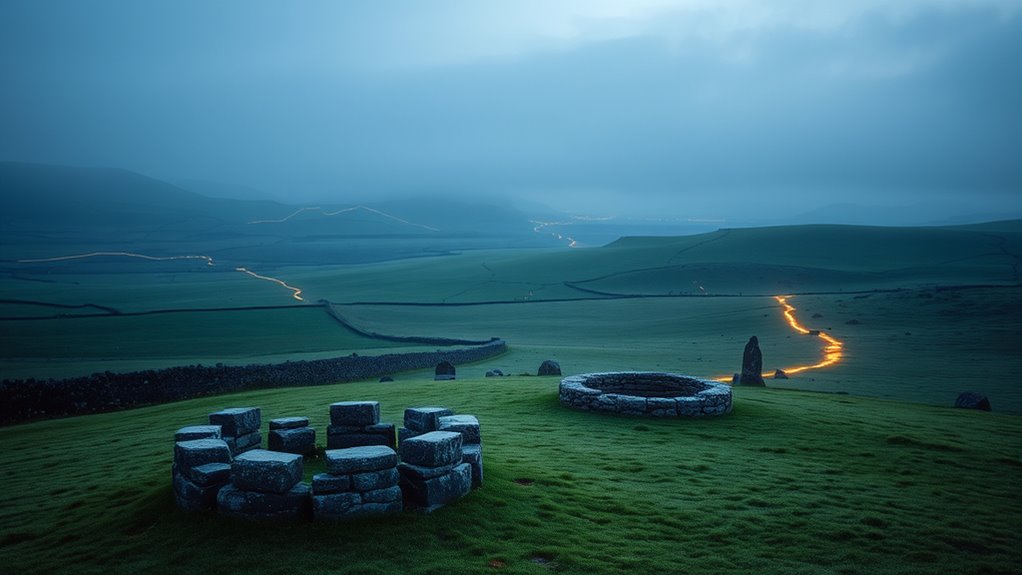
Have you ever wondered if certain lines of energy crisscross the Earth, connecting ancient sites and natural landmarks? This idea lies at the heart of ley lines—a concept suggesting that straight alignments of sacred sites, megalithic structures, and natural features form a network of energy pathways across the landscape. Proponents believe these lines aren’t just accidental alignments but represent an intricate system of energy grids that ancient civilizations intentionally built upon or aligned with. They argue that many ancient cultures, from the Egyptians to the Celts, understood and harnessed these energy pathways for spiritual, ceremonial, or practical purposes. This belief lends a layer of historical significance to ley lines, implying that our ancestors possessed a deeper understanding of the Earth’s subtle energies, which they incorporated into their sacred architecture and landscape planning.
However, the idea of energy grids connected by ley lines isn’t universally accepted. Skeptics point out that many of these alignments are based on selective interpretations of geographic features and archaeological sites. They argue that the perceived patterns often result from confirmation bias—seeing connections where none were intentionally designed. To them, ley lines are more a product of human pattern recognition than a reflection of actual energy flows. Despite this skepticism, the historical significance of many ancient sites aligned along these supposed lines cannot be dismissed. Sites like Stonehenge, the Pyramids of Giza, and the Chartres Cathedral are often said to be situated along ley lines, which some believe enhances their spiritual and cultural importance. These alignments, real or perceived, have inspired countless theories about ancient knowledge and the Earth’s hidden energies. Additionally, some researchers explore the mystical significance of these site alignments, adding to the intrigue and debate surrounding ley lines.
The debate intensifies when discussing what these energy grids might mean today. Some see ley lines as a mystical network that can influence health, well-being, or even the earth’s stability. Others view them as cultural artifacts—testaments to humanity’s desire to find meaning and connection in the landscape. Regardless of one’s stance, the enduring fascination with ley lines speaks to a universal desire to understand the unseen forces shaping our world. Whether regarded as literal energy pathways or symbolic patterns, they continue to inspire exploration, debate, and curiosity about the profound relationship between humans and the Earth’s ancient landscape.

Earth Grids: The Secret Patterns of Gaia's Sacred Sites (Wooden Books North America Editions)
As an affiliate, we earn on qualifying purchases.
As an affiliate, we earn on qualifying purchases.
Frequently Asked Questions
How Do Ley Lines Influence Modern Urban Planning?
You might notice that ley lines influence modern urban development by guiding landscape integration and city planning. Some planners consider these alignments when designing parks, roads, or buildings to create harmonious connections with natural features. Though scientific support is limited, these lines inspire aesthetic choices, aiming to blend urban spaces with the environment. By doing so, they foster a sense of continuity and balance in city landscapes, enhancing overall urban experience.
Are There Scientific Explanations for Ley Line Phenomena?
There are no solid scientific explanations for ley line phenomena. Some geophysical theories suggest that natural features like fault lines or magnetic anomalies might align with ley lines, but evidence remains inconclusive. Energy field hypotheses propose that these lines could be connected to human perception or electromagnetic fields, yet scientific research hasn’t validated these ideas. Overall, ley lines lack empirical support and are considered more myth or folklore than scientific fact.
Which Cultures Historically Recognized Ley Lines or Similar Concepts?
You’ll find that ancient cultures like the Chinese, Egyptians, and Celts recognized ley lines or similar concepts. They believed these alignments had mythical origins and held cultural significance, often linking sacred sites or spiritual power. For example, Chinese feng shui emphasizes energetic alignments, while the Celts regarded certain land features as spiritually important. These traditions show how different societies valued the idea of mystical or energetic pathways across the land.
Can Ley Lines Be Used for Spiritual Healing Practices?
Yes, you can use ley lines for spiritual healing practices. Many believe that energy healing and spiritual rituals performed along ley lines can enhance their effectiveness, as these lines are thought to channel natural earth energies. By aligning your intentions with these energetic pathways, you might experience deeper connections and healing. Incorporate meditation or rituals while focusing on specific ley lines to amplify your spiritual practices and promote well-being.
What Are the Most Famous Ley Line Alignments Worldwide?
You’ll find the most famous ley line alignments worldwide connect ancient site alignments like Stonehenge, the Pyramids of Egypt, and the Great Wall of China. These mystical energy pathways are believed to link significant historical and spiritual sites, creating a network that some say channels Earth’s energy. Exploring these alignments reveals a fascinating blend of archaeology and mysticism, inviting you to contemplate how ancient peoples might have perceived Earth’s hidden energetic grid.
Sacred site alignment compass
As an affiliate, we earn on qualifying purchases.
As an affiliate, we earn on qualifying purchases.
Conclusion
Remember, the truth often lies somewhere between fact and fiction. While ley lines captivate your imagination and spark fascinating debates, keep an open mind and question what you hear. As the saying goes, “Don’t believe everything you see or hear,” because sometimes the most intriguing stories are the ones you create yourself. Whether you believe in them or not, exploring these ideas reminds you that curiosity is the true gateway to understanding the mysteries around you.

Anima Premium 7 Chakra Healing Crystals Set for Energy Alignment – Large Raw Amethyst, Rose Quartz, Citrine, Lapis Lazuli, Clear Quartz, Tigers Eye & Red Jasper – Wooden Gift Box & Guidebook Included
NATURAL HEALING CRYSTALS – From Brazil to Madagascar each raw crystal carries Earth’s elemental power. Hand-chosen and energetically…
As an affiliate, we earn on qualifying purchases.
As an affiliate, we earn on qualifying purchases.
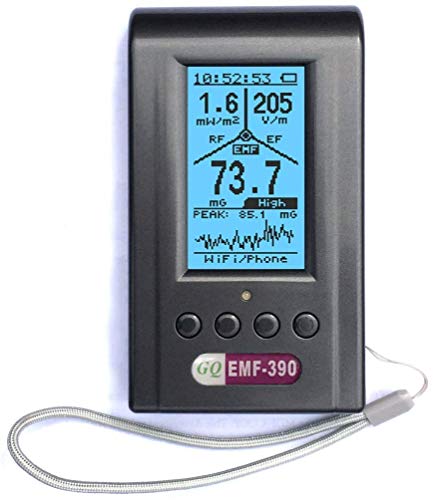
EMF Meter,Advanced GQ EMF-390 Multi-Field Electromagnetic Radiation 3-in-1 EMF ELF RF meter, 5G Cell Tower Smart meter Wifi Signal Detector RF up to 10GHz with Data Logger and 2.5Ghz Spectrum Analyzer
Multiple high sensitivity sensors installed for detecting Power line, Smart meter, Cell phone, Microwave etc.
As an affiliate, we earn on qualifying purchases.
As an affiliate, we earn on qualifying purchases.