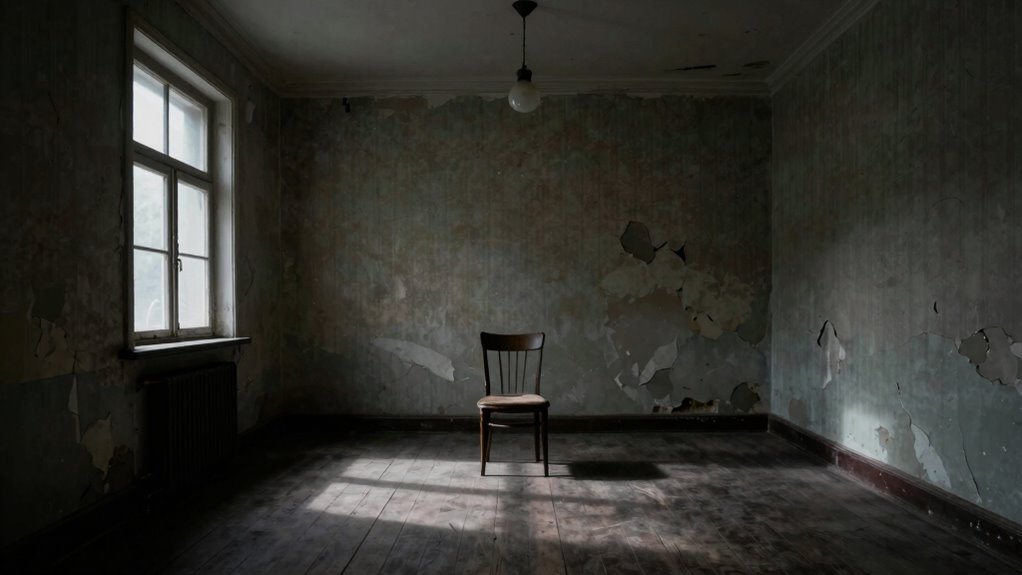
Feeling watched in empty rooms often comes from your brain’s natural tendency to detect faint environmental cues, like shadows or sounds, which may suggest potential threats. When you’re anxious or alert, your senses sharpen, making you more sensitive to these subtle signals. This heightened perception can cause you to interpret harmless stimuli as suspicious or alarming. Understanding how your emotional state influences this perception can help reduce paranoia—if you want to learn more, there’s much more behind this phenomenon.
Key Takeaways
- Perception of being watched often results from heightened sensitivity to subtle environmental cues, influenced by evolutionary survival mechanisms.
- Emotional states like anxiety amplify awareness of minor sounds or movements, increasing feelings of paranoia.
- The brain automatically interprets ambiguous cues, such as shadows or creaks, as potential threats, especially in vulnerable states.
- Heightened alertness in empty rooms intensifies sensory processing, making harmless cues seem more threatening.
- Past experiences and emotional sensitivity shape how individuals interpret environmental cues, fueling the sensation of being watched.

Have you ever felt uneasy or watched in an empty room, even when no one else is around? That sensation is more common than you might think, and it often stems from your brain’s response to subtle signals and environmental cues. Your mind is wired to detect potential threats, which means that even the faintest signs of movement or unusual silence can set off paranoia triggers. These triggers are automatic reactions designed to keep you alert, but they can also lead to feelings of being watched when there’s no real reason for concern.
Environmental cues play a significant role in shaping this perception. For example, shadows shifting in the corner of your eye, the faint creak of the floorboards, or the slight flicker of a light can all be misinterpreted as signs of someone nearby. Your brain constantly processes these cues, trying to determine whether they’re harmless or threatening. When your senses pick up on ambiguous or unfamiliar cues, your mind might fill in the gaps with imagined scenarios—like the idea that you’re being monitored. This tendency is rooted in evolution; our ancestors needed to be hyper-vigilant to survive, so your brain is still wired to respond to uncertainty with heightened alertness. Evolutionary adaptation has shaped our tendency to be hyper-aware of environmental signals, especially in moments of solitude.
Paranoia triggers can also be influenced by your emotional state. If you’re feeling anxious or stressed, your sensitivity to environmental cues amplifies. Small noises or shadows become more threatening, and your mind is more prone to assume the worst. In these moments, the feeling of being watched intensifies because your brain is interpreting neutral cues through a lens of suspicion. In fact, research shows that emotional states can significantly alter perception and increase the likelihood of experiencing paranoia. Even in the absence of external threats, your mind might create a sense of paranoia, making the environment feel more dangerous than it actually is. This is further compounded by the way our brains interpret environmental cues, which can be heightened when we’re in a state of heightened alertness or vulnerability. Recognizing how brain responses are influenced by our emotional and physical states can help you better understand these perceptions. Additionally, understanding the role of sensory processing can shed light on why these perceptions occur even without external stimuli.
As an affiliate, we earn on qualifying purchases.
Frequently Asked Questions
How Does Lighting Affect the Sensation of Being Watched?
Lighting influences your feeling of being watched by creating ambient illumination and shadow play. Bright, even lighting can reduce your sense of vulnerability, making you feel less observed. Conversely, dim or uneven lighting with shadows can heighten your awareness of unseen observers, intensifying the sensation of being watched. Shadows cast in empty spaces trick your mind into perceiving movement or presence, amplifying your discomfort and suspicion.
Can Personal Experiences Influence the Feeling of Surveillance?
Yes, your personal experiences can influence how you feel about surveillance. If you’ve faced privacy concerns or social anxiety before, you might be more sensitive to the feeling of being watched, even in empty rooms. These experiences shape your perception, making you more prone to discomfort or paranoia when sensing surveillance. Your background fundamentally primes you to interpret certain cues as intrusive, heightening the sensation of being monitored.
Are Certain Personality Types More Prone to Feeling Watched?
Yes, certain personality traits and anxiety disorders make you more prone to feeling watched. If you’re naturally more anxious, cautious, or suspicious, you might be more sensitive to perceived surveillance. People with anxiety disorders often experience heightened alertness and paranoia, increasing the likelihood of feeling watched even in empty rooms. Your tendencies toward vigilance and worry amplify these sensations, making you more susceptible to the psychological effects of perceived observation.
How Do Cultural Differences Impact Perceptions of Surveillance?
Cultural differences deeply shape your perception of surveillance. In some cultures, strict privacy expectations and cultural norms foster feelings of freedom, while others emphasize collective oversight, making you more aware of being watched. These norms influence how comfortable you feel in empty rooms or public spaces, affecting your sense of security and privacy. Understanding these cultural cues helps you grasp why perceptions of surveillance vary across societies, impacting your emotional and social experiences.
Does the Feeling of Being Watched Vary Across Age Groups?
Yes, your feeling of being watched varies across age groups. As a child, peer influence and childhood memories shape your sensitivity to surveillance, making you more aware or anxious. Teens and young adults often feel more scrutinized due to social media and peer judgments. As you age, you might become less affected, relying more on personal experiences than external cues. Your perception evolves with your social context and life stage, influencing your sense of being observed.
Conclusion
Next time you walk into an empty room and feel that prickling sensation, remember you’re not alone in that fear. It’s like walking through a silent forest where every rustle makes your heart race—your mind’s way of staying alert. That feeling of being watched taps into primal instincts, reminding you that even in silence, your senses are on guard. Embrace it as a sign of your mind’s incredible ability to protect you, even in the quietest moments.