

Random event generators (REGs) produce outcomes based on quantum fluctuations—tiny, spontaneous energy changes in empty space that are truly unpredictable. These fluctuations serve as ideal sources of randomness, essential for psi research and experiments. To guarantee accuracy, you need to regularly calibrate and test the devices for biases, which can skew results. Understanding how quantum phenomena create genuine randomness helps you interpret data confidently; if you keep exploring, you’ll uncover more about how these processes support scientific investigations.
Key Takeaways
- REGs utilize quantum fluctuations, inherently unpredictable phenomena, as sources of true randomness crucial for psi research.
- Quantum uncertainty ensures outcomes from REGs are fundamentally random, minimizing predictable biases.
- Systematic biases from device imperfections and environmental factors can skew data, requiring calibration and control measures.
- Rigorous testing and statistical analysis are essential to distinguish genuine anomalies from artifacts or biases.
- Proper implementation and bias mitigation in REGs strengthen the validity of findings related to mind-influenced or non-local effects.
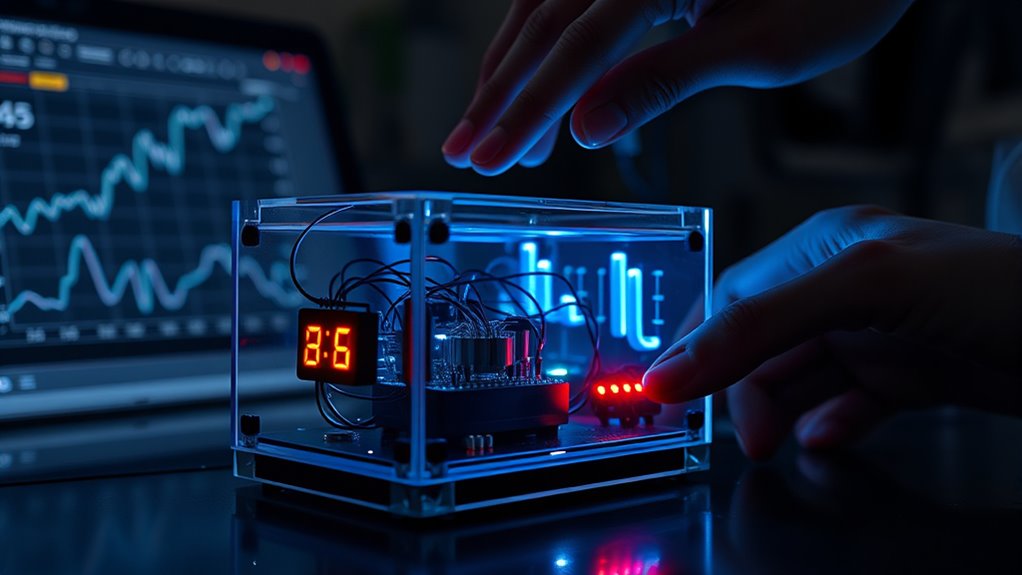
Random event generators (REGs) are devices that produce outcomes based on inherently unpredictable processes, often used in scientific research and decision-making. At their core, REGs rely on physical phenomena that are believed to be fundamentally random, providing a basis for understanding complex systems or exploring phenomena like consciousness and psi effects. One of the key scientific principles behind many REGs involves quantum fluctuations—minute, spontaneous changes in energy levels that occur in empty space. These fluctuations are considered truly random because they originate from quantum uncertainty, making them ideal sources for generating unpredictable data.
However, even with quantum phenomena at play, some researchers are concerned about statistical biases that can influence results. Statistical biases are systematic errors that skew outcomes away from true randomness. For example, slight imperfections in the device’s construction, environmental influences like temperature or electromagnetic interference, or even measurement techniques can introduce biases. When these biases creep in, they threaten the integrity of experiments, especially in psi research, where detecting subtle effects is vital. If an REG’s output is subtly biased, it might produce patterns that seem meaningful but are actually artifacts of the device or environment.
To combat these issues, scientists carefully calibrate and test REGs to identify and minimize biases. They often run thousands of trials, analyzing the data to guarantee that no consistent pattern emerges beyond what random chance would produce. Advanced statistical techniques help distinguish genuine anomalies from artifacts caused by biases. Still, it’s essential to recognize that no physical device is perfect—quantum fluctuations themselves can be influenced by technical noise, and environmental factors are hard to eliminate completely.
In psi research, where the goal is to detect non-local or mind-influenced effects, understanding the interplay between quantum fluctuations and statistical biases becomes even more vital. Researchers must assure that the generated randomness isn’t compromised by hidden biases or systemic errors. This involves rigorous control conditions, blind protocols, and repeated validation to confirm that any observed deviations are not simply the result of biased data or flawed randomness. Ultimately, acknowledging the role of quantum fluctuations and diligently addressing statistical biases allows you to better interpret results from REGs and assess claims of psi phenomena with greater scientific rigor.
Frequently Asked Questions
How Do Random Event Generators Differ From Traditional Measurement Tools?
Random event generators differ from traditional measurement tools because they rely on quantum randomness, producing unpredictable outputs based on subatomic particles. Unlike traditional instruments, they can be influenced by measurement bias, which may skew results. You can use them to explore phenomena like psi effects, but keep in mind that their reliance on quantum processes makes their data uniquely sensitive, requiring careful analysis to distinguish genuine signals from noise.
Can External Factors Influence the Output of a Random Event Generator?
Yes, external factors can influence the output of a random event generator. Environmental noise, like electromagnetic interference or vibrations, can cause fluctuations in results. Additionally, improper device calibration may lead to biased or inconsistent data. To minimize these effects, you should guarantee your device is well-calibrated and operated in a controlled environment, reducing external influences and improving the reliability of your measurements.
What Are the Limitations of Current Random Event Generator Technologies?
You might think random event generators are perfect, but measurement bias and technological constraints limit them. They struggle with precision, making it hard to distinguish true psi effects from noise. Advanced algorithms and better hardware could fix this, but current tech still faces significant hurdles. So, as impressive as they seem, these devices aren’t foolproof—revealing that science still has a way to go in mastering randomness.
How Reliable Are Random Event Generators in Psi Experiment Replication?
You can’t fully rely on random event generators in psi experiment replication because their statistical validity varies across studies. While they help control experimental variables, inconsistent results often challenge their reliability. You should consider factors like experimental controls and data analysis methods, which influence outcomes. Recognizing these limitations guarantees you interpret findings cautiously, understanding that current technology alone can’t assure definitive evidence of psi phenomena.
Are There Ethical Concerns Related to Using Random Event Generators in Research?
Yes, there are ethical concerns when using random event generators in research. You need to address privacy concerns, ensuring participants’ data stays confidential. Consent issues are also vital; you must inform participants about how their data will be used and get their explicit agreement. Failing to do so can compromise ethical standards, making it essential for you to prioritize transparency and respect participants’ rights throughout the study.
Conclusion
As you explore the science behind random event generators, remember that studies have shown people can influence these devices beyond chance levels, with some experiments reporting success rates of around 55%. While it might seem small, that 5% increase suggests there’s more at play than pure randomness. This intriguing statistic invites you to keep questioning and exploring the mysterious connection between mind and matter, opening new doors in psi research and understanding.