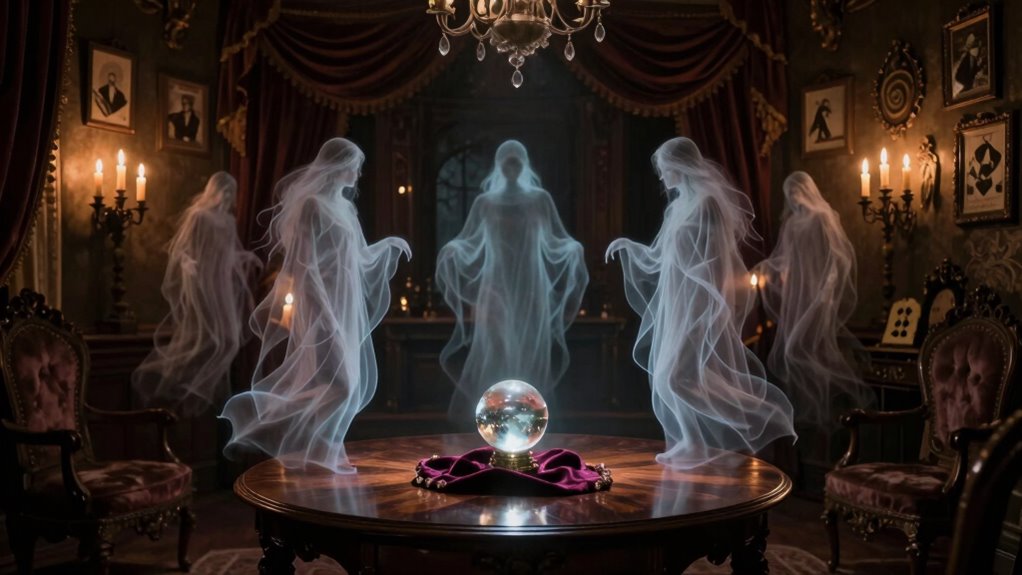

In the 1800s, spiritualism changed how you see the paranormal by making contact with the dead more mainstream. Seances, mediums, and supernatural phenomena became social and cultural norms, which blurred the line between the living and the dead. People believed these experiences were proof of an afterlife, influenced by media and spiritualist writings. Scientific investigations also aimed to prove or disprove these claims, shaping future views on the unseen world. If you’re curious, there’s much more to uncover.
Key Takeaways
- Spiritualism popularized seances, making contact with spirits a social and cultural phenomenon.
- Mediumship and paranormal phenomena gained mainstream acceptance through media and spiritualist churches.
- Scientific investigations into spiritualist claims fostered credibility and ongoing debates about genuine paranormal abilities.
- Techniques developed for spiritual communication influenced future methods and perceptions of the supernatural.
- Spiritualism challenged traditional religious views, reshaping beliefs about life, death, and the existence of an unseen spiritual realm.
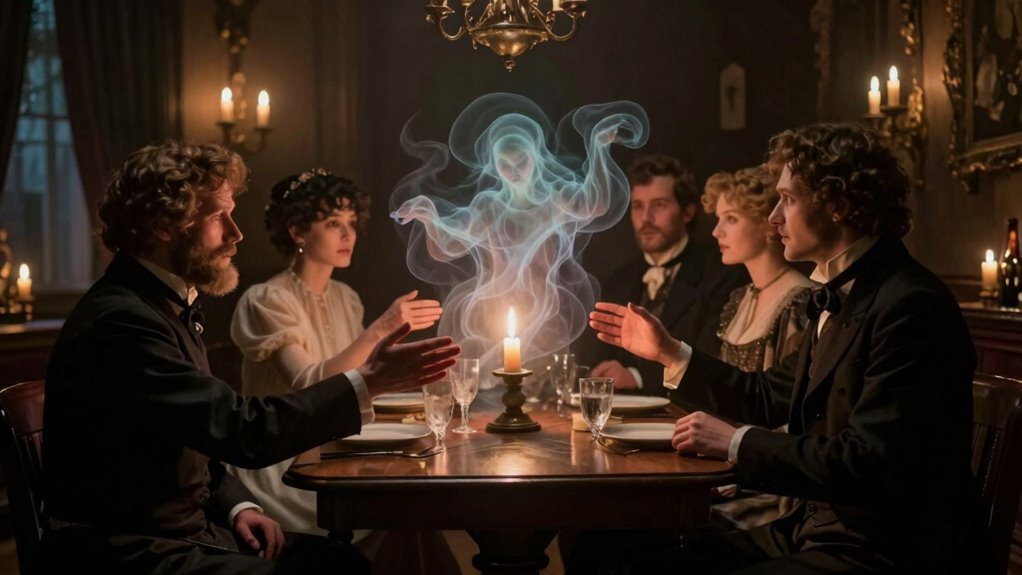
In the 1800s, a growing fascination with the supernatural swept across society, leading many to explore spiritualism and paranormal beliefs with fervor. You might have found yourself drawn to the idea that the dead could communicate with the living, sparking widespread interest in mediumship practices. These practices, often conducted during seances, became popular social events where participants sought contact with loved ones who had passed away. You could attend a seance, sit in a dimly lit room, and watch as a medium claimed to channel spirits, often producing phenomena like rapping sounds, apparitions, or moving objects. These seance phenomena seemed mysterious and compelling, fueling belief that the boundary between the living and the dead was more permeable than previously thought.
As interest grew, people began to see mediumship practices as a legitimate way to connect with the afterlife. Mediums gained fame, and their abilities—whether genuine or perceived—shaped public perceptions of the paranormal. Many believed that these séances provided undeniable proof of life after death, transforming spiritualism from a fringe activity into a mainstream movement. You might have been convinced that these phenomena weren’t mere tricks but evidence of a spiritual dimension that could be accessed through the right practices. The rise of spiritualist churches and publications further reinforced this idea, as stories of miraculous communications and supernatural encounters circulated widely. The development of psychic research aimed to scientifically investigate these phenomena, further shaping public perceptions and debates. This scientific approach contributed to the perception that spiritualism was not just entertainment but a serious inquiry into paranormal phenomena.
The fascination with mediumship techniques also led to the development of various methods and tools purported to enhance or verify spiritual communication, some of which are still referenced today. Your own curiosity about these phenomena might have sparked a desire to explore further, to witness a séance firsthand or analyze the methods behind mediumship practices. Whether viewed as genuine spiritual communication or clever entertainment, the impact of 1800s spiritualism reshaped how people thought about life, death, and what might lie beyond. It challenged traditional religious views and opened new avenues for understanding the unseen, with public interest fueling ongoing exploration and debate that have persisted into modern times.
seance kit with spirit table and séance accessories
As an affiliate, we earn on qualifying purchases.
As an affiliate, we earn on qualifying purchases.
Frequently Asked Questions
How Did Spiritualism Influence Scientific Research in the 1800S?
Spiritualism influenced scientific research in the 1800s by prompting investigations into mediumship evolution and séance practices. You see scientists and skeptics examining claims of spirits and supernatural phenomena, leading to experiments and debates. This era sparked a fascination with testing paranormal abilities under controlled conditions, pushing the boundaries of scientific inquiry. As a result, spiritualism challenged scientists to explore the unknown, shaping both scientific methods and public perceptions of the paranormal.
Were There Any Prominent Skeptics of Spiritualism During This Era?
Like sharp arrows piercing the fog of belief, skeptical scientists and secular critics challenged spiritualism’s claims. Prominent skeptics such as Harry Houdini and David Brewster exposed frauds and questioned the authenticity of séances. Their secular critiques acted as a lighthouse, guiding the public away from deception. You see, these skeptics’ unwavering scrutiny kept the movement honest, ensuring that truth and deception danced a delicate, visible waltz in the sphere of the supernatural.
How Did Spiritualist Practices Vary Across Different Countries?
You’ll notice spiritualist practices vary widely across countries due to cross-cultural rituals and regional beliefs. In France, séances often involved elaborate table movements, while in England, mediums focused on trance states. In the US, Spirit photography gained popularity, blending regional beliefs with technological advances. These differences reflect how local spiritual traditions and cultural contexts shape spiritualist rituals, making each country’s approach unique yet connected through a shared belief in communicating with spirits.
What Role Did Women Play in the Spiritualist Movement?
Women played a vital role in the spiritualist movement, often acting as pioneers who challenged traditional gender dynamics. You’d find many women leading séances, publishing journals, and advocating for spiritualist ideas, which helped give them a voice in society. Their involvement wasn’t just participation; it was transformative, reshaping perceptions of gender roles and empowering women to take active, influential roles in a movement that blurred societal boundaries.
Did Spiritualism Impact Religious Institutions or Beliefs Significantly?
Spiritualism profoundly impacted religious institutions and beliefs by challenging traditional doctrines with its emphasis on mediumship legitimacy and spiritual connection. You might see Spiritualist ethics promoting personal spiritual experiences over institutional authority, encouraging individuals to seek direct contact with spirits. This movement prompted many churches to reconsider their stances on the supernatural, leading to shifts in faith practices and fostering a more open, experiential approach to spirituality within society.
Conclusion
You can’t help but feel overwhelmed by the incredible shift spiritualism sparked in the 1800s. It wasn’t just a belief—it was a seismic upheaval that transformed skepticism into fervent hope and curiosity into a worldwide obsession. The very fabric of reality seemed to bend, blurring the lines between the seen and unseen. Truly, spiritualism rewrote the rules of what’s possible, turning ordinary folks into believers in the impossible, forever changing the course of paranormal history.