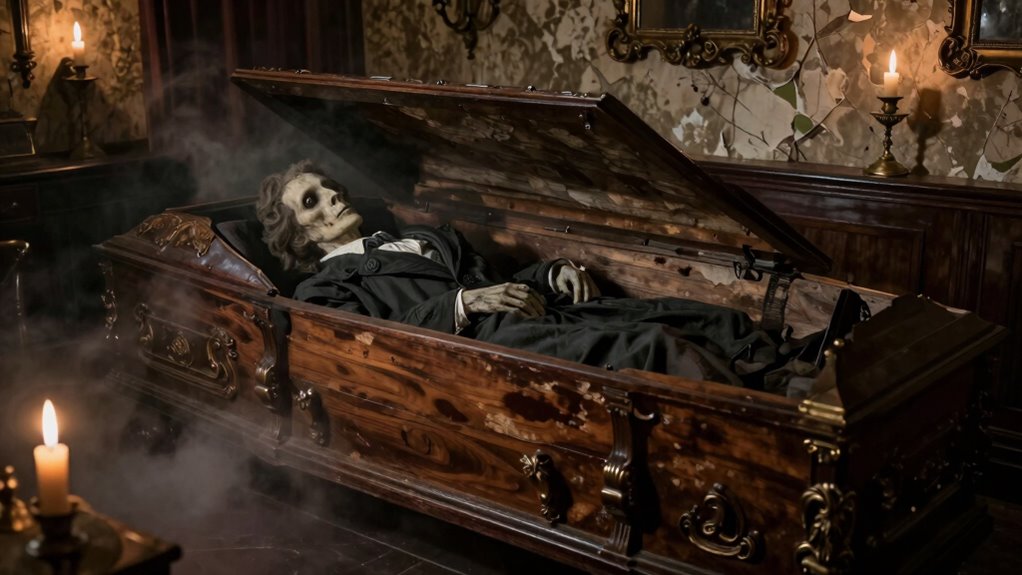

Coffin photography emerged during the Victorian era as a way for you to honor and remember loved ones, especially after the rise of portrait photography. You’d see lifelike images of the deceased often displayed in homes or albums, serving as tangible links to those who had passed. This practice reflected society’s acceptance of death and influenced mourning rituals. If you explore further, you’ll uncover how this haunting tradition provides insight into historical attitudes toward mortality and remembrance.
Key Takeaways
- Coffin photography emerged during the Victorian era as a respectful tribute and a way to preserve memories of the deceased.
- It reflects societal norms embracing death, mourning, and the desire for realistic, sentimental images of loved ones.
- Photographs often depicted the deceased in lifelike poses, sometimes with family or symbolic objects, emphasizing realism and emotional impact.
- The practice served as heirlooms and symbols of social status, reinforcing mourning rituals and cultural attitudes toward death.
- Declined over time due to changing norms, but its history reveals attitudes towards death and the role of visual remembrance.
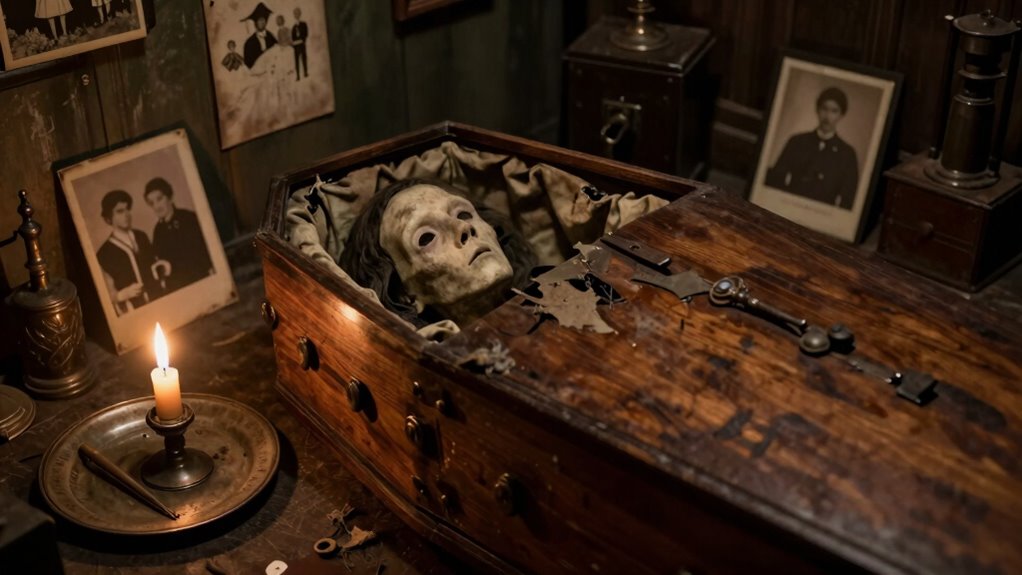
Coffin photography, a haunting yet fascinating tradition, has a long history rooted in various cultures around the world. During the Victorian era, this practice became especially prominent, intertwining with funeral customs that emphasized mourning and remembrance. Back then, photographs of the deceased served as keepsakes, offering a tangible connection to loved ones who had passed away. These images often depicted the deceased in a lifelike manner, sometimes posed with family members or surrounded by symbolic objects, reflecting the era’s fascination with mortality. The Victorian era’s obsession with mortality and the afterlife heavily influenced these portraits, making them a staple of funeral customs that sought to honor and memorialize the departed.
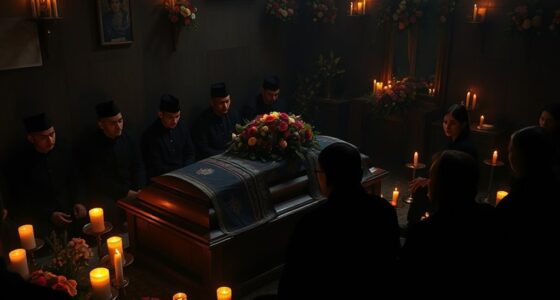
In Victorian society, death was an accepted part of life, and families often went to great lengths to preserve the memory of their loved ones. Coffin photography emerged as a way to cope with grief, providing a lasting image when physical presence was no longer possible. It was common for families to commission photographs of the deceased, especially children or those who died unexpectedly, to display in homes or include in mourning albums. These images often reflected the era’s fascination with death’s aesthetic, characterized by dark clothing, somber expressions, and carefully arranged settings that emphasized serenity or religious symbolism. The practice also reinforced social norms around mourning, with photographs serving as a visual extension of funeral customs that dictated specific rituals and behaviors during mourning periods. Additionally, photographic techniques during this period evolved, allowing for more detailed and realistic representations, which heightened the emotional impact of these images. Advances in studio photography further contributed to the quality and accessibility of coffin photographs, making them more common across different social classes. The cultural significance of these images extended beyond mourning, as they often served as a means of social status and familial pride. Furthermore, innovations in lighting and composition helped enhance the visual impact and emotional resonance of these portraits.
You might find it unsettling today, but in that time, coffin photography was a respectful tribute, a way to preserve the memory of the deceased in a society that valued visual documentation as a form of remembrance. The photographs weren’t just about death—they captured the passage from life to eternity, often imbued with symbolic meaning. Families viewed these images as precious heirlooms, passed down through generations, and a way to keep loved ones close even after they were gone. As photography techniques advanced during the Victorian era, the quality and realism of these images improved, making them even more poignant and treasured. Though the practice has largely fallen out of favor, understanding its role in funeral customs and cultural attitudes towards death helps shed light on how societies process grief and commemorate their dead. Additionally, the advancement of photographic technology played a significant role in enhancing the realism and emotional impact of coffin photographs.

Sunlit Vintage Picture Frame 4×6 Inch, Luxury Antique Photo Frames with Glass Front, Photo Display, Tabletop Wall Hanging, Gift Ideas, Bronze Gold
[Elegant Vintage Sculpture] Ornately designed polyresin brushed with elegant gold. Timeless style will be added to your photo…
As an affiliate, we earn on qualifying purchases.
As an affiliate, we earn on qualifying purchases.
Frequently Asked Questions
Were Coffin Photographs Ever Used for Legal or Forensic Purposes?
Yes, coffin photographs were sometimes used for legal or forensic purposes, especially in the 19th century when documenting death scenes or verifying identities. In this historical context, these photographs held cultural significance, helping families and authorities confirm deaths or preserve memories. You might see them as a way to guarantee legal clarity, revealing how society approached death and mourning during that era.
How Did Public Perception of Coffin Photography Change Over Time?
You see, public perception of coffin photography shifted as mourning rituals evolved and cultural symbolism changed. Initially, these images were seen as respectful tributes, but over time, some viewed them as morbid or intrusive. As society became more sensitive to privacy and emotional well-being, many started to see coffin photographs as a disturbing reminder of mortality. Today, they’re often regarded as historical artifacts rather than acceptable mourning practices.
Were There Any Notable Photographers Famous for Coffin Portraits?
You’ll find that notable photographers like Julia Margaret Cameron and William H. Mumler captured coffin portraits, emphasizing mourning rituals and photographic symbolism. Their images often reflected societal attitudes toward death, blending reverence with artistic expression. By focusing on these portraits, they helped shift public perception, transforming coffin photography from taboo to a meaningful way to honor loved ones. Their work remains a powerful demonstration of the deep cultural significance of death imagery.
Did Coffin Photography Influence Modern Funeral or Memorial Photography?
Yes, coffin photography influenced modern funeral and memorial photography by shaping cultural symbolism and artistic expression. You can see its impact in how contemporary images honor loved ones, emphasizing dignity and remembrance. This tradition helped evolve funeral photography from mere documentation to a meaningful art form, allowing you to express grief, respect, and cultural values. It highlights how visual storytelling continues to serve as a powerful tribute in memorial practices today.
What Safety or Ethical Concerns Surrounded Coffin Photography Practices?
You should be aware that coffin photography raised safety and ethical concerns, especially around mourning rituals and cultural taboos. People worried about respecting the deceased and their families, fearing exploitation or insensitivity. Some viewed it as a breach of privacy or dignity, while others believed it disrupted traditional mourning practices. These concerns led to debates on the appropriateness of capturing such intimate moments, emphasizing the importance of sensitivity and cultural awareness.

CapiSco 5X7FT Halloween Backdrop Nightmare Before Christmas Backgrounds for Baby Shower Portrait Indoor Night Antique Study Red Curtain Terror Skull Photo Studio Backdrop Party Decorations SCO87
◆1.Photography backgrounds size:5ftx7ft (1.5m width x 2.1m height)
As an affiliate, we earn on qualifying purchases.
As an affiliate, we earn on qualifying purchases.
Conclusion
So, here you are, marveling at this eerie tradition, thinking it’s all just morbid curiosity. Ironically, coffin photography was once a way to cherish life’s fleeting beauty and honor loved ones in their final moments. Maybe now, in our obsession with permanence and digital immortality, we’ve lost that honest, poignant connection. Perhaps, in trying to avoid death’s shadow, we’ve only made it more distant — a reminder that life’s fragility is what truly makes it precious.

ReliThick Cardinal Funeral Photo Album 4 x 6 Inch 200 Blank Pages Memorial Leather Memory Album Scrapbook for Memorial Service Celebration of Life Decor in Loving Party Supply(Remember Me)
Cherished Keepsake: remember your beloved with this beautifully designed funeral photo album, with the capacity to hold 200…
As an affiliate, we earn on qualifying purchases.
As an affiliate, we earn on qualifying purchases.
in Loving Memory Picture Frame 4 x 6 Funeral Memorial Photo Album Foldable for Loss of Loved One Remembrance Condolence Memorial Picture Frame for Loss of Mom Father Sympathy Gift 8 Photos Display
Sympathy Gift for Loss of Loved One: the family photo frames can be applied as a meaningful memorial…
As an affiliate, we earn on qualifying purchases.
As an affiliate, we earn on qualifying purchases.