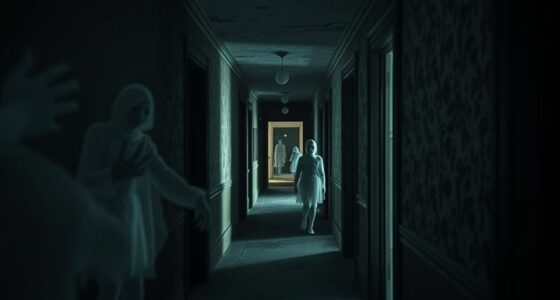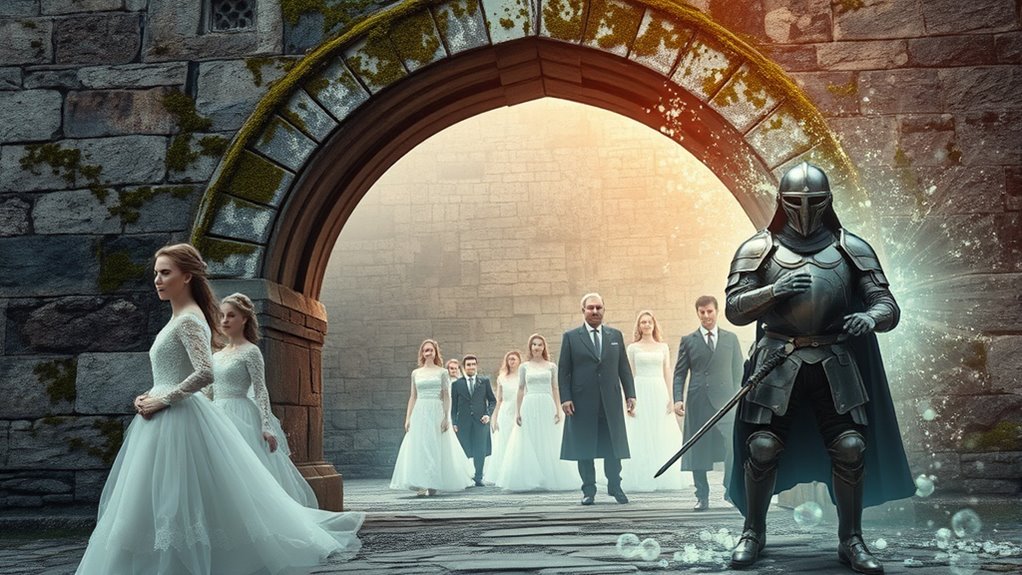

Time slips are brief experiences where you suddenly feel like you’ve traveled into the past, often in places rich with history. These moments can be influenced by your environment, beliefs, or even psychological factors like stress or fatigue. While some see them as portals to earlier eras, many experts suggest they’re illusions created by the mind’s memory and perception. Curious to explore what science and history say about these mysterious experiences? Keep going to uncover more secrets behind time slips.
Key Takeaways
- Time slips are fleeting experiences where individuals perceive glimpses into the past or future, often in historically significant locations.
- They are influenced by environmental factors, psychological states, and cultural beliefs, which can distort perception of reality.
- Many experiences do not align accurately with historical records, raising questions about their authenticity.
- Psychological explanations suggest that brain functions like memory, hallucination, and dissociation contribute to these phenomena.
- Understanding time slips involves exploring both their historical context and the psychological processes behind perception.

Have you ever experienced a moment where time seems to slip away, leaving you questioning what just happened? Maybe you’re walking through your neighborhood and suddenly feel like you’ve stepped back into a different era, or perhaps you recall a fleeting scene that feels vividly real but cannot be explained. These experiences, often called time slips, can feel surreal and disorienting. While some attribute these moments to supernatural forces, others look for scientific or psychological explanations. Understanding these phenomena involves exploring both the importance of historical accuracy and the role of the mind’s workings.
Time slips feel surreal, blending past scenes with present moments and challenging our perception of reality.
From a historical perspective, some believe that time slips are glimpses into the past, revealing moments that somehow bleed through into the present. Enthusiasts often point to locations with rich histories, suggesting that these places might act as portals or gateways to previous eras. However, skeptics argue that these experiences rarely hold up to scrutiny of historical accuracy. Memories and perceptions can be distorted, and the details that make the experience seem authentic may be subtly influenced by stories, media, or personal biases. Many so-called time slips occur in places that are historically significant, but upon closer examination, the details often don’t align perfectly with historical records. In this way, the quest for authentic historical accuracy becomes a challenge when trying to validate these experiences as genuine glimpses into the past. Additionally, the brain’s perception of reality can be easily manipulated, leading to experiences that feel real but are actually constructed by the mind.
Psychological explanations also play a significant role in understanding time slips. Our brains are incredibly complex, capable of creating vivid memories and hallucinations, especially under stress, fatigue, or in altered states of consciousness. Sometimes, a person might experience a fleeting moment of déjà vu or an intense daydream that feels like a different time period. These episodes can be triggered by subconscious memories, cultural influences, or even sleep deprivation. The mind’s tendency to fill in gaps, combined with our brain’s perception of reality, can produce experiences that seem like time slips. In fact, many psychologists interpret these episodes as manifestations of dissociative states or the brain’s attempt to process overwhelming information. These explanations highlight that what feels like slipping through time might be a powerful trick of the mind rather than an actual crossing into another era.
Ultimately, whether you see time slips as mysterious windows into history or as intriguing psychological phenomena, they reveal how our perception of time is fragile and malleable. Exploring both the historical and psychological angles helps demystify these fleeting moments, reminding us that our experience of time isn’t always as straightforward as it seems. Instead, it’s shaped by a complex interplay of memories, beliefs, and our brain’s uncanny ability to craft reality.
Frequently Asked Questions
Can Time Slips Be Scientifically Proven or Measured?
Time slips can’t be scientifically proven or measured definitively. While some suggest quantum theories might explain these phenomena, evidence remains inconclusive. Psychological explanations, like altered perceptions or memory lapses, are more widely accepted. You might experience a time slip as a subjective event, but current science lacks the tools to objectively verify or measure such occurrences. Until then, they stay in the domain of personal experience and speculation.
Are Time Slips Linked to Specific Locations or Environments?
You might notice time slips often occur in specific locations or environments due to location dependence and environmental triggers. For example, a historic battlefield could trigger a time slip for someone, as certain sights or sounds evoke vivid memories or sensations. These environments seem to act as catalysts, making time slips more likely in places with strong emotional or sensory ties. So, yes, location and environment play a significant role in these experiences.
Do Time Slips Occur More Frequently During Certain Times of Day?
You notice that time slips tend to happen more often during specific times of day, aligning with certain daily patterns. These temporal anomalies are more likely in quiet or interim periods, like dawn or dusk, when environmental energies shift. While not guaranteed, understanding these patterns can help you anticipate when a time slip might occur, especially in locations prone to such anomalies. Stay alert during these times for unusual experiences.
How Do Personal Beliefs Influence the Perception of Time Slips?
Your personal beliefs shape how you perceive time slips through cultural interpretations and belief systems. If you hold spiritual or paranormal views, you might see these experiences as meaningful or supernatural. Conversely, if you dismiss such ideas, you may see them as mere illusions or memory lapses. Your cultural background influences whether you interpret a time slip as a genuine phenomenon or just a coincidence, affecting your overall perception of these events.
Are There Known Methods to Prevent or Induce Time Slips?
You can’t reliably prevent or induce time slips, as they often involve temporary consciousness shifts and unpredictable temporal anomalies. To influence them, some suggest meditation or altered states of awareness to heighten sensitivity to subtle cues. However, these methods aren’t proven and may simply increase your awareness of potential shifts. Ultimately, understanding your mind and consciousness shifts can help you recognize when a time slip might occur or be more likely.
Conclusion
So, next time you wonder about those fleeting moments when time seems to warp, remember that time slips might just be your mind’s way of peeking into different realities. Could it be that time isn’t as fixed as we think? These mysterious experiences remind us that the universe holds secrets beyond our understanding, waiting to be uncovered. Are you ready to embrace the unknown and explore what lies beyond the ticking clock?