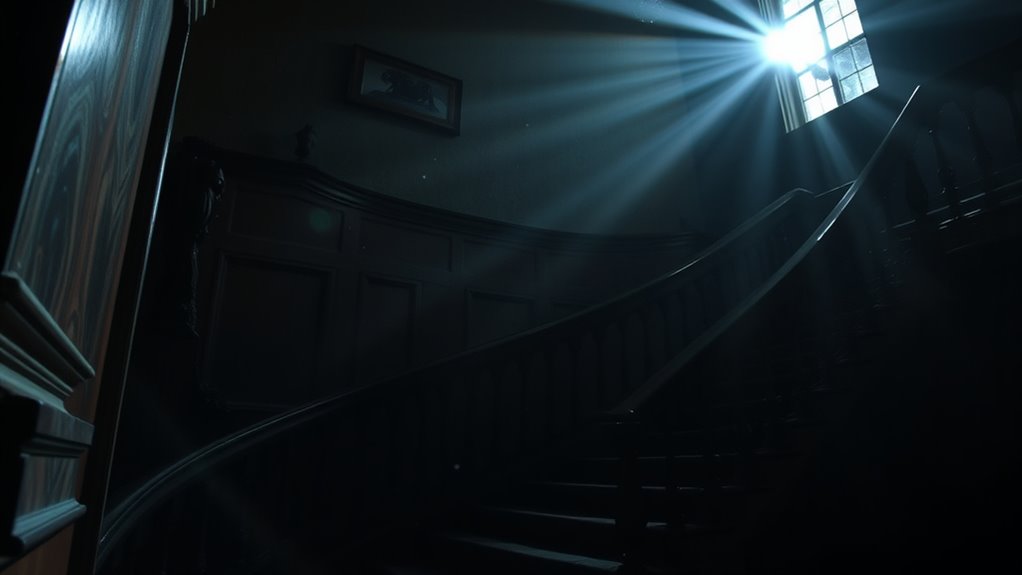

When you visit a haunted location, your mind’s expectations and beliefs heighten your sensitivity to ambiguous sounds and visuals. Dim lighting, shadows, and environmental cues can distort what you see and hear, making you interpret ordinary stimuli as paranormal. Your brain tends to fill gaps with supernatural explanations, especially when you’re already on edge. Understanding how your perceptions and surroundings influence your experience can reveal why these settings feel so unnerving — and there’s more to uncover behind these expectation effects.
Key Takeaways
- Expectation increases sensitivity, causing individuals to interpret ambiguous stimuli as paranormal.
- Dim lighting and shadows distort visual perception, making environmental cues appear supernatural.
- Beliefs and prior stories create a mental state that amplifies sensations like creaks or whispers.
- Environmental factors like drafts and sounds reinforce haunted narratives, strengthening perceptual biases.
- The combined psychological and environmental influences create a feedback loop, making experiences feel real despite no actual phenomena.
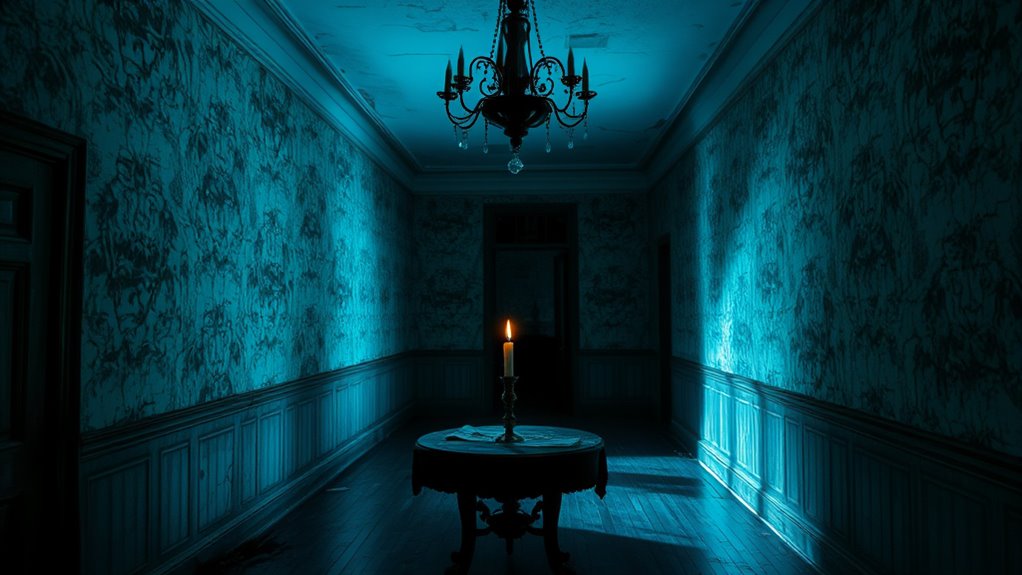
Many people visit haunted locations expecting to encounter supernatural phenomena, and this anticipation can considerably influence what they experience. Your mind plays a powerful role in shaping perceptions, often influenced by psychological factors like fear, expectation, and suggestion. When you walk into a supposedly haunted site, your beliefs and previous stories can heighten your sensitivity to subtle stimuli, making you more likely to interpret ordinary sounds or visuals as paranormal. Psychological influences are central here; your brain tends to fill in gaps and create patterns, especially when you’re primed to see or hear ghosts or spirits. This mental state amplifies sensations that might otherwise go unnoticed, such as creaking floorboards or flickering lights, which become eerie clues in your mind. Additionally, visual perception can be distorted by lighting conditions, further contributing to misinterpretations of the environment.
Expectations heighten your sensitivity, turning ordinary sounds into eerie clues of the supernatural.
Environmental factors also notably contribute to expectation effects. The setting’s atmosphere—dim lighting, old architecture, or atmospheric sounds—can evoke feelings of unease, even if there’s no supernatural presence. These environmental cues interact with your psychological state, reinforcing your beliefs about being in a haunted space. For example, a draft might be mistaken for a ghostly whisper, or shadows cast by trees could seem like figures lurking nearby. Darkness and unfamiliar surroundings reduce your ability to distinguish reality from imagination, heightening your suggestibility and making it easier for your mind to perceive supernatural activity where none exists.
Your heightened expectations, combined with environmental factors, create a feedback loop that intensifies your experience. When you expect to see or feel something paranormal, your brain becomes more alert to any ambiguous stimuli, interpreting them through a lens of fear or curiosity. This is why, even if there’s no genuine supernatural event, you might still leave a haunted location feeling unsettled or convinced you encountered something inexplicable. Your perceptions are vulnerable to influence because your mind is actively seeking confirmation of the supernatural, often filling in details based on your expectations and the environment’s cues.
Understanding this interplay between psychological influences and environmental factors helps clarify why haunted experiences can feel so real to visitors. Your brain, influenced by suggestion and ambient conditions, constructs a narrative that aligns with your anticipations. Recognizing these influences doesn’t diminish the thrill or mystery of haunted locations, but it does reveal how powerful your mind can be in shaping your experiences. In essence, expectation effects demonstrate how much of what you perceive is a product of your psychological and environmental context, highlighting the fascinating connection between belief, perception, and reality.

Valery Madelyn Halloween Decorations, Lighted Halloween Village Houses with Music and LED Lights, Resin Haunted House Spooky Town Scary Witch's Potion for Home and Party Table Desk Mantel, 8 Inch
【Original Design】 Valery Madelyn is a retail brand adhering to original designs. This meticulously handcrafted Halloween Potion Factory…
As an affiliate, we earn on qualifying purchases.
As an affiliate, we earn on qualifying purchases.
Frequently Asked Questions
Can Expectation Effects Be Measured Objectively?
Yes, expectation effects can be measured objectively using specific measurement techniques and experimental controls. You can design experiments with control groups and blind procedures to reduce bias, while employing tools like surveys, physiological sensors, or behavioral observations. These methods help quantify how expectations influence perceptions and experiences, allowing researchers to isolate and analyze the impact of expectation effects with scientific rigor and minimal subjectivity.
How Do Cultural Beliefs Influence Expectation Effects?
Cultural beliefs heavily influence expectation effects by shaping your perceptions through cultural narratives and belief systems. When you grow up hearing stories about haunted places, you’re more likely to interpret ambiguous stimuli as supernatural. These shared cultural expectations prime your mind to see or feel things that align with those beliefs. Fundamentally, your cultural background creates mental frameworks that heighten your sensitivity to potential paranormal cues, amplifying your experiences in haunted locations.
Are Expectation Effects Stronger in Certain Types of Haunted Locations?
Like a shadow cast by a flickering candle, expectation effects are stronger in certain haunted locations, especially where sensory manipulation and placebo influence are at play. Such sites, often with a dark history or eerie ambiance, amplify your beliefs, making you more susceptible to perception. The environment acts as a symbol of fear and mystery, intensifying your psychological responses and heightening the illusion of hauntings.
Can Expectation Effects Be Used Therapeutically?
Yes, expectation effects can be used therapeutically by harnessing placebo influence and belief modulation. When you believe a treatment will work, your mind can produce real benefits, even if the treatment is inert. By carefully shaping your expectations, you can enhance healing, reduce pain, and improve overall well-being. This approach leverages the power of your mind, demonstrating how belief impacts physical and emotional health.
What Role Does Individual Psychology Play in Expectation Effects?
Your individual psychology plays a pivotal role in expectation effects by shaping your mindset influence and perception bias. If you approach a situation with certain beliefs or fears, your mind filters experiences to reinforce those expectations, heightening sensations or beliefs of paranormal activity. Recognizing this, you can actively challenge your perception bias, potentially reducing false alarms and gaining a clearer, more rational understanding of the environment.

Remote-Controlled Horror Sound Machine, Various Horror Sound Effects and Ambient Music, Scary Toy, Office Prank, Gag Gift, Pocket-Sized April Fool's Gift, Christmas Gift (18 Voices)
【Horror Sound Machine】Just press a button to emit customizable ghostly wails and spooky ambient sounds within 100 feet!…
As an affiliate, we earn on qualifying purchases.
As an affiliate, we earn on qualifying purchases.
Conclusion
As you leave these haunted halls, remember the whisper of Poe’s Ravens and the shadows of Dickens’ ghosts. Your expectations shape what you see and feel, turning imagination into reality. Just like the ghostly visitors in stories, your mind can conjure the eerie and the unexplained. Embrace the mystery, knowing it’s your own beliefs that breathe life into these spectral tales. After all, sometimes the most haunting thing is simply what you expect to find.
Nouscan Red LED Light Bulbs Outdoor, 9W Equivalent 60W, E26 Medium Base A19 Decorative Red Colored Light Bulbs for Halloween, Christmas, Valentine's Day, Party Bars Mood Lighting, Non-Dim, 4 Pack
Easy Installation: Nouscan red light bulbs feature an E26 medium base, seamlessly screw these bulbs into standard light…
As an affiliate, we earn on qualifying purchases.
As an affiliate, we earn on qualifying purchases.

The Haunted Library #1
As an affiliate, we earn on qualifying purchases.
As an affiliate, we earn on qualifying purchases.