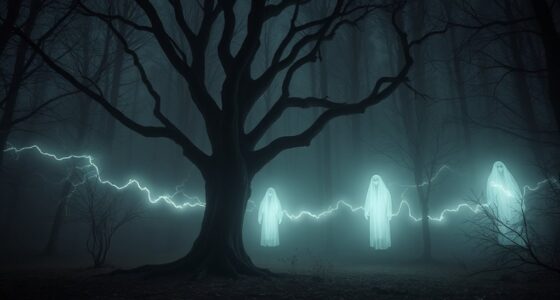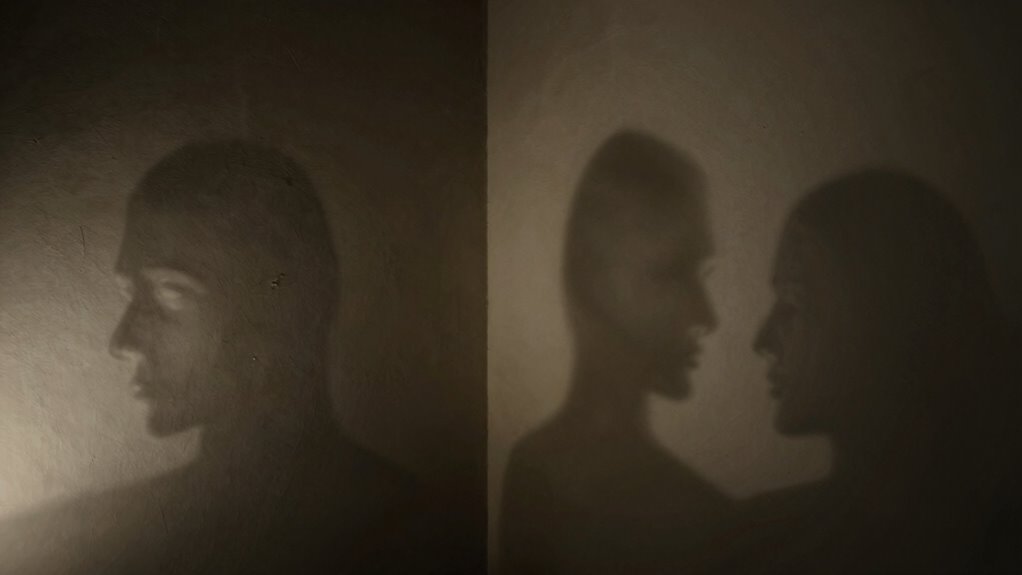

Your brain is wired to recognize familiar patterns, especially faces, even in darkness or ambiguous shapes. It uses neural pathways that react strongly to facial features and constantly seeks social cues for survival. When visual input is limited, your brain fills in gaps using past experiences and stored templates, often perceiving faces where none exist. This automatic tendency helps you identify friends or threats swiftly. To uncover more about this fascinating process, keep exploring how your mind interprets shadowy images.

Get books and cozy reading nights delivered free with Prime
- Fast, free delivery on millions of items
- Prime Video, Amazon Music and more included
- Member-only deals all year
Key Takeaways
- The brain’s face recognition areas are highly sensitive and can activate even with minimal visual cues.
- Neural patterns for faces are prioritized, leading to perception of faces in ambiguous or shadowy stimuli.
- Evolutionarily, rapid face detection helps identify social cues and potential threats quickly.
- Pareidolia and illusions occur when the brain interprets vague shapes as familiar faces.
- Neural plasticity allows the brain to fill in gaps, creating faces in darkness based on past experiences.
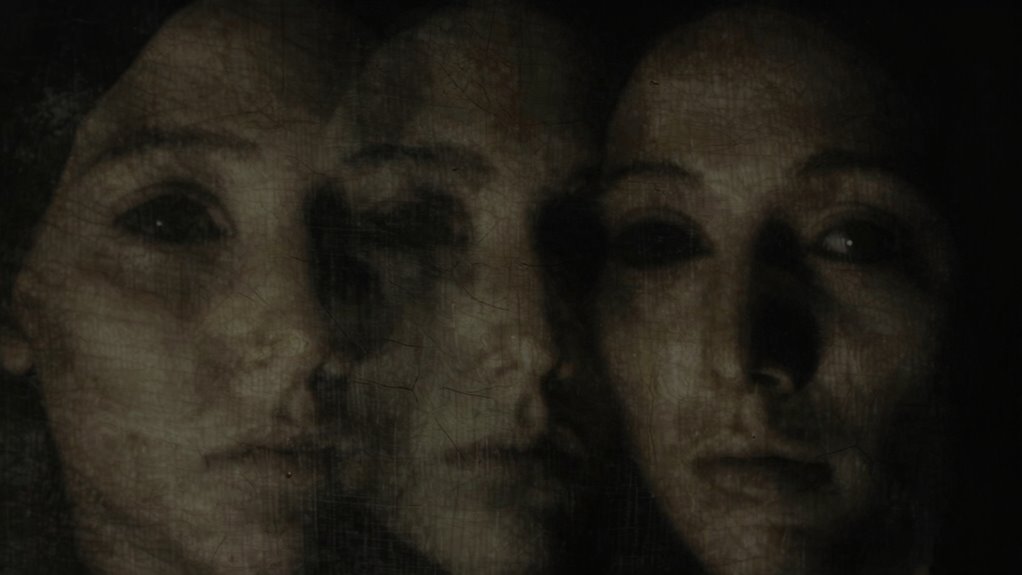
Have you ever noticed how your mind quickly spots faces in seemingly blank or dark spaces? It’s almost instinctive, and that’s because your brain is wired to recognize faces rapidly—an essential part of social interaction and survival. When you’re in a dark room or gazing at a shadowy wall, your visual perception kicks into overdrive, trying to interpret ambiguous stimuli. This process involves neural activation in specific regions of your brain, particularly those dedicated to face recognition, like the fusiform face area. These neural pathways are highly sensitive and respond strongly to facial features, even when the visual input is minimal or unclear.
Your brain constantly seeks patterns, especially faces, because they carry critical social and emotional information. When visual perception detects vague shapes or contrasts, it activates these neural circuits, leading you to perceive familiar features like eyes, noses, or mouths. This isn’t just coincidence; it’s an evolutionary advantage. Recognizing faces quickly allows you to identify friends, foes, or potential threats, often before your conscious mind even registers what you’re seeing. That’s why, in darkness or low-light conditions, your brain fills in the gaps, turning abstract shadows into recognizable faces.
This phenomenon is rooted in the brain’s remarkable ability to interpret incomplete data. When visual perception encounters ambiguous stimuli, it leans on stored templates and past experiences to make sense of what it’s seeing. The neural activation in face-sensitive areas intensifies, even if the actual visual cues are sparse. This heightened activity prompts your mind to see faces where there might be only random patterns of light and shadow. Your brain’s preference for faces is so strong that it sometimes “sees” them even when they aren’t there, leading to illusions or pareidolia—the tendency to interpret vague stimuli as meaningful images. Interestingly, this tendency is reinforced by the brain’s pattern recognition capabilities, which are essential for survival and efficient processing of complex visual information.
In essence, your brain’s neural activation and visual perception work together in a constant dance to interpret your environment. When darkness clouds your view, this system kicks into overdrive, filling in missing pieces with familiar and meaningful patterns. pareidolia is a common example of this process where the brain perceives familiar objects in random visual data. Recent research suggests that this tendency may also be linked to the brain’s evolutionary wiring, which prioritizes social cues for quick recognition and response. That’s why you might see a face in the dark or in a cloud of smoke—your brain is wired to prioritize social cues, even in the absence of clear visual information. It’s a fascinating example of how your mind’s neural networks are finely tuned to ensure you never miss an opportunity to recognize a face, even in the shadows. Additionally, this heightened sensitivity to faces demonstrates the brain’s incredible capacity for neural plasticity, adapting to interpret ambiguous stimuli based on context and experience.
As an affiliate, we earn on qualifying purchases.
Frequently Asked Questions
Can Seeing Faces in Darkness Indicate a Mental Health Issue?
Seeing faces in darkness doesn’t necessarily indicate a mental health issue; it’s often related to visual illusions and your brain’s cognitive processes. Your mind naturally seeks patterns and familiar shapes, especially in ambiguous or low-light situations. While occasional illusions are normal, if these experiences become frequent or distressing, it’s a good idea to consult a professional. They can help determine if underlying cognitive or mental health factors are involved.
Do Cultural Differences Influence Face Perception in Darkness?
Think of your mind as a canvas where cultural influences paint different perceptions. Yes, cultural differences shape how you interpret faces in darkness, acting as perceptual biases that color your experience. In some cultures, faces might symbolize trust or community, making you see them more readily. In others, they could represent caution or mystery, altering what you perceive in darkness. Your cultural background subtly guides your brain’s face-seeing tendencies.
How Does Age Affect the Tendency to See Faces in Darkness?
As you age, age-related perceptual changes influence your tendency to see faces in darkness. Younger individuals tend to be more sensitive to developmental face recognition, making them more likely to perceive faces in ambiguous stimuli. With age, these perceptual skills may decline, reducing the likelihood of seeing faces in darkness. However, some older adults might still experience this due to preserved or compensatory perceptual mechanisms.
Are There Specific Brain Regions Involved in This Phenomenon?
Yes, specific brain regions like the visual cortex and neural pathways are involved in this phenomenon. Your visual cortex processes visual stimuli and interprets ambiguous shapes, leading to face perceptions in darkness. These neural pathways connect the eyes to the brain, enabling you to fill in missing information and see familiar patterns, like faces. When visual input is unclear, these areas activate to create the illusion, making you perceive faces even when none are present.
Can Training or Therapy Reduce False Face Perceptions?
Yes, training and therapy can reduce false face perceptions. Perception training helps you recognize natural visual cues, making you less likely to see faces where none exist. Cognitive therapy addresses underlying thoughts and anxieties contributing to these perceptions. By practicing these techniques consistently, you can improve your visual processing and decrease false face perceptions, gaining better control over your experiences and enhancing your overall visual awareness.
Conclusion
So, next time you catch a glimpse of a face in the dark, remember—it’s not just your imagination. Your brain’s pattern-recognition tricks might be coincidentally aligning, turning random shadows into familiar faces. It’s a fascinating quirk of our mind, revealing how perception can sometimes deceive, or perhaps, beautifully, how it’s wired to find meaning even in darkness. After all, sometimes, the most extraordinary things happen just by chance.
Halloween Picks
halloween
As an affiliate, we earn on qualifying purchases.