
Pareidolia happens because your brain’s neural pathways are wired for quick pattern recognition, especially for faces and familiar shapes. When you look at photos or listen to sounds, your visual and auditory cortexes can pick out vague or random stimuli as meaningful images or voices. This process is shaped by both biology and culture, making certain patterns more recognizable based on your experiences. If you’re curious, there’s much more to uncover about how your mind transforms chaos into familiar images.
Key Takeaways
- Pareidolia arises from neural pathways evolved for rapid pattern recognition, especially in the visual cortex tuned to faces and familiar shapes.
- The brain’s face perception system can be triggered by vague or random stimuli in photos and sounds, leading to perceived familiar figures.
- Cultural backgrounds influence which patterns are recognized, as symbols and learned associations shape perceptual interpretations.
- Neural mechanisms are adaptable, with experience and exposure enhancing or diminishing pareidolic perceptions in both images and audio.
- Understanding pareidolia combines neuroscience and cultural context, revealing how biological and environmental factors shape perceptual phenomena.
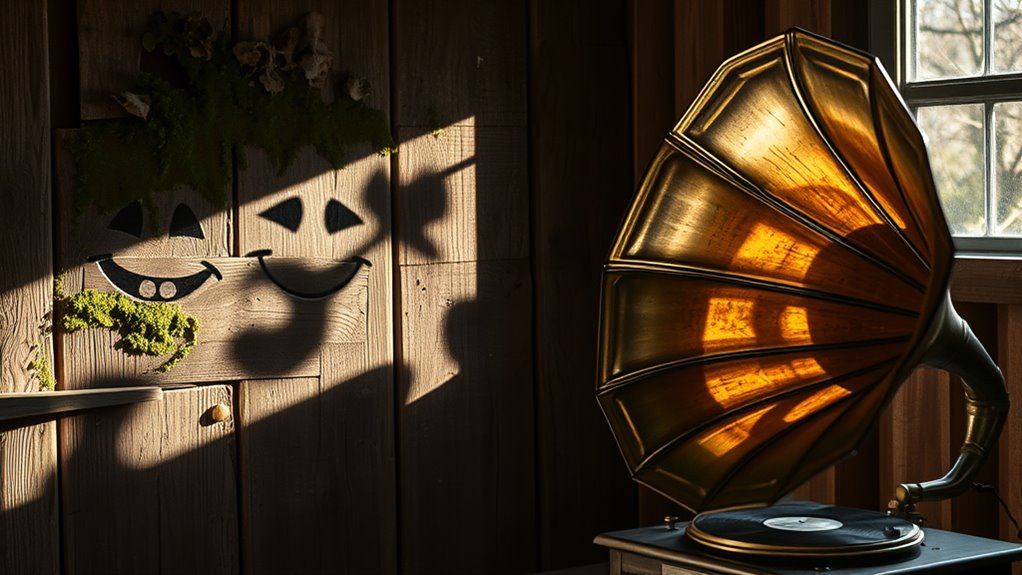
Pareidolia is the fascinating psychological phenomenon where your mind perceives familiar patterns—like faces or figures—in random images or sounds. When you see a face in a cloud formation or hear a hidden figure in static noise, your brain is engaging in pareidolia. At its core, this process involves complex neural mechanisms that have evolved to help you recognize important patterns quickly, especially faces, which are crucial for social interaction and survival. Your brain’s visual cortex is finely tuned to detect faces, enabling you to identify them even when they’re only hinted at or obscured. This neural sensitivity means that even ambiguous shapes can trigger the face perception system, leading to the experience of pareidolia.
However, the way you interpret these images or sounds isn’t purely biological; cultural influences play a significant role. Your cultural background shapes what patterns you’re more likely to see or hear. For example, someone raised in a culture where certain symbols or mythological figures are prominent may be more prone to see those specific images in abstract forms. Cultural influences also extend to auditory pareidolia, where familiar music, speech patterns, or sounds can evoke specific images or stories based on your learned associations. This cultural lens filters your perception, making certain pareidolic experiences more meaningful or recognizable to you than they might be to someone from a different background.
Your neural mechanisms are also adaptable, meaning that your experiences and environment can strengthen or weaken your tendency toward pareidolia. If you often look at clouds or listen to static with a particular focus, your brain becomes more attuned to these patterns. Conversely, through education and exposure to different stimuli, you can learn to suppress or refine your pareidolic perceptions. This adaptability highlights how both biology and culture shape your experience of pareidolia. Additionally, advances in neuroscience have helped us better understand the neural pathways involved in these perceptual phenomena, shedding light on the underlying mechanisms.
In essence, pareidolia isn’t just a quirky trick of your mind; it’s a complex interplay of neural mechanisms designed to detect patterns rapidly, combined with cultural influences that give these perceptions context and meaning. Your brain’s ability to find familiar shapes and sounds in random stimuli underscores how deeply ingrained pattern recognition is in human cognition. It reflects your evolutionary need to interpret the world quickly and efficiently, while also being molded by the cultural stories, symbols, and experiences that define your understanding of reality.

Infidelity Detection Kit | Find Two Substances Found in Male Body Fluids | Results in 10 Minutes | One Kit
Use for Infidelity Detection. Get accurate results. Looks for two different substances in fluids specific to males. Catch…
As an affiliate, we earn on qualifying purchases.
As an affiliate, we earn on qualifying purchases.
Frequently Asked Questions
Can Pareidolia Be Intentionally Triggered in Images or Sound Recordings?
Yes, you can intentionally trigger pareidolia in images or sound recordings. By creating visual illusions that resemble familiar objects or faces, you activate your brain’s pattern recognition. Similarly, auditory hallucinations can be designed to mimic voices or sounds, prompting your mind to perceive familiar patterns. These techniques leverage your natural tendency for pareidolia, making abstract images or sounds seem like meaningful images or voices.
How Does Brain Activity Differ When Experiencing Pareidolia Versus Actual Perception?
When experiencing pareidolia, your brain shows increased neural activation in regions linked to face recognition, like the fusiform face area. This differs from actual perception, where perceptual pathways process real stimuli. During pareidolia, your brain’s top-down processing influences perception, causing it to interpret random patterns as familiar objects. This heightened neural activity explains why you see faces or figures where none exist, highlighting your brain’s tendency to seek familiar patterns.
Are Certain Individuals More Prone to Pareidolia Than Others?
You might notice you’re more prone to pareidolia if your visual perception is sharper or influenced by certain cognitive biases. Some individuals, driven by heightened imagination or specific neural wiring, see faces or shapes where others don’t. This tendency varies naturally, making you more likely to interpret ambiguous images as familiar objects or beings. Your mind’s eye, fueled by these biases, turns mere shadows into vivid, recognizable figures—an intriguing glimpse into your unique perceptual world.
How Does Age Influence Susceptibility to Pareidolia Phenomena?
As you age, your susceptibility to pareidolia can change due to developmental differences and cognitive aging. Younger people, with more flexible thinking, often see faces or objects more easily in random images. As you grow older, cognitive aging may reduce this tendency, but some still experience strong pareidolia because of retained visual or auditory processing patterns. Overall, age influences how your brain interprets ambiguous stimuli, affecting pareidolia experiences.
Can Pareidolia Be Used Therapeutically in Psychological Treatments?
Yes, pareidolia can be harnessed therapeutically. Imagine using it in therapeutic visualization to help you access subconscious thoughts or process emotions more deeply. By recognizing familiar images or sounds, you can create a safe space for emotional processing, revealing insights and reducing anxiety. This technique encourages engagement and self-awareness, making therapy more effective and personalized, while also tapping into your brain’s natural tendency to find meaning in patterns.

Pennclys Clouds Wall Art Decor Over The Bed Sky Canvas Wall Art Abstract Minimalist Clouds Prints Painting Blue Sky Wall Decor Pictures for Living Room Bedroom 16×24 Inch Unframed Set of 3
UNFRAMED PRINTS: 16×24 inch unframed – (set of 3)
As an affiliate, we earn on qualifying purchases.
As an affiliate, we earn on qualifying purchases.
Conclusion
Just like a painter’s brush strokes reveal hidden faces in a canvas, your mind paints stories into images and sounds. Pareidolia is the detective, uncovering familiar shapes in chaos, turning random patterns into meaningful tales. It’s a dance between perception and imagination, where your brain becomes the artist and interpreter. Embrace this playful illusion, knowing it’s your mind’s way of finding connection and wonder amid the randomness, turning everyday moments into a gallery of hidden surprises.

Pure Resonance Audio SMG1 Sound Masking Generator – Adjustable White, Brown & Pink Noise for Speech Privacy & Productivity, Commercial-Grade, Mounting Bracket Included
Protect Privacy & Reduce Distractions – Effectively masks speech and background noise, ensuring confidential conversations remain private in…
As an affiliate, we earn on qualifying purchases.
As an affiliate, we earn on qualifying purchases.
300+ Mathematical Pattern Puzzles: Number Pattern Recognition & Reasoning (Improve Your Math Fluency)
As an affiliate, we earn on qualifying purchases.
As an affiliate, we earn on qualifying purchases.