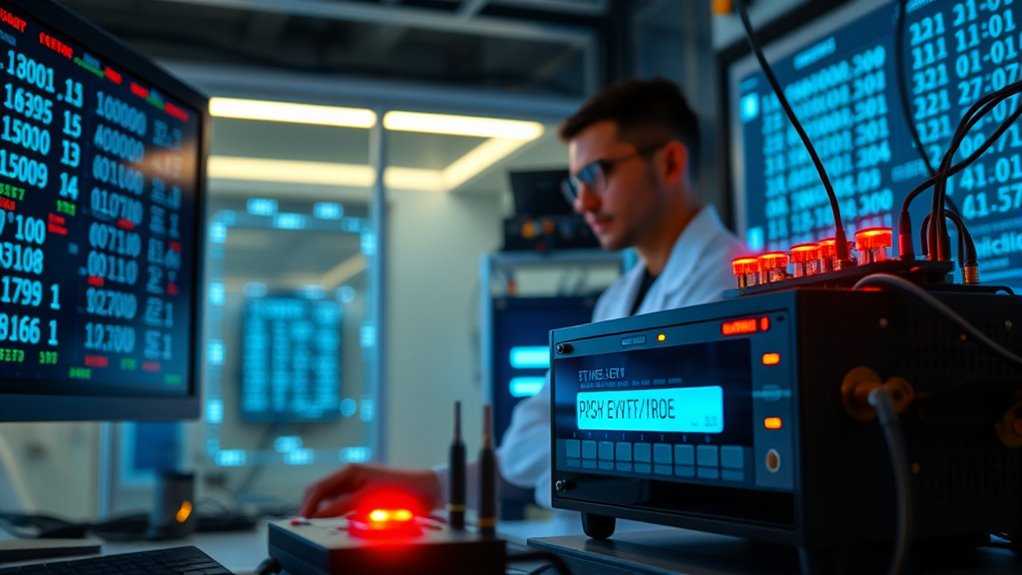

Random event generators in psi research rely on quantum fluctuations—tiny, spontaneous energy changes in a vacuum—that are inherently unpredictable. Unlike classical systems, these quantum processes produce true randomness through fundamental indeterminacy, serving as reliable sources for unbiased data. Measuring entropy in these quantum signals ensures the generated randomness remains genuine and suitable for scientific and cryptographic use. To understand how this complex science supports psi exploration, keep exploring how quantum phenomena create the foundation for these unique devices.
Key Takeaways
- Quantum fluctuations generate true randomness by spontaneous energy changes in the vacuum, forming the basis for Random Event Generators (REGs).
- REGs utilize quantum phenomena like photon detection or electron spins to produce unpredictable signals crucial for psi research.
- The inherent unpredictability of quantum fluctuations ensures high entropy and reliable randomness in experimental data.
- Accurate entropy measurement and system calibration prevent bias, maintaining the integrity of data used in psi phenomenon studies.
- Quantum RNGs’ fundamental indeterminacy supports scientific investigations into phenomena beyond classical explanation.

Have you ever wondered how random event generators produce unpredictable results? The answer lies in the fascinating world of quantum fluctuations and how scientists measure entropy to tap into the seemingly chaotic nature of reality. These devices, often called RNGs, rely on fundamental quantum phenomena that defy classical predictability. At the core, quantum fluctuations refer to the tiny, spontaneous changes in energy that occur in a vacuum, even when nothing appears to be happening. These fluctuations are inherently unpredictable, making them an ideal source of randomness. Unlike traditional algorithms that generate pseudo-random numbers based on deterministic processes, quantum fluctuations provide true randomness because they aren’t governed by any hidden variables or predictable patterns.
To harness this quantum unpredictability, scientists focus heavily on entropy measurement. Entropy, in this context, measures the amount of randomness or disorder within a system. When a random event generator taps into quantum fluctuations, it *fundamentally* captures the highest possible entropy, ensuring the results are genuinely unpredictable. The process involves collecting quantum signals—such as photon detections or electron spins—and then analyzing the data to quantify the entropy present. If the entropy measurement indicates sufficient randomness, the generated numbers can be considered truly random and suitable for cryptographic or scientific applications. Conversely, if the entropy falls below a certain threshold, the system may need recalibration to avoid biased or predictable outputs. Additionally, research in appliances labs enhances our understanding of how different components influence entropy generation and measurement accuracy.
Understanding how quantum fluctuations contribute to randomness is *vital* because classical systems are often limited by deterministic processes or external influences that can be manipulated or predicted. Quantum systems, on the other hand, operate on probabilities that are *fundamentally* indeterminate until measured. This intrinsic uncertainty is what makes quantum-based random event generators so reliable for sensitive tasks—like secure communications, cryptography, and even psi research, where the goal is to explore phenomena beyond conventional understanding. By meticulously measuring entropy and ensuring the influence of quantum fluctuations dominates the process, researchers can produce random sequences that are highly resistant to prediction or interference.

Random Number Generator – Incorporates a Visual Laboratory Grade Random Number Generator (RNG) Designed specifically for PSI Testing. Test for Psychokinesis (PK), Precognition and Telepathy.
THE RANDOM NUMBER GENERATOR (RNG-01) is a laboratory quality instrument that uses the immutable randomness of radioactivity decay…
As an affiliate, we earn on qualifying purchases.
As an affiliate, we earn on qualifying purchases.
Frequently Asked Questions
How Do Random Event Generators Differ From Other Psychic Testing Methods?
Random event generators differ from other psychic testing methods because they rely on quantum randomness, producing unpredictable data that minimizes bias. You analyze results through statistical analysis to detect any deviations that might suggest psychic influence. Unlike traditional tests, these generators provide real-time, objectively random data, making it easier to identify subtle effects. This scientific approach helps you evaluate psychic phenomena with greater precision and reduces subjective interpretation.
Can the Results of Random Event Generators Be Influenced by Consciousness?
Ever wondered if your consciousness can influence random event generators? The answer is yes, but it’s complex. While some believe conscious influence can sway results, measurement challenges make it hard to prove definitively. You might think your mind can affect outcomes, but the randomness is designed to minimize biases. So, yes, your consciousness could impact the results, but scientifically verifying this remains a challenge.
What Are the Limitations of Current Random Event Generator Technology?
You face limitations with current random event generator technology due to technological constraints like device precision and data collection methods. Additionally, statistical challenges make it hard to distinguish genuine effects from random noise, which can skew results. These issues hinder your ability to conclusively determine if consciousness influences the outputs, highlighting the need for improved technology and more rigorous statistical analysis in psi research.
How Do Researchers Control for Bias in Psi Experiments?
Think of bias as a sneaky shadow lurking in your experiment. To keep it at bay, researchers use double-blind procedures, so neither you nor the participants know key details, reducing influence. They also apply statistical controls, like filters, to distinguish genuine effects from chance. These methods work together to guarantee your results are as objective as possible, giving your findings more credibility and clarity in psi research.
Are There Any Known Biological Factors Affecting Random Event Generator Outcomes?
Biological influences and physiological factors can affect random event generator outcomes. You might consider how your brain activity, heart rate, or even hormonal fluctuations influence the results. These physiological factors can introduce subtle biases or patterns, impacting the randomness. Researchers acknowledge that biological influences are important, so controlling for these factors helps guarantee more accurate and reliable results in psi experiments involving random event generators.

The Life and Times of the Thunderbolt Kid: A Memoir (Random House Large Print)
As an affiliate, we earn on qualifying purchases.
As an affiliate, we earn on qualifying purchases.
Conclusion
As you explore the science behind random event generators, remember they’re like delicate bridges between the known and the mysterious. While the data sparks questions, it also ignites hope that understanding these devices could unseal secrets of the mind. Keep an open heart and curious mind—because just beyond the edge of reason, the universe whispers its most profound truths, waiting for you to listen. Embrace the journey; it’s where wonder begins.

Introduction to Quantum Physics and Information Processing
As an affiliate, we earn on qualifying purchases.
As an affiliate, we earn on qualifying purchases.
cryptographic quantum RNG
As an affiliate, we earn on qualifying purchases.
As an affiliate, we earn on qualifying purchases.